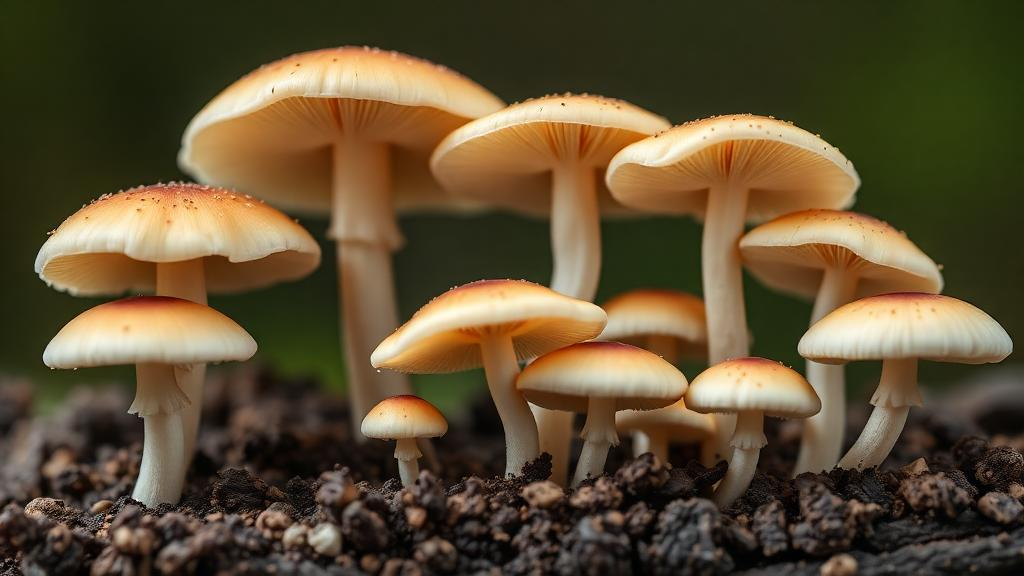
A group of small pink-spored mushrooms long dismissed as humble decomposers is quietly rewriting one of ecology’s most consequential stories: how free-living fungi abandon the decay business and evolve into intimate partners of living plants. A new study of the genus Clitopilus, published in IMA Fungus, provides the first comprehensive genomic and physiological portrait of this agaric lineage, and the picture it paints is one of evolution in mid-transition. Multiple lineages within the genus carry molecular signatures of saprotrophy and biotrophy simultaneously, offering scientists a rare, living snapshot of the earliest steps in symbiosis evolution.
Saprotrophic fungi make their living by decomposing dead organic matter, while biotrophic fungi derive nutrients from living hosts, often through mutualistic mycorrhizal associations that shape entire forest ecosystems. The shift between these lifestyles represents a pivotal evolutionary event, but the genomic and physiological machinery driving it has remained largely obscure. Clitopilus, a genus of roughly 154 recognized taxa in the family Entolomataceae, proved an ideal testing ground because one member, Clitopilus cf. baronii, had already been shown to form mutualistic symbiosis with poplar trees in laboratory conditions, hinting that the genus harbored latent symbiotic capacity.
The research team, working with seven strains representing five Clitopilus species, combined genome sequencing, phylogenetics, nutritional profiling, enzyme assays, and chemical analysis into a single integrative framework. Several strains were isolated directly from the ectomycorrhizal root tips of oak species and even from orchid roots, while others came from fruiting bodies collected in the wild. An analysis of the internal transcribed spacer region, a standard fungal DNA barcode, revealed a striking ecological pattern: multiple taxa within the section Scyphoides had been recovered from living plant roots, whereas species in the other two sections were found exclusively on soil and decaying wood.
The genomes themselves told an equally compelling story. Assembly sizes ranged from roughly 36 to 55 megabases, with variation driven largely by transposable element content; one strain, CAB, carried transposable elements across nearly a quarter of its assembly. Two assemblies, from strains XST and 50334, achieved near chromosome-level contiguity with ten or more telomere-to-telomere scaffolds and no sequencing gaps. Gene counts ranged from about 11,000 to nearly 18,000, and secondary metabolite biosynthetic gene clusters varied substantially even among closely related strains, indicating dynamic evolutionary turnover of metabolic capabilities.
The most revealing analysis examined carbohydrate-active enzymes, or CAZymes, the protein toolkit fungi use to dismantle plant cell walls. When the team plotted CAZyme profiles from 25 fungal genomes, including white-rot and brown-rot decomposers as well as ectomycorrhizal and endophytic symbionts, the first principal component alone explained 97 percent of the variation and cleanly separated lifestyles. Three Clitopilus strains clustered squarely with ectomycorrhizal and endophytic fungi, characterized by contracted repertoires of lignocellulose-degrading enzymes, while others grouped with white-rot saprotrophs, retaining full degradative capacity.
Strikingly, this lifestyle heterogeneity occurred even within a single species complex. Among the strains of Clitopilus cf. baronii, strain XST clustered with saprotrophs, while its close relatives QYL-10 and NL-19 showed enzyme profiles resembling biotrophic fungi. The authors interpret this as evidence that lifestyle transitions in Clitopilus are underway at fine evolutionary scales, driven by ecological adaptation to local substrates and hosts rather than reflecting fixed species-level traits. Lifestyle, in other words, behaves as an evolvable ecological strategy rather than a permanent identity.
Physiological experiments reinforced the genomic signals. All strains grew poorly on the sugars mannitol and sucrose, and the inability to use sucrose correlates with the absence of invertase genes of the GH32 family across all sequenced genomes, a feature shared with many mycorrhizal fungi. All strains preferred organic nitrogen sources such as peptone and yeast extract, and strain-specific enzyme measurements of urease, acid protease, chitinase, nitrate reductase, and acid phosphatase revealed divergent nutrient-acquisition strategies that did not track phylogenetic relationships, suggesting independent adaptation to different habitats.
Two further traits pointed toward plant-associated capacity. Six of the seven strains produced indole-3-acetic acid, a plant hormone central to symbiosis establishment, but only when the amino acid tryptophan was supplied, indicating a biosynthetic pathway characteristic of plant-associated fungi; strains 84496 and CAB produced especially high amounts. Meanwhile, all seven genomes contained recognizable biosynthetic gene clusters for pleuromutilin, a diterpenoid antibiotic, yet chemical analysis showed only some strains actually produced the compound. Most tellingly, the three plant-associated C. cf. baronii strains had lost all pleuromutilin tailoring genes except the core terpene synthase, hinting at a possible trade-off between antibiotic warfare in soil and the chemical diplomacy required for mutualism.
Together, the results position Clitopilus as a new model system for studying the dawn of symbiosis. The convergent evidence from CAZyme remodeling, hormone production, and root-derived isolation records suggests that transitions from decomposer to plant partner are either ongoing or recently completed in multiple lineages. The remaining questions are substantial: what selective pressures tip the balance, whether laboratory symbioses hold in nature, and how environmental conditions such as nitrogen availability control the switch. But for now, these unassuming mushrooms have given scientists something rare, a window into the evolutionary moment when a fungus stops eating the dead and starts negotiating with the living.
Subject of Research: Evolutionary transition from saprotrophy to biotrophy in the fungal genus Clitopilus
Article Title: Ecological genomics of saprotrophy to biotrophy transitions in the genus Clitopilus (Fr. ex Rabenh.) P. Kumm. ( Agaricales , Entolomataceae )
Article References: Zhang, Y., Wang, Y., Druzhinina, I. S., Vasco, F., Zhong, D., Peng, L., Yao, J., Yuan, Z., & Martin, F. M. (2026). Ecological genomics of saprotrophy to biotrophy transitions in the genus Clitopilus (Fr. ex Rabenh.) P. Kumm. (Agaricales, Entolomataceae). IMA Fungus, 17, Article e179417. https://doi.org/10.3897/imafungus.17.179417
Image Credits: AI Generated
DOI: 10.3897/imafungus.17.179417
Keywords: Clitopilus, fungi, mycorrhiza, comparative genomics, CAZymes, pleuromutilin, indole-3-acetic acid, symbiosis, saprotrophy, biotrophy, Entolomataceae, Ecological
News Source: Roger Howard. (October 19, 2026). Mushroom genomes capture fungi caught in the act of evolving into plant partners. Scienmag.