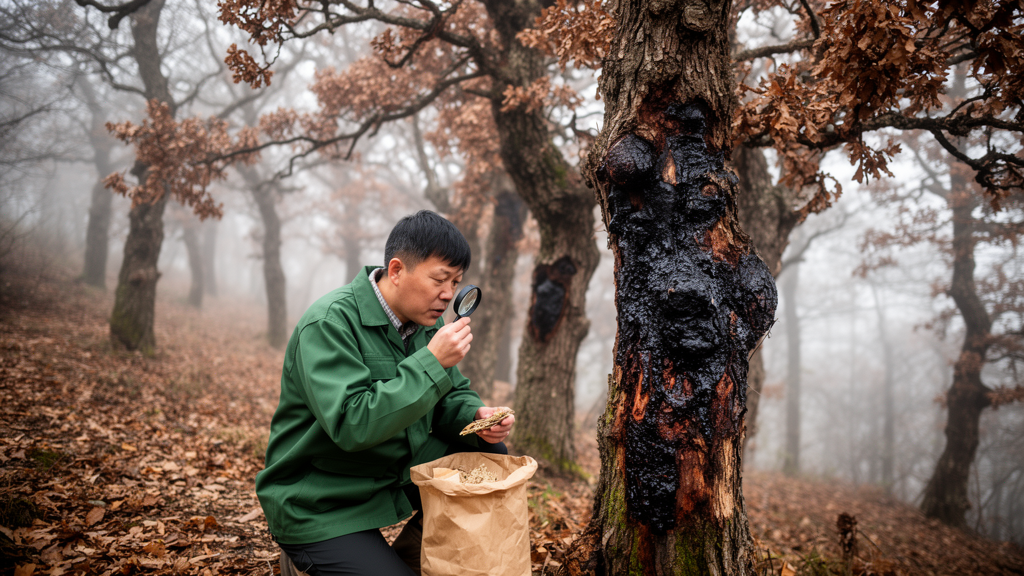
Deep in the forest farms around Guangzhou, an invisible attacker has been quietly killing one of southern China’s most important canopy trees. In 2021, plantations of Castanopsis carlesii and Castanopsis hystrix, two evergreen members of the beech family that dominate broadleaved forests across South and Southeast Asia, began showing alarming outbreaks of stem canker and dieback. Trunks developed dark necrotic lesions, bark rotted at the base, and entire crowns withered above the wounds. A new study published in MycoKeys now identifies the culprit as a species previously unknown to science: Lasiodiplodia carlesii, a fungal pathogen named after the very tree it attacks. The discovery matters far beyond taxonomy, because it reveals an emerging disease threat to plantations that have expanded steadily across China in recent decades and hints at the risk of spillover into unrelated crop species.
Castanopsis is no ordinary genus. With more than 120 species distributed across tropical and subtropical Asia, these trees are keystone components of evergreen broadleaved forests, anchoring ecosystem function across a remarkable range of habitats. Roughly 60 of those species grow south of the Yangtze River in China, and several carry substantial economic weight. Some, such as C. piriformis and C. boisii, produce edible nuts; C. costata is used in traditional medicine. C. carlesii and C. hystrix are widely planted in Guangdong and Guangxi provinces because they grow fast and regenerate vigorously, making them attractive for timber, firewood, and reforestation. Yet the disease pressures facing these plantations have remained poorly charted. Until this study, only four foliar pathogens had ever been documented on C. hystrix, and all of them cause relatively minor leaf spots rather than lethal stem infections.
The genus Lasiodiplodia, a member of the fungal family Botryosphaeriaceae, has long been on foresters’ watch lists. These fungi are notorious agents of stem canker, dieback, and fruit rot across a huge range of subtropical and tropical woody plants. Individual species have devastated Eucalyptus grandis plantations, infected citrus in Iran, and rotted the stems of cacao trees. The most infamous member, L. theobromae, attacks grapevines, papaya, and many other crops worldwide. Precisely identifying which Lasiodiplodia species is involved in an outbreak is notoriously difficult, however, because the fungi look alike and their scientific classification has been tangled for decades. Modern practice therefore relies on a polyphasic approach that combines physical characteristics with DNA sequences from four genetic loci: the internal transcribed spacer region (ITS), translation elongation factor 1-alpha (tef1-α), beta-tubulin (tub2), and the second largest subunit of RNA polymerase II (rpb2).
The investigation began on 23 April 2021 at Longan Cave Forest Farm in Guangzhou, where symptomatic bark was sampled from the trunks of diseased C. carlesii and C. hystrix trees. Researchers cut small fragments from the margins of lesions, surface-sterilized them with ethanol and sodium hypochlorite, and plated them on potato dextrose agar to coax out the fungi inside. Twenty fungal strains emerged. Preliminary genetic screening showed that sixteen of them belonged to Lasiodiplodia, sharing roughly 98 to 99 percent ITS identity with known species such as L. theobromae and L. rubropurpurea but not matching either one cleanly. The remaining four strains were Pseudofusicoccum-like fungi that would later serve as an unplanned but informative control group in the pathogenicity experiments.
To pin down exactly what these isolates were, the team sequenced all four diagnostic loci and built a massive phylogenetic dataset: 118 Lasiodiplodia strains representing 68 species, rooted with the outgroup Diplodia sapinea and totaling 1,782 aligned characters. Using both Maximum Likelihood and Bayesian Inference methods, implemented through an automated fungal phylogenetics pipeline with model selection and ultrafast bootstrap support, the researchers found that their four Castanopsis isolates formed a distinct, strongly supported monophyletic clade with 100 percent bootstrap support and a posterior probability of 1. The clade sat as sister to Lasiodiplodia syzygii, a pathogen of wax apple fruit, but was clearly separated from it by fixed DNA differences: six base pair substitutions in ITS, five in tef1-α, and three in tub2. That combination of genetic distinctiveness and consistent support across independent tree-building methods satisfied the criteria for describing a new species.
Morphology told a corroborating story. The new fungus produces dark brown to black fruiting bodies called conidiomata, studded with filiform paraphyses that become divided by one to seven septa at maturity. Its spores, or conidia, start out hyaline and single-celled before maturing into dark brown, single-septate, longitudinally striated ellipsoids averaging 28.1 by 14.5 micrometers. Compared with its closest relative L. syzygii, L. carlesii has slightly smaller conidia, septate rather than aseptate paraphyses, and faster-growing colonies that blanket a standard petri dish within three days rather than four. Interestingly, the study also documented substantial phenotypic plasticity: conidia grown on artificial medium averaged 25.9 by 12.5 micrometers, while those produced on inoculated host branches swelled to 28.9 by 15.4 micrometers. The authors note that this environmental sensitivity of spore dimensions underscores why molecular markers, not morphology alone, must anchor species boundaries in this genus.
The decisive evidence came from infection experiments on two-year-old seedlings of three Castanopsis species. Researchers wounded shoots with a sterile cork borer and inserted plugs of fungal culture, then tracked lesion development with digital calipers. Within three days, the Lasiodiplodia isolate had produced dark brown bark rot around the inoculation sites on C. carlesii, C. faberi, and C. hystrix alike. Statistical analysis using Kruskal-Wallis tests followed by Bonferroni-corrected post-hoc comparisons confirmed that the Lasiodiplodia treatments produced significantly larger lesions than both unwounded-in-effect controls and the Pseudofusicoccum-treated wounds on all three host species (all p < 0.001 for the overall tests). The Pseudofusicoccum isolate, by contrast, was completely avirulent. The pathogen was re-isolated from the resulting necrotic tissue and confirmed by sequencing, fulfilling Koch’s postulates, the gold standard for proving causation in infectious disease. In a handful of seedlings, necrotic lesions eventually girdled the stems entirely, and classic dieback of the crown followed roughly thirty days after inoculation, faithfully reproducing the symptoms seen in the field.
The most unsettling result, however, came from tests outside the beech family. When detached fruits of Syzygium samarangense, the wax apple, a commercially grown Myrtaceae fruit, were inoculated with four L. carlesii strains, all four induced water-soaked brown lesions. Statistical analysis showed that two strains, BZ-FL-1 and BZ-GF-2, produced significantly larger lesions than controls at all measured time points, while the other two showed weaker or transient effects. This cross-family infection capacity echoes a well-known trait of the genus: Lasiodiplodia species are famously plurivorous, capable of jumping among distantly related hosts. The authors are careful to note a caveat. Because the fruit assays used detached tissues under laboratory conditions, the results demonstrate pathogenic potential rather than confirmed field-level disease, and whole-plant trials under natural conditions will be needed to establish how real the spillover risk is in mixed plantations.
Even with that caution, the implications for forest health are serious. This is the first report of any Lasiodiplodia species infecting Castanopsis, extending a host range that previously included only two known Fagaceae associates, both documented on European oak. The abundant fruiting bodies that developed at infection sites late in the inoculation experiments suggest that diseased trees could serve as sources of secondary inoculum, spreading spores to neighboring hosts. The researchers recommend regular monitoring for canker and dieback symptoms in Castanopsis stands and adjacent non-Fagaceae trees, prompt removal of infected material, and strict controls on the movement of seedlings, cuttings, and pruning tools between stands. An integrated management strategy, they argue, should combine pathogen-free planting stock with silvicultural practices that minimize mechanical wounds, supplemented by future work on fungicide sensitivity and biological control agents. For the fast-growing plantations that now blanket hillsides across Guangdong and Guangxi, the arrival of L. carlesii is a warning that monoculture forestry, even with native species, can create the conditions for entirely new diseases to emerge.
Subject of Research: Discovery and pathogenicity of the novel fungal pathogen Lasiodiplodia carlesii causing canker and dieback in Castanopsis plantations in China
Article Title: Lasiodiplodia carlesii sp. nov. ( Botryosphaeriales , Botryosphaeriaceae ), a novel pathogen causing canker and dieback on Castanopsis ( Fagaceae ) plantations in China
Article References: Zhang, Y., Feng, J., Jiang, N., Xu, J., Qin, C., Xu, F., & Tian, L. (2026). Lasiodiplodia carlesii sp. nov. (Botryosphaeriales, Botryosphaeriaceae), a novel pathogen causing canker and dieback on Castanopsis (Fagaceae) plantations in China. MycoKeys, 137, 81-102. https://doi.org/10.3897/mycokeys.137.184738
Image Credits: AI Generated
DOI: 10.3897/mycokeys.137.184738
Keywords: Lasiodiplodia carlesii, Castanopsis, plant pathology, fungal taxonomy, Botryosphaeriaceae, canker, dieback, forest health, Koch's postulates, phylogenetics, China, cross-family infection
News Source: Kristina Jarvis. (October 18, 2026). Scientists Name New Fungal Killer Behind Devastating Dieback of China’s Evergreen Oak Forests. Scienmag.