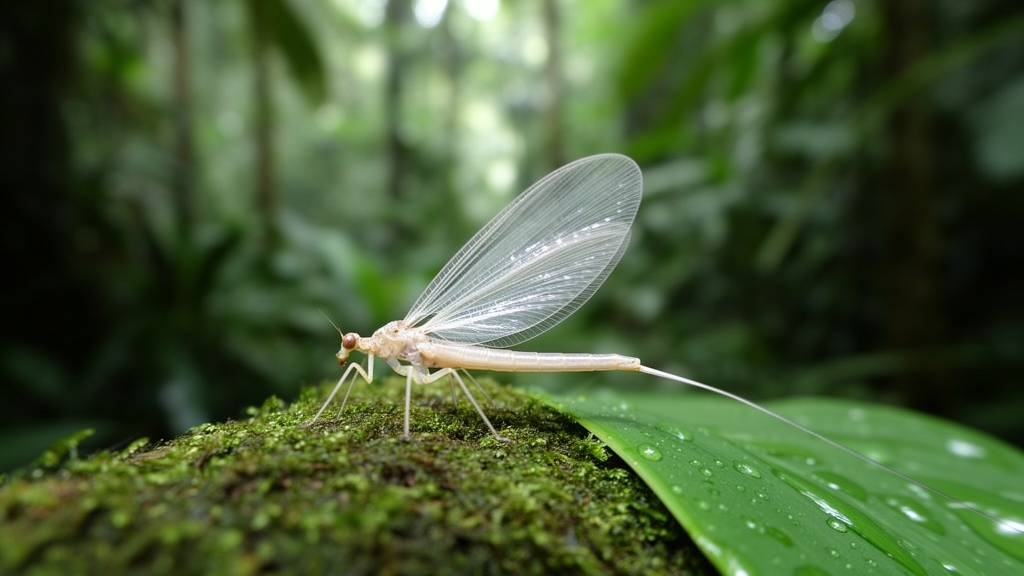
Deep in the mountain streams of New Guinea, scientists have pulled yet another handful of new species out of the water. A study published in the journal Alpine Entomology describes six previously unknown species of Labiobaetis, a genus of small mayflies, and lifts the number of known species on the island to 43, the highest concentration of species in this genus anywhere on Earth. Worldwide, the genus now stands at 162 described species, making it one of the most species-rich groups within the entire order Ephemeroptera, the mayflies.
The research, based on material collected partly in 1999 and mainly between 2006 and 2016, concentrated on the high central mountain chain of the island. The team, led by Thomas Kaltenbach and Michel Sartori of the Muséum cantonal des Sciences Naturelles in Lausanne together with colleagues, combined painstaking larval morphology with DNA barcoding of the mitochondrial gene cytochrome oxidase subunit 1, or COI. Before this study, 37 Labiobaetis species were known from New Guinea. The six new additions, described and illustrated from their larval stages, bring the island total to 43, and the authors are explicit that this is almost certainly not the end of the story.
Five of the six new species belong to a group called petersorum, which is endemic to New Guinea and known from nowhere else. The new species are Labiobaetis amber, L. bilibil, L. kinibeli, L. nabire and L. simbuensis. The sixth, L. kokoda, belongs to a different endemic group, vitilis. As part of the work, the researchers also reassigned an already known species, L. xeniolus, to the petersorum group, enhanced the morphological characterisation of that group, and provided a dichotomous identification key covering all of its species.
The choice of names reflects both places and people. L. amber is named after Amber village in Indonesia’s Papua Province, near which the type specimens were collected at 1200 metres. L. bilibil honours the indigenous Bilibil people of the Madang region of Papua New Guinea, where the species was found at 350 metres. L. kinibeli is dedicated to Mr. Kinibel, a successful collector of many of the specimens, and was found at altitudes between 900 and 2000 metres. L. nabire takes its name from Nabire Regency in Central Papua, and L. simbuensis from Simbu Province, where it was collected at 2350 metres on Mount Wilhelm. L. kokoda is named for the Kokoda Trek in Central Province, along which the larvae were gathered at 1390 metres.
Distinguishing such closely related species requires an extraordinary level of technical detail. The larvae were dissected in Cellosolve and mounted on slides, then photographed with focus-stacking equipment and, in one case, imaged with a scanning electron microscope. The petersorum group is defined by a suite of characters: a wide, sub-rectangular labrum with a well-developed arc of long simple setae; mandibles whose outermost denticle is enlarged into a blade-like structure; a thumb-like distomedial protuberance on the second segment of the labial palp; the absence of hind protoptera, or wing buds; broad femora armed with dozens of spine-like setae; and large gills, the tergalii, with strongly pigmented tracheae. Even a single fine, transparent seta near the tip of each claw turned out to carry taxonomic weight, and re-examination of older type material revealed this subapical seta in species where it had been overlooked in the original descriptions.
The genetic analysis was equally rigorous. DNA was extracted non-destructively so that the specimens could still be studied morphologically afterwards. A 658-base-pair fragment of COI was amplified and sequenced, and the resulting alignment, more than 99.5 percent complete, contained 36 percent parsimony-informative sites. The researchers reconstructed a Bayesian gene tree and applied three independent species delimitation methods: the distance-based ASAP, the tree-based PTP and the GMYC model, which works on a time-calibrated ultrametric tree. All three methods agreed on the status of the new species. Pairwise COI distances between molecular operational taxonomic units, or MOTUs, averaged 18.7 percent, with a minimum of 8.5 percent, far beyond the roughly 3 percent divergence threshold generally accepted for mayflies.
One of the most intriguing findings concerns L. xeniolus. Specimens morphologically identical to this species were collected at sites far from its type locality, and their COI sequences revealed seven distinct MOTUs, labelled L. cf. xeniolus A through G. Because no sequence exists from the type locality, the authors prudently refrained from formally naming these populations, but the genetic clustering suggests a potentially cryptic species complex hiding behind a single name. They recommend that future studies sample more populations and add nuclear genome data to complement the mitochondrial barcodes. A similar caution applies to specimens resembling L. petersorum collected in the Tamrau Mountains, designated L. cf. petersorum pending comparison with material from the type area.
Why is New Guinea such a hotbed of mayfly diversity? The island, the second largest in the world after Greenland, is a geological composite assembled from many separate terranes, and the evolutionary history of its biota involves connections to Australia, uplift, volcanism and rifting. The authors point to strong evidence that recent environmental change in the extremely structured central highlands, with its ongoing formation of rich aquatic resources, remote valleys and isolated mountain blocks, has been the primary driver of diversification for aquatic insects there. Each isolated valley and mountain range can act as an evolutionary crucible, splitting populations and letting them diverge into distinct species over time.
The blade-like mandibular incisors that define the petersorum group also appear in several other mayfly genera, including Baetis, Liebebiella, Philibaetis and Branchiobaetis, which the authors interpret as most likely a case of convergent evolution. Intriguingly, this trait is usually paired with a wide labrum bearing a strong arc of setae, and the researchers speculate that the combination could be a co-adaptation to a particular feeding mode such as scraping algae from stones. Testing that hypothesis, they note, will require further study of how these larvae actually make a living in their streams.
For now, the message is one of staggering, unfinished discovery. Given the extraordinary biodiversity of New Guinea, the limited collecting effort of past decades, the many regions still unexplored, and the evident richness of Labiobaetis on the island, the authors expect numerous additional species to surface as fieldwork continues. A genus once thought to be well catalogued keeps yielding surprises with every expedition, and the never-ending story of its diversity, as the original title puts it, is clearly still being written in the cold, fast streams of New Guinea’s highlands.
Subject of Research: Taxonomy and genetic delimitation of new Labiobaetis mayfly species from New Guinea
Article Title: New species of Labiobaetis Novikova & Kluge from New Guinea ( Ephemeroptera , Baetidae ): a never-ending story of diversity
Article References: Kaltenbach, T., Vuataz, L., & Gattolliat, J.-L. (2023). New species of Labiobaetis Novikova & Kluge from New Guinea (Ephemeroptera, Baetidae): a never-ending story of diversity. Alpine Entomology, 7, 83-134. https://doi.org/10.3897/alpento.7.106089
Image Credits: AI Generated
Keywords: Labiobaetis, mayflies, Ephemeroptera, Baetidae, New Guinea, new species, COI barcoding, species delimitation, taxonomy, freshwater insects, biodiversity, petersorum group
News Source: Gavin Prescott. (October 18, 2026). Six New Mayfly Species From New Guinea Push a Tiny Genus Toward a Global Record. Scienmag.