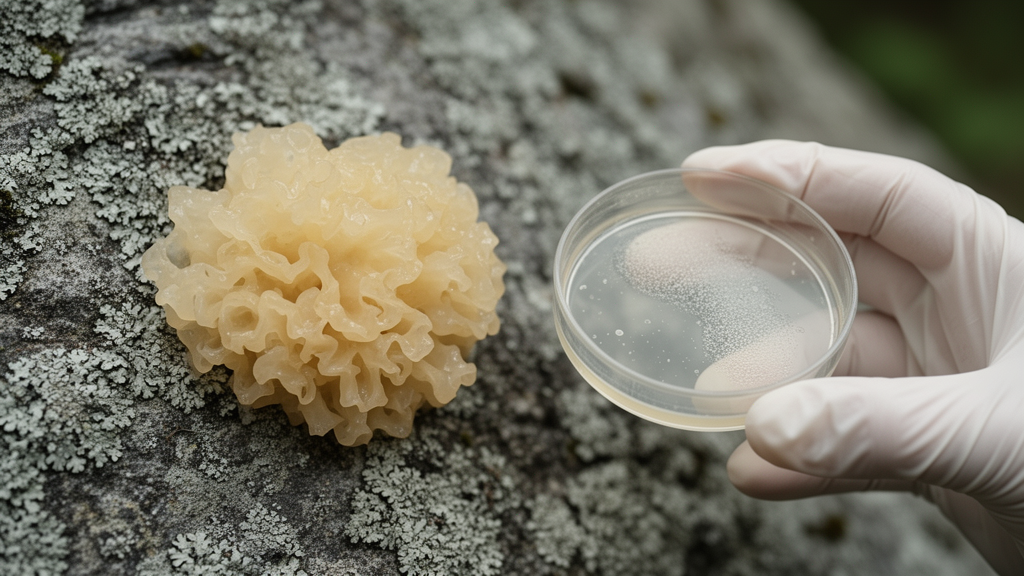
Deep inside the bright orange and yellow lichens that crust rocks, walls and tree bark across Europe, a microscopic fungus is living a double life that scientists have only now managed to photograph in full. A new study published in IMA Fungus has mapped, cell by cell, the two radically different body forms of Tremella parietinae, a basidiomycete fungus that spends its existence inside the common lichen Xanthoria parietina. Using fluorescent in situ hybridization coupled with confocal laser scanning microscopy, together with PCR amplification and Sanger sequencing, researchers showed that the filamentous phase of the fungus is confined to the lichen’s spore-producing tissue, the hymenium, while its unicellular yeast phase roams far more widely through the thallus, including the upper and lower cortices and the margins of the apothecia. The finding confirms a suspicion that has been building for nearly a decade: the yeast stages of lichen-inhabiting Tremella species are less picky about where they live than the conspicuous filamentous stages that have historically defined the species.
The work targets the Tremella caloplacae species complex, a group of fungi that parasitize or commensally inhabit lichens of the family Teloschistaceae. For most of the twentieth century, these organisms were known almost exclusively from the small galls and deformations they induce in their host lichens, structures that house the sexual fruiting bodies, or basidiomata. Tremella caloplacae itself was first described in 1906 as a hyphomycete, an error that took nearly a century to correct when it was recognized as a lichen-associated tremellomycete. Only recently did molecular data, morphology and host preferences allow researchers to split the complex into five newly described species, each tightly associated with a particular lichen genus: Tremella caloplacae sensu stricto on Variospora, T. elegantis on Rusavskia elegans, T. nimisiana on Xanthocarpia, T. parietinae on Xanthoria parietina, T. pusillae on Calogaya pusilla, and T. sorediatae on Rusavskia sorediata. What remained unknown was whether these fungi, like many other dimorphic basidiomycetes, alternate between a filamentous form and a yeast form, and if so, where each form resides within the lichen.
The research team chose Tremella parietinae as their focal species because its host, Xanthoria parietina, is one of the most common and widespread lichens in Europe, making large-scale sampling straightforward. The team collected specimens from three contrasting locations: a riparian corridor at El Sotillo near Villaviciosa de Odón in Madrid, Spain, where galls were abundant on the local Xanthoria population; an urban site near the Swedish Museum of Natural History in Stockholm, where no galls were found on any thallus; and the calcareous coastal cliffs of Öland, Sweden, where an exploratory screening of other Teloschistaceae lichens was carried out. In total, 57 specimens were analysed, spanning lichens with and without visible galls, and including non-Teloschistaceae species such as Candelaria concolor and Physcia aipolia to test whether the fungus might stray beyond its known host family.
The FISH-CLSM technique was central to the study. The researchers designed specific probes targeting the nuclear large subunit ribosomal DNA of Tremellales, doubly labelled with 6-FAM and FITC fluorophores to boost signal intensity against the strong green autofluorescence of Tremella cells, alongside Cy5-labelled probes for the Lecanoromycetes host. Before hybridization, lichen fragments were fixed in methanol-free formaldehyde and treated with acetone to dissolve the strongly autofluorescent secondary metabolites that would otherwise swamp the signal. Permeabilization with chitinase from Streptomyces griseus and sodium dodecyl sulfate allowed the probes to penetrate fungal cell walls, and hybridization was carried out at 46 °C in a buffer containing 10 percent formamide. Imaging was performed on an inverted Olympus IX83 confocal microscope with a 60× oil immersion objective, using sequential scanning to separate the green and red channels and negative controls to calibrate laser intensity and gain, ensuring that autofluorescence was not mistaken for true hybridization signal.
The results were unambiguous. In all twelve fragments examined from five Xanthoria parietina specimens, Tremella parietinae was detected. Yeast cells appeared intermixed with host hyphae, usually in superficial areas of both the upper and lower cortices of the thallus, in the thalline margins of apothecia, and within the hymenium itself. They were distributed either in small patches or as isolated cells. Crucially, the filamentous stage, with its hyphae, basidia, haustoria and clamp connections, was observed only in specimens bearing galls, and exclusively within the hymenium. Basidiospores were seen only inside the galls. In one apothecium without galls from a gall-bearing specimen, mature two-celled basidia matching the morphology of those in galls were observed, but without yet-developed epibasidia, the structures where meiosis and spore formation occur. Haustoria, the specialized feeding structures the fungus uses to draw nutrients from its host, were only found in fully formed basidiomata.
PCR amplification and sequencing corroborated the imaging results and extended them across the sampling sites. From the 24 Xanthoria parietina specimens collected in Madrid, Tremella parietinae was detected in roughly 38 percent of specimens without galls and in 88 percent of specimens with galls. In Stockholm, however, none of the eight gall-free specimens yielded any Tremella DNA, a striking contrast that the authors suggest may reflect environmental constraints on the yeast’s presence or on its detectability, though false negatives cannot be ruled out with the current method. Phylogenetic analysis of the ITS and nuclear large subunit ribosomal DNA regions, using maximum likelihood with four independent partitions and 1000 bootstrap pseudoreplicates, placed all sequences from Xanthoria specimens, whether from galls or from apparently clean tissue, firmly within the T. parietinae clade, confirming that the yeast and filamentous phases belong to the same species.
The exploratory screening of other Teloschistaceae lichens on Öland revealed an even more intriguing pattern. Tremella caloplacae sensu stricto was detected by PCR in a range of host genera including Athallia, Calogaya, Caloplaca, Gyalolechia, Flavoplaca and Variospora, yet its basidiomata are known only from Variospora species. This discrepancy suggests that the yeast phase of T. caloplacae is less host-specific than its filamentous phase, a pattern consistent with findings from other lichen-associated Tremella species such as T. lethariae, T. macrobasidiata and T. variae, where yeasts have been visualized across multiple lichen species while the fruiting bodies remain confined to a single host. Notably, no T. parietinae was detected in Candelaria concolor or Physcia aipolia, reinforcing the idea that even the yeast phase retains some degree of host association, though the authors caution that PCR detection limits and the possibility of dominant sequences masking rarer ones complicate definitive conclusions.
The Teloschistaceae present a particularly interesting chemical environment for these fungi. The family is rich in anthraquinones, secondary metabolites concentrated in the thalline cortex that are known to have antifungal activity and could theoretically suppress the growth of Tremella yeasts within the thallus. Recent work on Pertusaria lichens has shown a negative correlation between the presence of antimicrobial secondary compounds and tremellalean fungi, lending support to this hypothesis. Yet anthraquinones also serve a critical photoprotective role, shielding the lichen from ultraviolet radiation and blue light. Since yeasts from other fungal groups are known to be sensitive to UV radiation, the same pigments that might act as a chemical barrier could paradoxically protect Tremella yeasts nestled inside the Xanthoria thallus. The authors present both hypotheses as avenues for future investigation, noting that the interplay between lichen chemistry and fungal life-cycle dynamics remains largely unexplored.
What triggers the switch between yeast and filamentous phases in lichen-associated Tremella remains unknown, though parallels from dimorphic pathogenic fungi offer clues. In animal and plant pathogens, morphogenesis is linked to temperature shifts, pH fluctuations, nutrient availability, host immune compounds and pheromone recognition between compatible yeast cells. The researchers speculate that the unusually high incidence of galls in the Madrid population may reflect a high density of yeast cells within the lichen thalli, increasing the probability of encounters between compatible mating types and thereby favouring the transition to the filamentous, sexually reproductive phase. Studies on the lichenicolous genus Plectocarpon have suggested that gall formation may be tied to changes in the host’s production of carbon-based secondary compounds, hinting that similar mechanisms could operate in Tremella. As metagenomic techniques become more sensitive and affordable, the authors anticipate that the hidden yeast diversity within lichens will prove far richer than current PCR-based surveys suggest, opening the door to a more complete understanding of how these dimorphic fungi navigate the intimate, layered world inside their lichen hosts.
Subject of Research: Life cycle and host specificity of the lichen-inhabiting dimorphic fungus Tremella parietinae
Article Title: Living in each other’s pockets: insights into the life cycle of Tremella caloplacae s. l.
Article References: Freire-Rallo, S., Tuovinen Nogerius, V., Wedin, M., & Millanes, A. M. (2026). Living in each other’s pockets: insights into the life cycle of Tremella caloplacae s. l.. IMA Fungus, 17, Article e157916. https://doi.org/10.3897/imafungus.17.157916
Image Credits: AI Generated
DOI: 10.3897/imafungus.17.157916
Keywords: Tremella parietinae, lichenicolous fungi, Xanthoria parietina, Teloschistaceae, dimorphic fungi, FISH-CLSM, yeast phase, basidiomycetes, lichen symbiosis, host specificity, anthraquinones, IMA Fungus
News Source: Roger Howard. (October 18, 2026). Hidden Yeast Phase Revealed in Lichen-Dwelling Fungus Tremella parietinae. Scienmag.