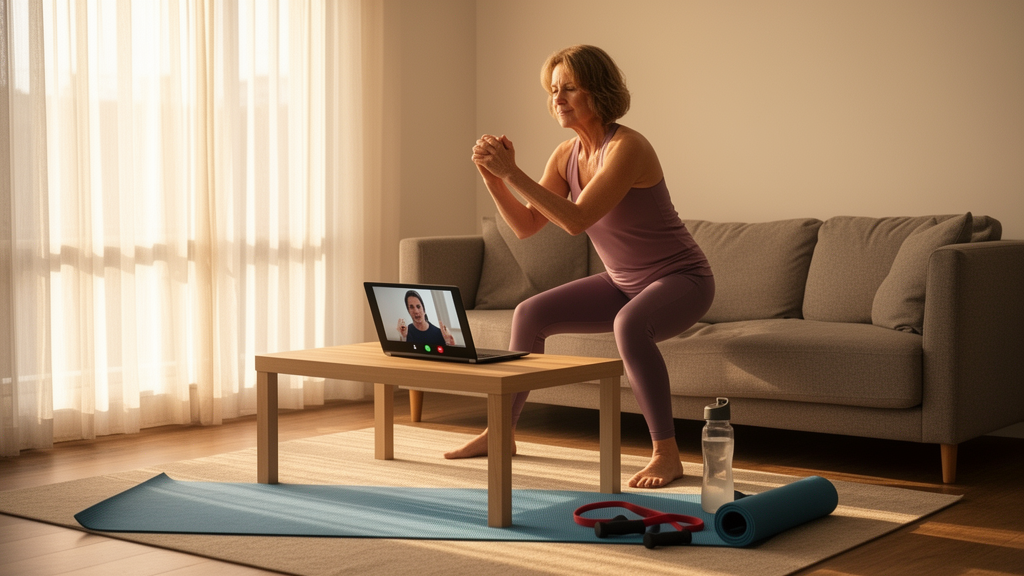
Four months after finishing a supervised online exercise program, most cancer survivors still wanted to keep moving — but many struggled to turn that good intention into a lasting habit. That is the central finding of a qualitative study published in Supportive Care in Cancer, which followed 17 adults who had taken part in an eight-week group exercise telerehabilitation program in Victoria, Australia. The research, embedded within a randomized controlled trial known as TeleCaRe, offers one of the first close-up looks at what happens to exercise behavior after the webcam sessions end.
The stakes of the question are high. Exercise-based rehabilitation is recommended as part of best-practice cancer care because regular physical activity can blunt the adverse effects of treatment, improve physical and psychological function, and enhance quality of life. Large-scale evidence cited by the researchers suggests that long-term exercise improves disease-free survival by 28 percent and overall survival by 37 percent in people with cancer. Yet survivors entering rehabilitation are typically far below recommended activity levels: previous studies report an average of just 12 minutes of moderate-to-vigorous activity per day, and half say they exercise fewer than two days a week.
Structured, supervised rehabilitation programs are seen as a promising first step toward changing those numbers, but keeping people active once the program finishes has proven difficult. Telerehabilitation — delivered through videoconferencing, wearable devices, and mobile applications — was developed to overcome practical barriers to attending in-person sessions, allowing participants to exercise safely at home while still receiving demonstration, instruction, monitoring, and expert guidance. Group-based cancer exercise telerehabilitation has been shown to be safe and feasible, although earlier work raised concerns that participants may find it harder to build the social connections that make in-person groups motivating.
In the TeleCaRe trial, participants in the experimental arm received an eight-week program of twice-weekly, 60-minute group exercise sessions supervised by a physiotherapist trained in cancer care. The sessions combined seated or standing aerobics, body-weight exercises such as squats, and equipment including resistance bands and free weights, all individually tailored. The program also incorporated information provision, self-monitoring through a Fitbit activity tracker, feedback, goal setting, an online information portal, and an individualized home exercise plan — a package of recognized behavior change techniques. Before starting, and again at discharge, participants discussed ongoing exercise options one on one with the physiotherapist.
To understand the medium-term impact, the researchers purposively sampled 17 trial participants — roughly half female, averaging 58 years old, with ages ranging from 21 to 80 — for semistructured interviews four months after their final session. Interviews were conducted by PhD-qualified physiotherapists not involved in delivering the program, audio-recorded, transcribed verbatim, and independently coded by two researchers using NVivo software. The team analyzed the data inductively within an interpretive description framework, refining a shared codebook through repeated discussion, and returned transcripts to participants to verify accuracy. Data collection ran from June 2022 to December 2023 across a large public health service spanning metropolitan Melbourne to regional Victoria.
The overarching theme that emerged was that telerehabilitation facilitated positive exercise intentions that persisted well beyond the program. Participants described the program as a lifeline that connected them with skilled, empathetic clinicians at a dark point in their recovery, empowering them through knowledge, opportunity, and connection. One participant with breast cancer recalled being weak, having lost her hair, and feeling awful, saying the program pulled her out of that period and calling such services a lifeline for people like her. Others articulated vivid long-term reasons for exercising, from coping better with chemotherapy to reducing the fear of recurrence.
For many, feeling the benefits of exercise during the program — less fatigue, a return to work — created a positive cycle that prompted them to seek further activity once it ended. Some returned to the gym, took up golf, lawn bowls, or swimming, or folded the program’s home exercises into their regular routines. Purposeful walking was the most common activity because it was convenient. Family members reinforced the momentum, sometimes exercising alongside participants or buying them equipment, and for some the program acted as a conduit back into community life, such as volunteering at a bowls club.
But acting on those intentions proved far harder in what participants called the new reality created by cancer. Comorbidities, ongoing treatment side effects such as pain and fatigue, and disrupted life circumstances limited many people’s ability to exercise, and some expressed guilt about not keeping up. Without the structure, accountability, and convenience of scheduled sessions, several described a disconnect between knowing they should exercise and actually doing so. COVID-19 added a double barrier: some participants contracted the infection and were physically unable to exercise, while others avoided community gyms and pools for fear of infection due to immunocompromise.
Previous exercise experience emerged as the strongest determinant of who kept moving. Survivors who had exercised before their diagnosis — swimming, running, gym training, regular walking — described those activities as goals to return to and appeared to bounce back quickly from setbacks, likely helped by higher self-efficacy. Those new to exercise held positive intentions but were less likely to act on them, often managing only incidental activity around the home or occasional walks. The researchers suggest this pattern fits the transtheoretical model of behavior change: telerehabilitation helps people move from contemplation into action, but the leap from action to maintenance is difficult once professional supervision disappears, and health setbacks can push people back toward contemplation even as their positive intent remains.
The authors conclude that telerehabilitation can be a valuable first step toward initiating exercise, but that many survivors — particularly those without previous exercise experience — need ongoing support afterward to convert good intentions into sustained behavior. In real-world clinical settings, resources rarely allow the years-long, phased support used in the landmark trial linking exercise to improved colon cancer survival, so the researchers point to flexible models such as physiotherapy navigators and community-based programs like LiveStrong at the YMCA or the Alberta Exercise Program to bridge the gap. The study has limitations: participants came from a motivated trial cohort who needed internet access, adherence to the program was low, and interviews were short, though no new themes emerged in the final transcripts. Even so, the message is clear — the webcam sessions plant the seed, but the hard work of keeping cancer survivors exercising begins when the screen goes dark.
Subject of Research: Cancer survivors' exercise behaviour after completing a group exercise telerehabilitation program
Article Title: A qualitative study of cancer survivors’ exercise behaviour 4 months after a telerehabilitation program
Article References: Dennett, A. M., Peiris, C. L., Rimayanti, M. U., Barton, C., Taylor, N. F., Harding, K. E., Tan, G., Ezzat, A., & Shields, N. (2026). A qualitative study of cancer survivors’ exercise behaviour 4 months after a telerehabilitation program. Supportive Care in Cancer, 34(10), Article 941. https://doi.org/10.1007/s00520-026-11016-y
Image Credits: AI Generated
DOI: 10.1007/s00520-026-11016-y
Keywords: telerehabilitation, cancer survivors, exercise, behavior change, qualitative research, physiotherapy, cancer rehabilitation, telehealth, physical activity, survivorship, qualitative, cancer
News Source: Nathaniel Bowman. (October 18, 2026). Cancer survivors call telerehabilitation a lifeline, but exercise habits fade without ongoing support. Scienmag.