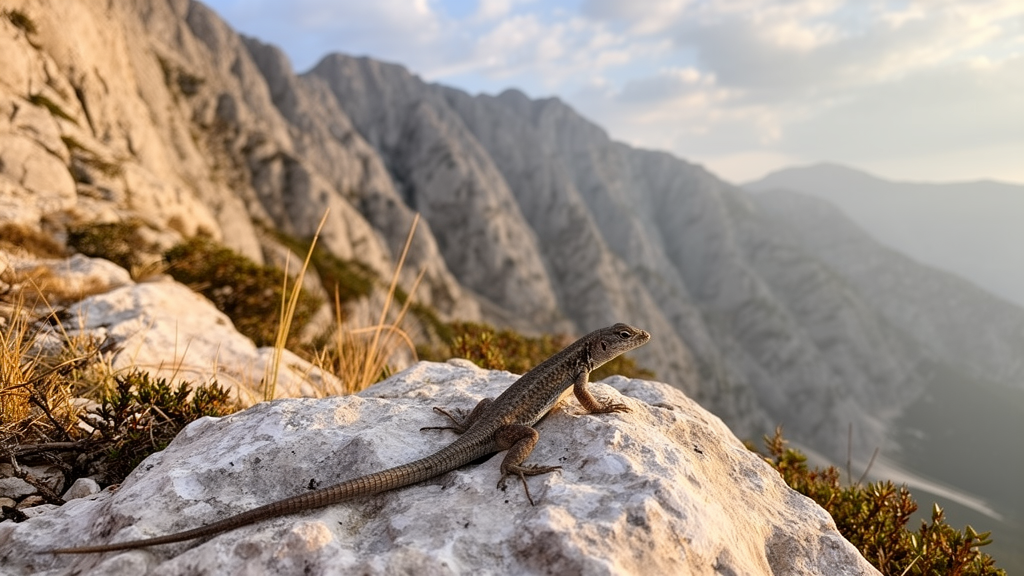
Deep in the limestone ramparts of the Dinaric Alps, a cold-adapted lizard is clinging to a life that is slowly being squeezed upward. The Mosor rock lizard, Dinarolacerta mosorensis, is a stenoendemic reptile found nowhere else on Earth except scattered mountain masses in Croatia, Bosnia and Herzegovina, and Montenegro. A new study published in the journal Herpetozoa has now delivered the most comprehensive review of the species’ range in decades, combining historical records with six years of targeted fieldwork. The results redraw the map of this Near Threatened species, extend it further north than ever recorded, and expose stark gaps in the protection of the habitats it depends on.
The research team compiled a total of 211 records spanning the years 1886 to 2024, drawing on 95 literature entries and 116 newly collected field observations. After filtering out vague historical references and duplicates, the researchers validated 33 distinct range localities, of which nine are reported for the first time. These new sites include Mount Čvrsnica, Mount Bjelašnica, Mount Visočica, Mount Treskavica, the Rakitnica Canyon, Mount Romanija, the Sutjeska Canyon, Mount Bioč, and the Morača Mountains. The discoveries push the species’ known distribution roughly 65 kilometres further north than the previous northernmost record on Mount Prenj, and confirm its presence west of the Neretva River, a biogeographical boundary long suspected but rarely documented for this lizard.
Perhaps the most striking quantitative finding concerns altitude. The highest confirmed occurrence is now 2,031 metres above sea level on Mount Volujak in Montenegro, surpassing the previous record of 1,900 metres on Mount Durmitor. Meanwhile, 91 percent of all records sit above 1,000 metres, reinforcing the picture of a species that thrives in cold montane conditions between roughly 1,100 and 1,900 metres. Lower-elevation occurrences are rare and largely confined to deep canyons, such as the Mrtvica River Canyon in Montenegro at 270 metres, which researchers interpret as relictual populations stranded in microclimatic refugia. This altitudinal profile is critical because it makes the species acutely sensitive to warming temperatures, which effectively shrink the cold habitat band it can occupy.
The study quantified the species’ range using two complementary methods. Range polygons delineated primarily by the 1,000-metre contour yielded a total area of 5,014.36 square kilometres, while the standard 10-by-10-kilometre European Environment Agency reference grid produced 55 cells totalling 5,500 square kilometres. Applying IUCN Red List criteria, the researchers calculated an Extent of Occurrence of 18,725.34 square kilometres and an Area of Occupancy of 528 square kilometres based on 2-by-2-kilometre grid cells. Both figures exceed those in the most recent IUCN assessment, likely because of the new northern and western findings in Bosnia and Herzegovina. The authors caution that the range remains an underestimate and that further targeted surveys are needed to fully delineate the species’ distribution.
Croatia emerges as a far smaller piece of the puzzle than previously believed. The entire known Croatian distribution falls within just seven grid cells, and when measured by range polygons, the species occupies a mere 93.55 square kilometres, less than 2 percent of the global total. This contrasts sharply with the 10 percent figure reported in the latest IUCN evaluation. Only two confirmed Croatian localities remain: Mount Mosor, the type locality, and Mount Biokovo. The researchers were unable to reconfirm historical records from Mount Kozjak and Mount Opor, concluding that these were probably misidentifications or extirpations, and the enigmatic 1907 museum specimens from Sinj remain unresolved pending further surveys of the surrounding mountains.
Bosnia and Herzegovina now stands out as the stronghold of the species, with 16 confirmed range localities covering 55.84 percent of the total range. The new discoveries on Mount Romanija, Mount Bjelašnica, Mount Visočica, and Mount Treskavica reveal that the lizard’s distribution extends much further north than previously mapped. The finding on Mount Čvrsnica confirms the species west of the Neretva River, a river known to act as a significant barrier to gene flow for many Balkan taxa. The researchers also documented the species in the Sutjeska and Rakitnica Canyons at lower elevations, renewing the argument that deep gorges may serve as both upstream and downstream corridors linking fragmented montane populations.
Montenegro, the best-studied country for this species, yielded two new range localities and a reconfirmation on Mount Volujak. The country hosts 15 range localities occupying 42.30 percent of the global range. The researchers surveyed several promising mountains, including Mount Rumija, Mount Sinjajevina, and Mount Bjelasica, without finding the species, but they identified numerous potential sites where undiscovered populations may persist, particularly along high-elevation corridors that likely served as dispersal pathways during glacial periods. Populations on Mount Orjen and Mount Lovćen appear fragmented from the main range and face distinct Mediterranean-influenced threats, warranting continuous monitoring.
Protected area coverage varies dramatically across the species’ range. Overall, 44 percent of the known Area of Occupancy falls within protected areas, but the figure ranges from 100 percent in Croatia, where both localities are part of the Natura 2000 network, to 53.3 percent in Montenegro and just 37.5 percent in Bosnia and Herzegovina. The researchers argue that establishing new protected areas is fundamental, particularly in Bosnia and Herzegovina where coverage is lowest. As EU candidate countries, both Bosnia and Herzegovina and Montenegro are expected to develop Natura 2000 networks in the future, and the authors strongly recommend aiming for the highest possible percentage of protection in each biogeographical region to ensure the species’ Favorable Conservation Status.
The conservation implications are sobering. The researchers argue that climate change is the main threat to the species, a cold-adapted relict already confined to its interglacial refugia on mountaintops. Mountain and island endemics face predicted extinction risks of 84 to 100 percent by 2100, and montane lacertids are considered particularly vulnerable to rising temperatures and intensified competition from warm-adapted species. The authors observed an altitudinal shift on Mount Mosor, where the lizard was recorded at 750 metres in 2009 but has not been seen below 890 metres in recent surveys, suggesting a retreat to higher ground. They recommend revisiting all lower-altitude historical sites, such as the Korito Plateau and Kameno Brdo, as these are the first areas where the species’ survival will be jeopardized by warming.
The study also challenges assumptions about the species’ competitive weakness. Contrary to suggestions that the Mosor rock lizard avoids areas with other lizards, the researchers documented syntopy with multiple species, including Dalmatolacerta oxycephala, Podarcis melisellensis, Podarcis muralis, and Algyroides nigropunctatus, across several mountains. Differences in microhabitat use, such as rock height and preference for humid areas, likely allow coexistence. The authors emphasize that future research should focus on species distribution modeling, genetic studies, and ecological investigations to understand population structure, fragmentation, and interspecific relationships. Without such evidence-based strategies, the future of this endemic and relict Dinaric species remains uncertain in a warming world.
Subject of Research: New distribution data of the Mosor rock lizard (Dinarolacerta mosorensis): a review of its range and conservation status
Article Title: New distribution data of the Mosor rock lizard ( Dinarolacerta mosorensis ): a review of its range and conservation status
Article References: Burić, I., Lauš, B., Merdan, S., Kranželić, D., Gvozdenović Nikolić, S., Iković, V., Ćurić, A., & Lisičić, D. (2025). New distribution data of the Mosor rock lizard (Dinarolacerta mosorensis): a review of its range and conservation status. Herpetozoa, 38, 173-186. https://doi.org/10.3897/herpetozoa.38.e153017
Image Credits: AI Generated
DOI: 10.3897/herpetozoa.38.e153017
Keywords: Mosor rock lizard, Dinarolacerta mosorensis, Dinaric Alps, herpetology, IUCN Red List, Balkan endemics, climate change, protected areas, Bosnia and Herzegovina, Montenegro, Croatia, range mapping
News Source: Margaret Porter. (October 18, 2026). Mosor rock lizard range remapped: nine new sites reveal a shrinking refuge in the Dinaric Alps. Scienmag.