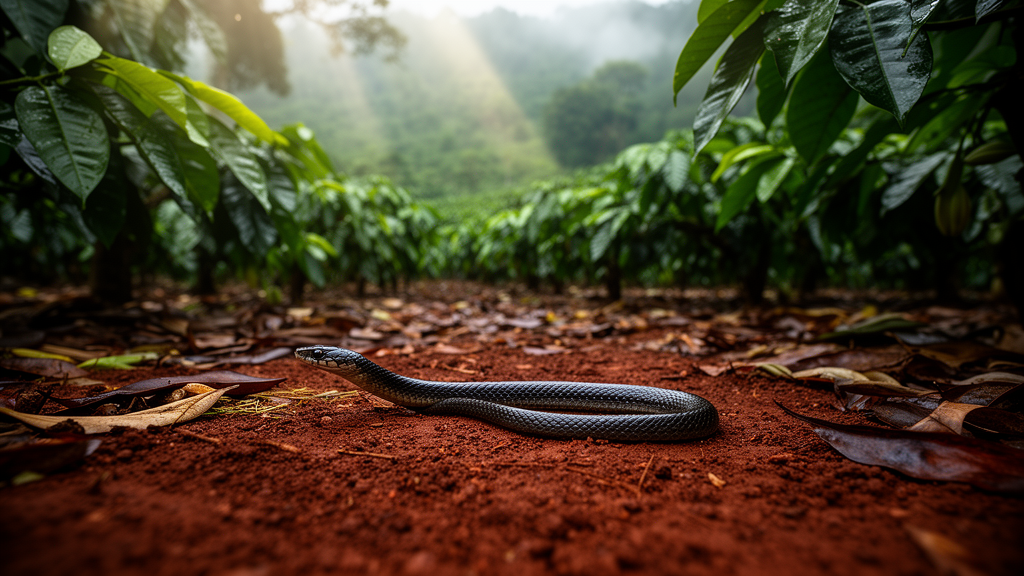
Deep in the cardamom and coffee plantations of the Siruvani Hills, farmers digging in the soil have been unearthing a strange, glossy black snake with a bizarre armored tail — and it turns out the animal is a species entirely new to science. A team of Indian and British herpetologists has formally described the burrowing reptile as Rhinophis siruvaniensis, a new member of the shieldtail snake family Uropeltidae, in the journal Evolutionary Systematics. The discovery, based on a series of three specimens collected from the Attappadi Plateau straddling the Kerala–Tamil Nadu border, is the fourth new species of the genus Rhinophis to be described from Peninsular India in just two decades, and it highlights how much undiscovered life may still be hiding in the heavily fragmented forests of the Western Ghats.
Shieldtail snakes are among the most peculiar reptiles on Earth. Small, cylindrical and adapted to a fully fossorial — burrowing — lifestyle, they spend their lives underground, pushing through soil with pointed snouts and ending in large, dome-shaped caudal discs or ‘shields’ that give the family its common name. Currently, 73 species of uropeltids are known, classified under seven genera and distributed across Peninsular India and Sri Lanka, with the Western Ghats of India representing one of the family’s diversity hotspots. But recent phylogenetic studies have suggested high levels of cryptic diversity within these snakes, meaning that many populations that look similar may actually be distinct species, calling for fine-scale sampling across regions of high uropeltid diversity.
The genus Rhinophis, with 26 species, is the second most-diverse genus within the Uropeltidae and the only one that occurs both in Peninsular India and Sri Lanka. Although most Rhinophis diversity is concentrated in Sri Lanka, which hosts 20 species, the genus is represented by six species in Peninsular India. During field surveys for uropeltid snakes, the research team encountered a novel Rhinophis population in the Attappadi Plateau of the Siruvani Hills. The specimens were hand collected from plantations, where they were dug out during agricultural digging operations, and deposited at the Bombay Natural History Society in Mumbai and the Centre for Ecological Sciences at the Indian Institute of Science in Bengaluru.
To determine whether the Siruvani population represented a new species, the researchers combined detailed morphological documentation with phylogenetic reconstruction using mitochondrial DNA. Following established protocols, they recorded a total of 31 morphometric and meristic characters for each specimen, including scalation counts, measurements taken with digital vernier calipers to the nearest 0.1 millimeter, and colour patterns documented under a stereo microscope. Ventral scale counts were recorded following standard conventions, and dorsal scale row reductions were documented at the anterior region, at mid-body, and near the vent. Comparative data for other Indian and Sri Lankan Rhinophis were obtained from published literature or by examining museum specimens.
For the genetic analysis, the team extracted total genomic DNA from liver tissue and amplified two mitochondrial markers, 16S rRNA and NADH dehydrogenase subunit 4 (ND4), using a standard three-step PCR protocol. Because relationships within Rhinophis are generally not well resolved, the researchers added a third mitochondrial marker, 12S rRNA, to their sequence matrix. The sequences were aligned using the MUSCLE algorithm, ambiguously aligned sites were removed with Gblocks, and the three markers were concatenated for phylogenetic reconstructions using both Maximum Likelihood and Bayesian Inference methods, with sequences of the genera Plectrurus and Pseudoplectrurus serving as outgroups to root the resulting trees.
The phylogenetic analyses delivered a clear verdict. Most Peninsular Indian Rhinophis formed a well-supported clade, and within this clade the specimen from Attappadi formed a strong sister relationship with two specimens of R. melanoleucus from Wayanad, with maximum support values in both analyses. Comparing uncorrected p-distances indicated moderate levels of divergence between the Attappadi sample and R. melanoleucus, ranging from 2.0 to 2.2 percent on 16S rRNA and 4.0 to 4.1 percent on ND4. Intriguingly, the analyses also showed that R. travancoricus and R. goweri were more closely related to the Sri Lankan Rhinophis than to other Indian congeners, a finding with significant biogeographic implications for understanding how these burrowing snakes colonized and diversified across the two landmasses.
Despite the moderate genetic divergence, the new species can be readily distinguished from its sister lineage by a suite of unique external morphological characters and by geographic separation. Rhinophis siruvaniensis is diagnosed by a combination of 17 dorsal scale rows at or well beyond mid-body, 202 to 205 ventral scales, 4 to 8 paired subcaudals, and a distinctive colouration of dark brownish-black dorsum with pale whitish blotched lateral and ventral regions. The holotype, an adult with a snout-vent length of 284.2 millimeters, was collected in July 2015 at Jellipara in Kerala’s Palakkad District at an elevation of 781 meters. Two paratypes were collected in May 2020 from the Siruvani Hills in Tamil Nadu’s Coimbatore District at around 1000 meters elevation, and a fourth, presumably neonatal specimen was excavated from the soil at Jellipara in July 2020.
The new species closely resembles R. melanoleucus in overall colouration, but can be easily differentiated by having fewer ventral scales — under 206 versus over 217 — and by having 17 dorsal scale rows at mid-body rather than 15. It differs from all other Peninsular Indian Rhinophis except R. travancoricus and R. goweri by the presence of 17 mid-body dorsal scale rows, and from those two species by having substantially more ventral scales. The new species also has more ventrals than R. fergusonianus, and differs from R. goweri, R. karinthandani and R. sanguineus in its ventral colouration, which features a creamy white venter extending ventrolaterally as intermittent patches along with dark brownish-black blotches, in contrast to the bright yellow venter of R. goweri, the off-white speckled venter of R. karinthandani, and the bright red venter of R. sanguineus. The species name is a toponym, latinized after its known distribution range in the Siruvani Hills.
The geographic separation between the new species and R. melanoleucus is itself a fascinating story of biogeographic barriers. While R. melanoleucus is restricted to the south-western region of the Wayanad plateau, R. siruvaniensis is found in the Attappadi plateau and Siruvani Hills. These two regions are interrupted by several valleys and massifs, including the Chaliyar River, a deep river valley separating the Camel’s Hump Hills from the Gudalur Plateau, and the high massifs of the Nilgiri Hills. These massifs, separated by the Chaliyar River Valley, have been shown to act as biogeographic barriers for many mid- to high-elevation species, and may have served as barriers to gene flow between the two lineages, driving their independent evolution into distinct species.
The discovery carries an urgent conservation message. Rhinophis siruvaniensis is currently known only from around the type locality, entirely outside protected areas or conservation reserves, in a region characterized by mid-elevation wet evergreen forests found amidst villages and monoculture plantations. Live specimens were typically found under fallen logs and rocks or during minor digging operations inside plantations at a depth of about 30 centimeters. Local farmers reported that these snakes are sometimes inadvertently wounded or killed while digging during their routine work, and roadkills as well as live snake crossings were sighted on the tarred road connecting Anaikatti and Attappadi. The presence of juveniles in July suggests that breeding is likely associated with the southwest monsoons, and anecdotal reports from experienced local farmers indicate the species is active on the land surface during night or day, feeding on earthworms, generally observed from June to December. The Siruvani Hills have also yielded several other recently described narrowly endemic species, including three rhacophorid frogs, a shieldtail snake, two lizards, and the uropeltid Teretrurus siruvaniensis, which co-occurs with the new species. The researchers stress that the discovery of R. siruvaniensis in this historically well-studied region underscores the need for continued biodiversity exploration and, critically, for improved protection of the remaining forests of the Siruvani Hills, which are currently dominated by monoculture plantations.
Subject of Research: A new species of Rhinophis Hemprich, 1820 (Squamata, Uropeltidae) from Siruvani Hills, Western Ghats, India
Article Title: A new species of Rhinophis Hemprich, 1820 ( Squamata , Uropeltidae ) from Siruvani Hills, Western Ghats, India
Article References: Cyriac, V. P., Umesh, P. K., Achyuthan, N. S., Kulkarni, V., & Ganesh, S. R. (2025). A new species of Rhinophis Hemprich, 1820 (Squamata, Uropeltidae) from Siruvani Hills, Western Ghats, India. Evolutionary Systematics, 9(2), 191-201. https://doi.org/10.3897/evolsyst.9.150536
Image Credits: AI Generated
DOI: 10.3897/evolsyst.9.150536
Keywords: species, Rhinophis, Hemprich, Squamata, Uropeltidae, Siruvani, Hills, Western, Ghats, India, scientific research
News Source: Margaret Porter. (October 18, 2026). New shieldtail snake species unearthed in India’s Western Ghats plantations. Scienmag.