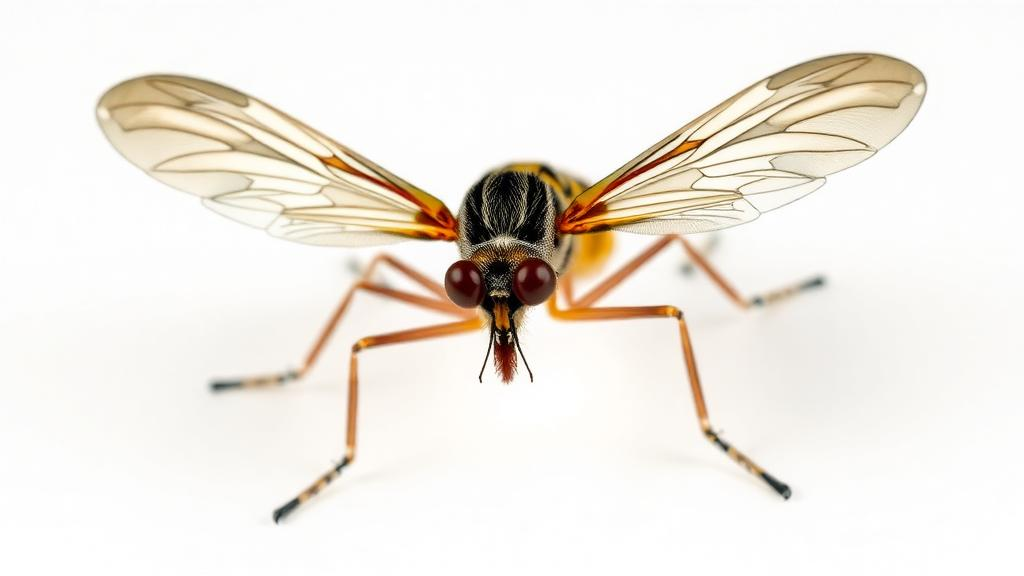
Deep in the mountain streams and river gorges of the Balkan Peninsula, a quiet census of one of Europe’s most overlooked insect groups has produced a discovery that stretches back more than a century. A new study published in the journal ZooKeys documents dozens of new country records for crane flies across the Balkans and, remarkably, describes a new subspecies of an exceptionally rare crane fly based largely on specimens that had been sitting in museum drawers for decades. The finding underscores just how little is still known about the fly fauna of southeastern Europe, even in an age of genome sequencing and global biodiversity databases.
Crane flies, the long-legged members of the insect order Diptera that make up the superfamily Tipuloidea, are often mistaken for oversized mosquitoes, though they are harmless to humans. Their larvae typically develop in moist soil, decaying vegetation, and streamside sediments, making them sensitive indicators of habitat quality. Despite their ecological importance and their sheer diversity, with thousands of species across Europe, the crane fly fauna of the Balkan Peninsula remains what the study’s authors describe as poorly known, even after decades of increasing faunistic and taxonomic attention.
The new research, led by Levente-Péter Kolcsár, presents fresh records of two crane fly families, Limoniidae and Tipulidae, from across the peninsula. In total, the team reports twenty species from Albania, fifteen from Montenegro, seven from North Macedonia, three from Bosnia and Herzegovina, three from Serbia, and one each from Croatia and Bulgaria. Many of these represent the first documented occurrences of the respective species in those countries, and several had never before been recorded anywhere in the Balkans. For a region that is often treated as a biodiversity hotspot for other groups, the sheer number of first records in a single paper is a striking measure of how under-sampled the peninsula’s fly fauna has been.
The specimens behind these records were gathered using a combination of classic field techniques: entomological nets swept through vegetation, aspirators for picking individual insects off surfaces, light traps that exploit the photic attraction of nocturnal flies, and pyramid emergence traps positioned over waterlogged substrates to catch adults as they emerge from their aquatic or semi-aquatic larval stages. Most material was preserved in seventy percent ethanol, a standard medium that keeps specimens pliable enough for later dissection of delicate genital structures, while others were stored in triangular glassine envelopes for pinned preparation.
Identifying crane fly species is rarely a matter of glancing at wing patterns. The decisive characters frequently reside in the male and female terminalia, the modified structures at the tip of the abdomen that mediate reproduction. The researchers examined and photographed these structures using a Zeiss Stemi 305 stereomicroscope and an AmScope B120 microscope fitted with a Canon 90D digital camera, then merged multiple focal planes into sharp composite images with Zerene Stacker software. For several rare or poorly known species, these photographic illustrations of male genitalia are published for the first time, giving future researchers a reliable visual reference that earlier schematic drawings could not provide.
The centerpiece of the study, however, is a taxonomic detective story involving a species so rare that its type specimens were collected in 1870. Dactylolabis (Coenolabis) posthabita was originally described by the Finnish entomologist John Bergroth in 1888 from Ljubljana, in present-day Slovenia, under the name Limnophila posthabita. The Soviet dipterist Evgeny Savchenko later examined the type series of three males, redescribed the male genitalia, and transferred the species into the genus Dactylolabis, tentatively placing it in the subgenus Coenolabis. That placement remained uncertain for decades because Coenolabis is defined primarily by female characters, and at the time only males were known.
Over the following century the species accumulated only a handful of records. In 1984, the Romanian researcher Lia-Adina Erhan-Dincă reported sixteen males and ten females from the Eastern Carpathians, but the whereabouts of that material is now uncertain: the specimens she deposited in the Grigore Antipa National Museum of Natural History in Bucharest appear to be either lost or uncatalogued in the museum’s Diptera collection. A Hungarian record followed in 2021, based on five males, and the new study’s first author located additional Hungarian material, including females, in the Hungarian National History Museum in Budapest. Three males and one female collected in 2023 near Kraljevo, Serbia, in an open oak forest beside a church graveyard, provided the crucial fresh material for comparison.
By comparing the Serbian and Hungarian specimens with the type material held in the Finnish Museum of Natural History Luomus in Helsinki, and with the published illustrations of Savchenko and Erhan-Dincă, the researchers found clear but relatively minor differences among the three populations. The most notable concerned the female hypogynial valves, elongate structures of the ovipositor: Hungarian and Serbian females possess well-developed valves reaching roughly half the length of the cerci, whereas Savchenko had noted that the Romanian females appeared to have short valves. Because the Romanian specimens were unavailable for direct examination and the 1984 illustrations are schematic, the authors could not resolve whether the Romanian population belongs to the same species at all.
Within the material that could be compared directly, the Hungarian population stood out. Its male terminalia differ from those of the nominate form in the shape and position of the interbase, a component of the male genital apparatus: in the Hungarian specimens the fused median portion of the interbase sits at approximately half the length of the aedeagal complex, rather than at two-thirds as in the Slovenian and Serbian material, and the ventral arm of the interbase is rectangular with a narrow, pointed apex rather than drop-shaped with a triangular tip. The female genital frame also differs, with lateral arms roughly twice as long as wide in caudal view. Because the examined specimens show no distinct differences in overall appearance, coloration, wing venation, or antennal segmentation, a pattern of morphological uniformity seen across other members of the subgenus, the authors chose to describe the Hungarian population as a new subspecies, Dactylolabis (Coenolabis) posthabita tothi, rather than a full species, pending future genetic analyses that may clarify its degree of differentiation.
The subspecies name honors the memory of Sándor Tóth, the Hungarian entomologist who collected the majority of the type specimens in 1977 and who died in 2024. His material came from Potony, most likely along the Drava River or in a nearby natural forest patch, with additional specimens from an old juniper-dominated open sandy steppe reserve a few kilometers away and from the oak and sweet chestnut forests of the Mecsek Mountains. Intriguingly, two of the female paratypes had been misidentified in 1965 as a different species, Dactylolabis tergestina, and only now have been recognized for what they truly are, a reminder of how much hidden diversity can lie dormant in museum collections until someone looks closely enough.
The study also raises the tantalizing possibility that the Romanian population, if its short hypogynial valves are confirmed, could represent a distinct species altogether. Erhan-Dincă recorded her specimens from a wet, well-forested montane habitat between mid-September and late October, a markedly different flight period from the late-spring-to-early-summer window observed for the Slovenian, Hungarian, and Serbian populations, and at higher elevations. Combined with the reported difference in female genitalia, these ecological and phenological gaps suggest that the Romanian material warrants further investigation with fresh specimens.
Beyond the taxonomic headline, the faunistic results paint a picture of a region whose insect inventory is still being written. Among the forty-four species treated in the paper, records include Cheilotrichia neglecta, new to the entire Balkans from a small temporary pond in Montenegro at 1,465 meters elevation; Hoplolabis idiophallus, previously known only from Bulgaria, now documented from twenty-five males at the confluence of the Vjosa and Drinos rivers in Albania; and Tipula pechlaneri, previously known only from Greece, recorded from spring brooks at 1,575 meters in Serbia’s Golija Mountains. Several species were photographed for the first time, including Gonomyia conoviensis from a mountain river in Albania and Symplecta alexanderi from the Vjosa floodplain.
The authors are careful to note that most of the newly recorded species are common and widespread in Europe, and that their presence in the Balkans is best explained by the historical lack of faunistic research in the region rather than by recent dispersal events of the kind documented in some other European crane flies. In other words, the flies were almost certainly always there; it is the record-keeping that has been catching up. As sampling continues across the peninsula’s canyons, springs, and mountain forests, researchers expect such discoveries to remain frequent, and the case of Dactylolabis posthabita shows that even a species described from three males in 1870 can still hold surprises, from misidentified paratypes to an entirely new subspecies waiting in a Budapest cabinet.
Subject of Research: Taxonomy and faunistics of crane flies in the Balkans and Hungary
Article Title: A new subspecies of Dactylolabis ( Coenolabis ) posthabita (Bergroth, 1888) from Hungary and new faunistic records of crane flies ( Diptera , Tipuloidea ) from the Balkans
Article References: Kolcsár, L.-P., d’Oliveira, M. C., Graf, W., Kovács, T., Murányi, D., & Ivković, M. (2026). A new subspecies of Dactylolabis (Coenolabis) posthabita (Bergroth, 1888) from Hungary and new faunistic records of crane flies (Diptera, Tipuloidea) from the Balkans. ZooKeys, 1291, 303-324. https://doi.org/10.3897/zookeys.1291.199961
Image Credits: AI Generated
DOI: 10.3897/zookeys.1291.199961
Keywords: crane flies, Diptera, Tipuloidea, Limoniidae, Tipulidae, Balkans, new subspecies, Dactylolabis, ZooKeys, faunistics, taxonomy, Hungary
News Source: Gavin Prescott. (October 17, 2026). New Crane Fly Subspecies Emerges From Museum Drawers as Balkan Survey Reveals Dozens of First Records. Scienmag.