Deep in the humid subtropical forests of southern China, a quiet revolution in fungal taxonomy has just been published. Researchers surveying diseased leaves across four provinces have discovered four previously unknown species of Pseudoplagiostoma, a genus of microscopic fungi that straddles the line between plant pathogen, harmless endophyte, and decomposer. The new species, formally described in the journal MycoKeys, were named Ps. artocarpi, Ps. cinnamomi, Ps. malloti, and Ps. trachelospermi, each after the plant genus from which it was isolated. The discovery lifts the number of known species in this enigmatic genus to roughly 36 and, more importantly, demonstrates how modern DNA sequencing is exposing fungal diversity that older, purely visual methods simply could not detect.
The story of Pseudoplagiostoma begins in 2010, when mycologists formally separated the genus from look-alike fungi in the family Gnomoniaceae. Its type species, Ps. eucalypti, had been isolated from diseased Eucalyptus leaves in Australia, and for years the genus was known chiefly as a culprit behind eucalyptus leaf spot diseases. Superficially, Pseudoplagiostoma resembles the genera Plagiostoma and Diaporthe, but it differs in telling details: its sexual form produces immersed, rostrate fruiting bodies with an ostiole, unitunicate asci bearing a non-amyloid subapical ring, and ascospores that are hyaline, either aseptate or single-septate near the middle, and tipped with elongated, hyaline terminal appendages. Its asexual form produces both superficial and immersed conidiomata packed with clusters of apically proliferating conidiogenous cells, releasing hyaline, ellipsoidal conidia in the near absence of distinct conidiophores.
Ecologically, the genus is far more versatile than its pathogenic reputation suggests. Some species live quietly as endophytes inside asymptomatic plant tissue, others function as saprobes breaking down dead leaf litter, and still others cause leaf spots, twig dieback, and fruit rots. They colonize an impressive range of woody hosts across plant families including Myrtaceae, Lauraceae, Fagaceae, bamboos, Dipterocarpaceae, and Anacardiaceae. This ecological breadth is precisely why the new Chinese finds matter: three of the four host families recorded in the study, Moraceae, Euphorbiaceae, and Apocynaceae, had never before been linked to Pseudoplagiostoma, expanding the known host range of the genus considerably.
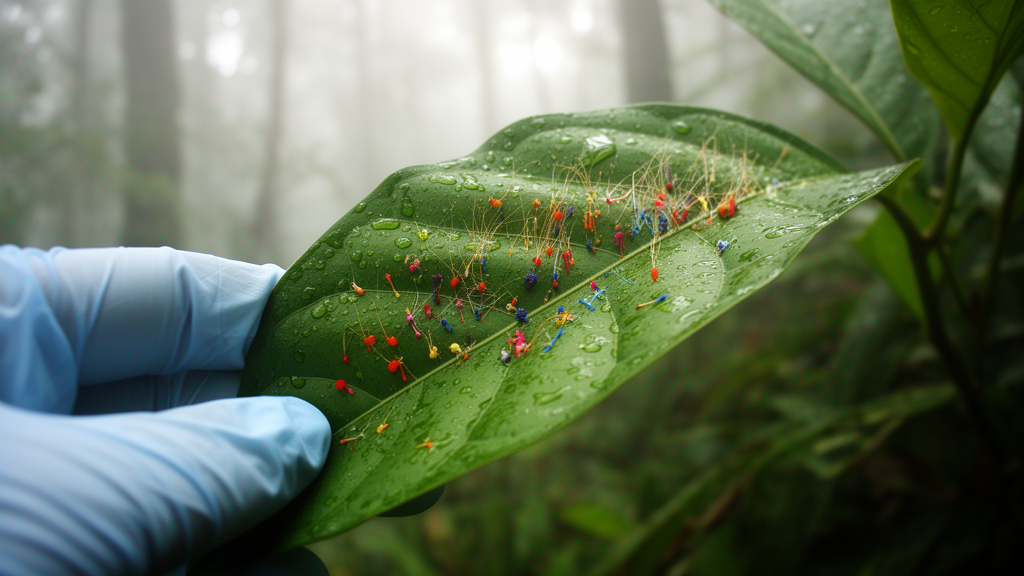
The fieldwork behind the discovery took place between October and December 2025, when the team collected symptomatic or rotted leaves from Artocarpus hainanensis in Hainan Province, Cinnamomum sp. in Fujian Province, Mallotus hookerianus in Hainan, and Trachelospermum jasminoides in Anhui Province. Back at the laboratory of Shandong Normal University, the researchers employed two complementary isolation techniques. For single-spore isolation, conidia were spread across water agar and incubated at 25 degrees Celsius, then individual germinating spores were picked with a sterile needle under a stereomicroscope and transferred to potato dextrose agar. For tissue isolation, five-millimeter squares of diseased leaf were surface-sterilized in 75 percent ethanol, treated with 5 percent sodium hypochlorite for thirty seconds, rinsed three times in sterile water, and pressed lesion-side down onto the same medium.
With pure cultures established, the team turned to the microscope. Colony morphologies were photographed on days 7 and 14 of incubation, and sporulating cultures were mounted in lactic acid-phenol solution for examination under an Olympus BX53 light microscope. Using image analysis software, the researchers measured at least 15 replicates of every microscopic feature, from conidiogenous cells to conidia. The results were strikingly consistent across all four isolates: flask-shaped, phialidic conidiogenous cells and thin-walled, aseptate, hyaline conidia with densely granular interiors and subtle flat basal scars. Yet each species showed its own measurable signature. Ps. artocarpi produces relatively small conidia of 12.4 to 20.0 by 7.3 to 9.8 micrometers and pycnidia with a pale yellowish-amber ostiolar disc, while Ps. cinnamomi yields the largest conidia of the group, up to 23.1 micrometers long, exuded from pale brown to dark brown fruiting bodies.
Morphology alone, however, was never going to settle the question of whether these isolates were genuinely new. The researchers therefore extracted genomic DNA using the CTAB protocol and amplified five genetic loci: the internal transcribed spacer region (ITS), the large ribosomal subunit (LSU), and the protein-coding genes RPB2, TEF1-alpha, and TUB2. These five markers were concatenated into a single alignment of 4,123 characters covering 90 taxa, including four species of the related genus Pyrispora as outgroups. Of those characters, 1,598 were parsimony-informative, providing ample signal for resolving evolutionary relationships. The matrix was aligned with MAFFT, refined manually in BioEdit, and subjected to both maximum likelihood analysis in RAxML with 1,000 bootstrap replicates and Bayesian inference run until split frequencies converged below 0.01.
The phylogenetic results were unambiguous. The 90 isolates resolved into 40 species-level lineages, and the eight new Chinese strains fell into four well-defined clades, each with maximal statistical support: maximum likelihood bootstrap values of at least 90 percent and Bayesian posterior probabilities of 1.0. Pairwise sequence comparisons drove the point home. Ps. artocarpi differs from its closest relative, Ps. quercus, at 1.06 percent of ITS positions, 1.72 percent of LSU positions, 2.47 percent of TEF1-alpha positions, and 1.34 percent of TUB2 positions. Even more dramatic, Ps. malloti diverges from its sister species Ps. engelhardiae by 7.52 percent at ITS and a remarkable 18.07 percent at TEF1-alpha, while Ps. trachelospermi differs from Ps. fagacearum by 19.82 percent at TEF1-alpha. In molecular terms, these are vast distances, comparable to differences between entire genera in other fungal groups.
Interestingly, the study also revealed the limits of individual genes. The RPB2 locus, often a workhorse in fungal phylogenetics, performed poorly here, failing to consistently separate closely related species with stable support, and was excluded from the primary species-delimitation framework. The ITS, TEF1-alpha, and TUB2 trees, by contrast, were highly congruent, and the more conserved LSU showed only minor local rearrangements. Crucially, none of the four new species shifted position among the single-gene trees; all were consistently nested within the main Pseudoplagiostoma clade and recovered as distinct lineages in the concatenated analysis. The analyses also confirmed that the new taxa belong firmly in Pseudoplagiostoma rather than the closely related genus Pyrispora, which is distinguished by aseptate ascospores and a lack of the thick-walled conidia typical of Pseudoplagiostoma.
The morphological contrasts that corroborate the molecular story are equally vivid. Ps. quercus produces thick-walled, multi-guttulate conidia that are slightly constricted at the middle and curved, with a prominent basal hilum; Ps. artocarpi’s conidia are thin-walled, granular, straight, and bear only an inconspicuous flat scar. Ps. engelhardiae forms wheel-shaped colonies and oblong-fusiform, sulcate conidia, whereas Ps. malloti grows irregularly and produces smooth, broadly oval spores. Ps. trachelospermi, isolated from star jasmine, stands out with pale amber to light brown pycnidia embedded in cottony white mycelium dotted with transparent vesicles, setting it apart from the black, leathery fruiting bodies of Ps. dipterocarpicola and the slimy black pycnidia of Ps. tonkinense. A newly constructed identification key covering the genus now guides mycologists through these characters step by step.
One important caveat tempers the excitement. Because no artificial inoculation assays were performed, the four isolates must be regarded as fungi associated with leaf-spot lesions rather than confirmed primary pathogens; they may turn out to be pathogens, opportunistic colonizers, or latent endophytes depending on host condition and environment. Likewise, while their subtropical origin hints at warm, humid preferences, the study did not test temperature-dependent growth, and extrapolations from the well-studied Ps. eucalypti, which grows best at around 25 to 26 degrees Celsius, remain speculative. The authors call for pathogenicity assays, cross-inoculation tests, growth experiments across temperature gradients, and multi-season field surveys to clarify the ecology of these newcomers. For now, the discovery stands as a vivid reminder that even in well-studied regions, the fungal world remains largely unmapped, and that the combination of patient fieldwork, careful microscopy, and multi-locus DNA sequencing continues to reveal species hiding in plain sight on ordinary leaves.
Subject of Research: Taxonomy and multi-locus phylogeny of four new Pseudoplagiostoma fungal species from diseased leaves in China
Article Title: Four new species of Pseudoplagiostoma ( Pseudoplagiostomataceae , Diaporthales ) based on morphology and multi-locus phylogeny from China
Article References: Sheng, J.-Y., Jiang, Y., Yan, X.-G., Wang, X.-S., Zhang, Y., Ai, C.-C., Zhang, X.-G., & Wang, S. (2026). Four new species of Pseudoplagiostoma (Pseudoplagiostomataceae, Diaporthales) based on morphology and multi-locus phylogeny from China. MycoKeys, 139, 251-276. https://doi.org/10.3897/mycokeys.139.207860
Image Credits: AI Generated
DOI: 10.3897/mycokeys.139.207860
Keywords: Pseudoplagiostoma, Diaporthales, fungal taxonomy, new species, phylogenetics, China, plant pathology, leaf spot fungi, ITS, TEF1-alpha, mycology, endophytes
News Source: Roger Howard. (October 17, 2026). Hidden in Plain Sight: Four New Fungal Species Uncovered on Chinese Leaves. Scienmag.