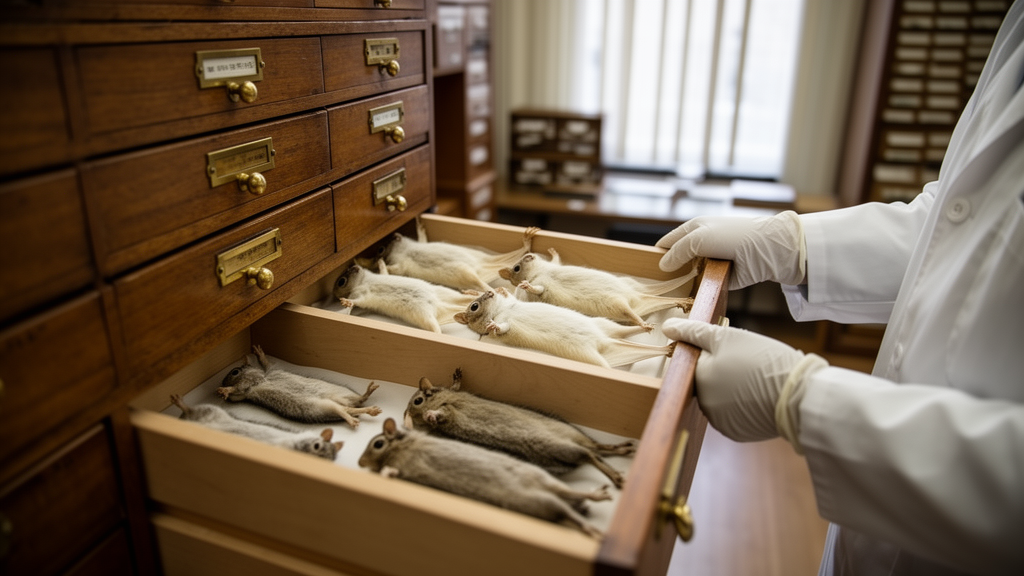
More than 800 museum specimens of North American flying squirrels have delivered a surprising verdict on one of ecology’s oldest rules. A team led by Tiffany A. Paalman analyzed 814 northern flying squirrels, 475 Humboldt’s flying squirrels, and 360 southern flying squirrels, drawing on collections spanning from 1871 to 2024. The specimens came from 30 natural history museums across the United States and Canada, including the Smithsonian National Museum of Natural History and the Museum of Vertebrate Zoology at Berkeley. The researchers set out to test whether these gliding mammals follow Bergmann’s rule and Allen’s rule, two classic ecogeographical patterns that describe how endothermic animals respond to climate across latitude.
Bergmann’s rule, formulated in 1847, holds that animals within a species tend to be larger in colder environments. Allen’s rule, proposed in 1877, predicts that appendages such as ears, tails, and limbs become shorter in colder climates to conserve body heat. Both patterns are widely attributed to thermoregulation: a larger, more compact body loses heat more slowly, while protruding appendages radiate warmth. These rules have broad support across birds and mammals, but the new study reveals that flying squirrels, with their unique gliding lifestyle, may play by a different set of biomechanical constraints.
The findings, published in Ecology and Evolution, show that the three species responded in strikingly different ways. The northern flying squirrel, which ranges across boreal forests from Alaska to the Appalachian Mountains, largely followed the overall pattern: body weight and length increased with latitude, consistent with Bergmann’s rule. Yet its ear length showed no relationship with latitude at all, and its tail actually grew longer toward the north, directly contradicting Allen’s rule. The Humboldt’s flying squirrel, found along the Pacific Coast, displayed the opposite of Bergmann’s rule, with body size weakly declining toward higher latitudes, though this trend was not statistically significant. Its ear length, however, did decrease with latitude, matching Allen’s prediction. The southern flying squirrel, occupying deciduous forests of eastern North America, showed almost no latitudinal trends in body size or ear length, but its tail grew significantly longer toward the north.
The most consistent and unexpected pattern across all three species was tail length. In every analysis, tails grew longer at higher latitudes, the precise opposite of what Allen’s rule predicts. The researchers argue that this discordance reflects the powerful influence of aerodynamic function over thermoregulatory adaptation. Thorington and Heaney previously demonstrated that tail length scales positively with body size across gliding squirrels, proposing that larger animals require longer tails to maneuver during flight. Because body size increases with latitude in these species, tail length may simply follow suit, driven by the demands of gliding rather than by cold climates.
Flying squirrels offer a particularly rigorous test of these rules because their patagium, the furry membrane stretching between forelimbs and hindlimbs, makes them obligate gliders. The tail acts as a stabilizer and brake during descent, and its dimensions are tightly linked to flight performance. The study suggests that within specialized locomotor guilds, functionally critical traits may respond more strongly to biomechanical demands than to ambient temperature. This finding reinforces that ecogeographical rules are not universal and that functionally constrained traits can exhibit latitudinal patterns that directly oppose thermoregulatory predictions.
The research also highlights the value of museum collections for testing ecological patterns across vast spatial and temporal scales. Because the specimens span more than 150 years, the morphological variation likely reflects not only spatial differences but also temporal changes driven by climate warming and habitat modification. Previous work has shown that anthropogenic climate change is altering body size and appendage morphology in mammals, and increasing habitat fragmentation has affected the distribution of flying squirrels in recent decades. The authors note that their dataset does not allow robust statistical analysis of temporal trends, but they suggest that investigating climate-driven morphological change over such a vast timescale would provide insight into microevolutionary dynamics under environmental change.
The study’s species-specific results underscore that ecogeographical patterns can vary dramatically even among closely related organisms occupying overlapping ranges. The northern flying squirrel, a boreal specialist, adhered most closely to the overall pattern, while the Pacific Coast Humboldt’s flying squirrel and the eastern southern flying squirrel each displayed unique combinations of adherence and opposition. This variation likely reflects differences in forest structure, gliding ecology, and evolutionary history among the three species. The authors emphasize that interpreting the negative relationship between latitude and body size in Humboldt’s flying squirrel requires caution because of its comparatively smaller sample size and more restricted geographic distribution.
The findings carry broader implications for understanding how animals will respond to rapid climate change. If functionally critical traits such as tail length are shaped more by locomotor demands than by temperature, then warming climates may not drive the morphological shifts that Allen’s rule would predict. Conversely, if body size follows Bergmann’s rule in some species but not others, the consequences of warming for thermoregulation and energy balance will vary among even closely related organisms. The authors argue that investigating both adherence to and exceptions from ecogeographical rules is critical to anticipating organismal responses in changing environments.
The research team included Joseph P. Morton and Cori Lopazanski, with supervision from faculty at Duke University. The work received no specific funding from public, commercial, or nonprofit agencies, with stipend support provided through Duke University. The authors declare no conflicts of interest. The full dataset, including specimen records from all contributing museums, is publicly available through the Duke Digital Repository and the GitHub repository of the lead author, allowing other researchers to build on this work and continue probing the boundaries of ecological rules in one of nature’s most remarkable mammalian lineages.
Subject of Research: Ecogeographical rule adherence in flying squirrels across latitudinal gradients
Article Title: Breaking the Rules: Museum Data Reveal Divergent Support for Classic Ecogeographical Rules in North American Flying Squirrels
Article References: Paalman, T. A., Morton, J. P., Lopazanski, C., Silliman, B. R., & Wolf, A. T. (2026). Breaking the Rules: Museum Data Reveal Divergent Support for Classic Ecogeographical Rules in North American Flying Squirrels. Ecology and Evolution, 16(10), Article e74470. https://doi.org/10.1002/ece3.74470
Image Credits: AI Generated
DOI: 10.1002/ece3.74470
Keywords: flying squirrels, Allen's rule, Bergmann's rule, museum specimens, latitudinal gradients, thermoregulation, gliding biomechanics, tail length, ecogeography, climate change, Breaking, Rules
News Source: Drew Townsend. (October 17, 2026). Museum Specimens Reveal Flying Squirrels Break Allen’s Ecogeographical Rule. Scienmag.