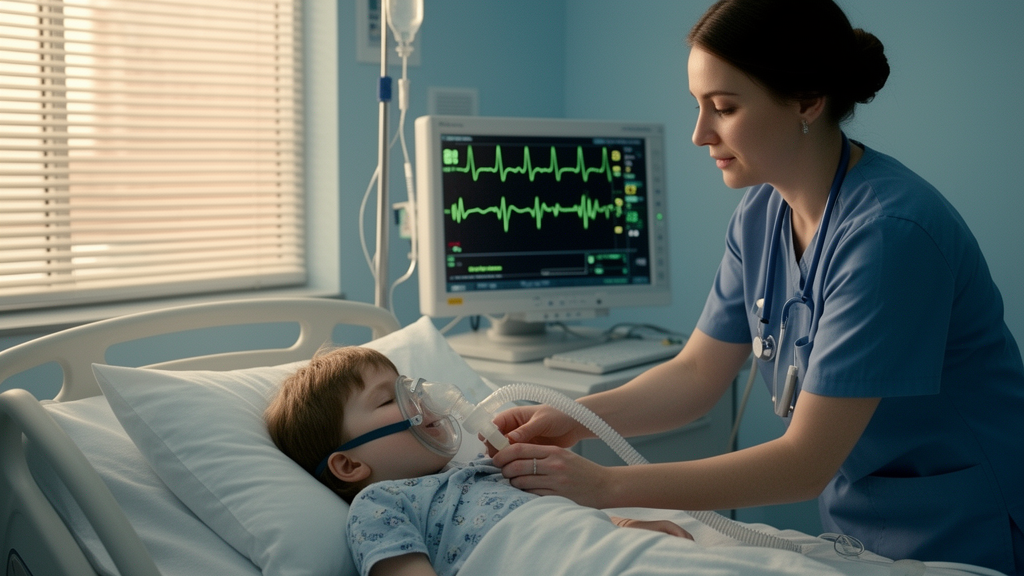
When a two-year-old girl arrived at the pediatric intensive care unit of Beatrix Children’s Hospital in Groningen, Netherlands, in acute respiratory failure, her medical team faced a diagnostic puzzle. She had a one-week history of progressive fatigue and cold-like symptoms, yet infection markers were low and cultures came back negative. A spontaneous breathing trial on day two failed unexpectedly, revealing respiratory muscle weakness no one had anticipated. What followed was a carefully documented case in which a bedside electrical signal from the diaphragm helped clinicians track recovery and successfully wean the child from mechanical ventilation.
The case, published in the journal Frontiers in Pediatrics by pediatric intensivists Braamskamp, Koopman, and Kneyberg of University Medical Center Groningen, centered on a monitoring technology known as electrical activity of the diaphragm, or EAdi. This signal is captured through a specialized feeding tube fitted with electrodes that rest against the diaphragm, providing a continuous, real-time measure of diaphragmatic activation. Unlike airway pressures or tidal volumes, which reflect the combined output of ventilator and patient, EAdi isolates the patient’s own neural drive to breathe.
Retrospective history-taking after the failed breathing trial proved decisive. The girl’s parents recalled a gradual onset of drooping eyelids, bulbar symptoms such as difficulty chewing, and fatigability during exertion over preceding weeks. Single-fiber electromyography supported a diagnosis of a neuromuscular transmission disorder. Initial antibody testing for acetylcholine receptors was negative, leaving the team to weigh the possibilities of seronegative myasthenia gravis or a congenital myasthenic syndrome, two conditions with overlapping presentations but different treatment responses.
Structured respiratory monitoring began sixty hours before treatment initiation. At that point, the child was ventilated with pressure control set at fourteen centimeters of water, positive end-expiratory pressure at five, and her tidal volume measured 5.97 milliliters per kilogram. Her EAdi signal was persistently low, consistent with severe respiratory muscle weakness. Pyrigros was started, and thirty-six hours later the dose was increased after early clinical improvement became apparent.
Over the following one hundred twenty hours, the numbers told a striking story. Median EAdi rose from 1.69 microvolts in the six hours before treatment to 7.7 microvolts in the final six hours before extubation, a more than fourfold increase. Simultaneously, ventilator settings were reduced to pressure control of ten centimeters of water, and the child maintained adequate ventilation. The team calculated a tidal volume to EAdi ratio, which declined over the treatment period, suggesting a shift in the relative contribution of ventilator support versus patient effort. Five days after treatment initiation, the girl was successfully extubated without additional respiratory support.
The trajectory of the EAdi signal appeared to capture recovery of neuromuscular transmission before it became visible in standard ventilator variables. This distinction matters clinically because it suggests the signal reflected a genuine pharmacological treatment effect rather than a change driven by ventilator settings alone. The finding aligns with prior reports. A 2017 case study in the Journal of Critical Care found EAdi more informative than maximal inspiratory pressure in tracking improvement in a patient with myasthenic weakness, while subsequent work has described how diaphragm function assessment, including the EAdi-peak to tidal volume ratio, can characterize respiratory muscle efficiency during spontaneous breathing trials and guide weaning decisions.
Follow-up ultimately clarified the underlying diagnosis. Six months after admission, repeat testing showed positive acetylcholine receptor antibodies, confirming juvenile myasthenia gravis rather than a congenital myasthenic syndrome. The distinction is significant because the two conditions differ in mechanism and long-term management. At twelve-month follow-up, the child remained clinically stable with only mild residual ptosis, no hospital readmissions, and no recurrent respiratory failure.
The authors emphasize that the case has clear limitations. Reference values for EAdi in healthy children are not established, and the ratio of tidal volume to EAdi could not be robustly interpreted because ventilator settings were intentionally changed during the observation period. EAdi should be interpreted in light of sedation, comfort, disease evolution, and concurrent ventilator adjustments rather than as a standalone marker of extubation readiness.
Even with those caveats, the case adds to a growing literature suggesting that EAdi can serve as a complementary monitoring tool in children with suspected neuromuscular respiratory compromise. The signal provided bedside information on diaphragmatic activation that airway pressure and tidal volume alone could not capture, and it appeared to track the pharmacological reversal of weakness in real time. For intensivists managing ventilated children with unexplained weakness, the case suggests that a diaphragm electrical signal may deserve a place alongside conventional ventilator variables when weighing extubation decisions.
Myasthenic disorders occupy a challenging corner of pediatric critical care because their respiratory consequences can outpace recognition of the underlying condition. In children, the neuromuscular junction is still maturing, and the clinical signs of impaired signal transmission—drooping eyelids, difficulty chewing or swallowing, and fatigue that worsens with activity—can be subtle or attributed to more common childhood illnesses. In this case, the child’s two-month history of ptosis had been compensated by head tilting and eyebrow raising, adaptations that a family may not recognize as symptoms of disease. Only when a respiratory infection added load to already weakened respiratory muscles did the compensation collapse, producing hypercapnic failure severe enough to require emergency intubation.
The diagnostic pathway in such cases is rarely straightforward. Antibody testing for acetylcholine receptors and for anti-muscle-specific kinase antibodies, the two most common serological markers of myasthenia gravis, returned negative results during the intensive care stay. Seronegative presentations are well documented, particularly in early-onset disease, and congenital myasthenic syndromes—genetic defects in the machinery of neuromuscular transmission—can mimic the autoimmune form closely. This diagnostic uncertainty has practical consequences: pyridostigmine, an acetylcholinesterase inhibitor that prolongs the presence of acetylcholine at the synaptic cleft, is the mainstay of symptomatic treatment for myasthenia gravis but may be less effective or even counterproductive in some congenital subtypes. The decision to start the drug was therefore a therapeutic trial in the truest sense, and the clinical response carried diagnostic weight.
It is precisely in this ambiguous setting that the EAdi signal proved its worth. Because the electrode catheter sits in the esophagus at the level of the diaphragm, it records the compound electrical potential of the crural diaphragm each time the brain recruits the muscle. When neuromuscular transmission is impaired, the diaphragm’s electrical output falls even if the central respiratory drive is intact, and the ventilator must assume most of the work of breathing. As pyridostigmine restored transmission, the same neural drive produced progressively larger electrical signals, and the ventilator could be dialed back in step. The fourfold rise in median EAdi over five days, occurring while support was reduced rather than increased, gave the team a quantitative argument that the child’s own respiratory pump was recovering.
The timing of the signal changes deserves emphasis. Conventional ventilator variables such as peak inspiratory pressure and tidal volume are confounded by every adjustment the clinician makes; when pressure support falls and tidal volume is maintained, that may reflect either improving patient effort or simply the machine compensating differently. EAdi, by contrast, is generated entirely by the patient, though it remains sensitive to sedation levels, patient-ventilator asynchrony, and catheter position. The authors note that the ratio of tidal volume to EAdi—a rough index of muscular efficiency—declined during treatment, consistent with the diaphragm becoming more effective at converting electrical activation into airflow. Such ratios have been studied in adult weaning research, where a high ratio suggests weak conversion of drive into ventilation, but pediatric reference values remain undefined.
The eventual seroconversion observed at follow-up adds an instructive epilogue. Repeat acetylcholine receptor antibody testing turned positive months after the initial negative result, a pattern that can occur when antibody titers fluctuate with disease activity or when testing is performed early in the immune response. The confirmed diagnosis of early-onset myasthenia gravis, rather than a congenital myasthenic syndrome, validated the treatment choice and shaped long-term management, which in this child consisted of continued oral pyridostigmine with outpatient neurological follow-up and no further respiratory episodes through twelve months.
For the wider pediatric critical care community, the case sits within a broader movement toward monitoring the respiratory muscles directly rather than inferring their state from gas exchange and ventilator waveforms. Diaphragmatic ultrasound, transdiaphragmatic pressure measurement, and phrenic nerve stimulation each offer complementary windows on respiratory muscle function, but few are as well suited to continuous bedside use as the EAdi catheter, which is already embedded in neurally adjusted ventilatory assist modes used in some intensive care units. What this report adds is a demonstration, in a single well-documented child, that the signal can serve as a treatment-response marker in neuromuscular disease, not merely as a weaning aid in ordinary respiratory failure. Whether EAdi-guided weaning improves outcomes in pediatric myasthenic disorders will require systematic study, but the case establishes a plausible physiological foundation for such trials and offers clinicians facing similar diagnostic uncertainty a monitoring strategy that made the invisible process of neuromuscular recovery visible at the bedside.
Subject of Research: Use of electrical activity of the diaphragm monitoring to guide ventilator weaning in a child with myasthenia gravis
Article Title: Case Report: EAdi-guided ventilatory management leads to successful extubation in a pediatric myasthenic disorder
Article References: Braamskamp, M. J. A. M., Koopman, A. A., & Kneyber, M. C. J. (2026). Case Report: EAdi-guided ventilatory management leads to successful extubation in a pediatric myasthenic disorder. Frontiers in Pediatrics, 14, Article 1893086. https://doi.org/10.3389/fped.2026.1893086
Image Credits: AI Generated
DOI: 10.3389/fped.2026.1893086
Keywords: EAdi, diaphragm monitoring, mechanical ventilation, myasthenia gravis, pediatric intensive care, ventilator weaning, neuromuscular disorder, pyridostigmine, Case, Report, EAdi-guided, ventilatory
News Source: Ophelia Keating. (October 17, 2026). EAdi Monitoring Guides Ventilator Weaning in Child With Myasthenic Disorder. Scienmag.