In the lowland rainforests of French Guiana, a small golden-eyed treefrog has just changed how scientists can study it. A three-year capture-recapture study published in the journal Herpetozoa demonstrates that the iris patterns of the Neotropical hylid treefrog Osteocephalus oophagus are distinctive enough to serve as natural biometric signatures, allowing researchers to identify individual frogs from eye photographs alone. The finding matters because reliable individual identification is the backbone of ecological and behavioural research, yet the marking techniques traditionally used in amphibian studies are often invasive and may compromise the very animals scientists are trying to understand.
For decades, researchers studying amphibian populations have faced an uncomfortable trade-off. Estimating survival, population size, and life-history traits through capture-recapture analyses requires recognising the same individual across repeated encounters. In large mammals, genetic identification from faecal samples can accomplish this with minimal disturbance. In amphibians, however, the standard approach has long been toe clipping, the surgical removal of one or more toes to create a permanent marking code. Studies cited by the research team show that toe clipping can affect survival, physiology, and behaviour in frogs, undermining both animal welfare and the integrity of the data collected. Biometric techniques, which identify individuals using measurable phenotypic features, offer a promising alternative, but they depend on finding a trait that is both unique to each individual and stable over time.
Animal biometrics has an impressive track record across the tree of life. Eyespots on butterfly wings, injury marks in white sharks, stripe arrangements in zebras and tigers, and even nose prints in cattle have all been used to distinguish individuals without handling. In amphibians, photographic identification based on skin patterns has been applied successfully in many species. The problem is that this approach fails entirely for species in which some or all individuals lack distinct dorsal markings, and Osteocephalus oophagus is precisely such a species. Although the frog exhibits some dorsal patterns, these are often very limited, inconsistently present across individuals, or restricted to specific body regions, making systematic comparisons difficult.
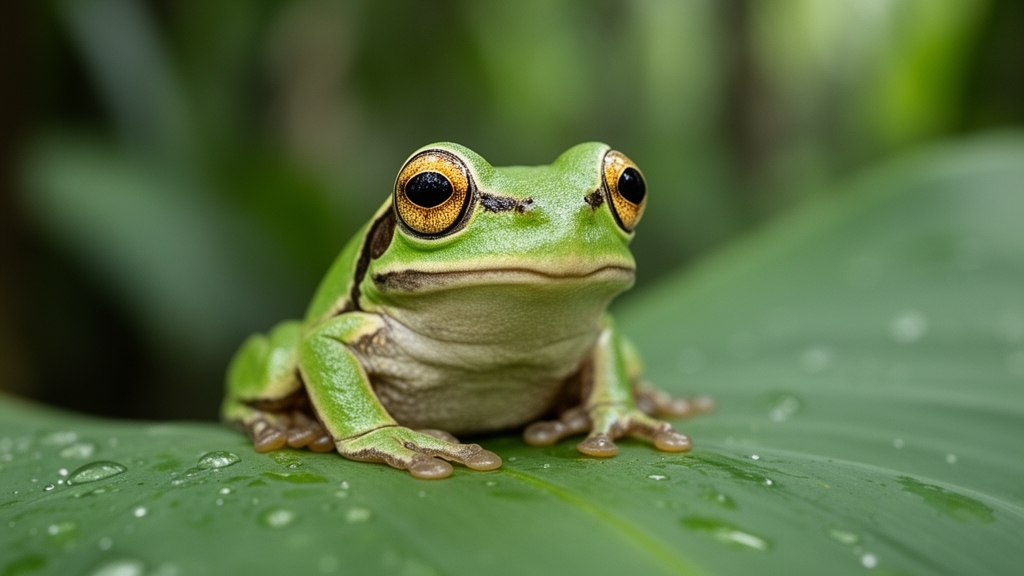
The eyes, however, told a different story. Osteocephalus oophagus possesses complex golden irises crossed by thin, black, radial lines around the pupil, whose arrangement appears to create a unique, fingerprint-like pattern in each individual. Iris recognition was originally developed for human identification, where iris texture is sufficiently complex to serve as a lifelong biometric signature, and it has since been tested in geckos, cattle, goats, and tigers. A recent study even demonstrated that iris characteristics can be used to distinguish amphibian species. What had never been tested before was whether iris patterns could identify individual frogs, and whether those patterns remain stable across encounters.
To answer these questions, the research team conducted a capture-recapture study on an approximately five-hectare river island in lowland rainforest within the Les Nouragues nature reserve in French Guiana, near the Saut Pararé field camp of the CNRS Nouragues Ecological Research Station. The study ran during the rainy seasons of March through May in 2021, 2022, and 2023. Sampling focused on an array of 39 artificial pool sites spaced every 20 metres along the trails covering the island, each consisting of three flower pots of different capacities, 0.1 litres, 0.3 litres, and 1 litre, installed at a height of 130 centimetres to mimic the natural breeding pools used by treefrogs. Natural breeding sites such as tree hollows were also surveyed throughout the island.
The field protocol was designed to minimise disturbance from the very first encounter. Frogs were systematically searched for in and around artificial and natural pools between 18:40 and 02:00, with the aim of sampling all adult males and females present on the island during each study period. Upon first capture, a frog was caught by hand and photographed with Olympus TG-620 and TG-630 cameras, including both eyes, the dorsal and ventral sides, and the hind legs, before being released at the capture site. The eye photographs were later cropped to isolate the iris and compiled into a reference library on rugged Windows 10 tablets carried into the field. During subsequent encounters, both eyes were photographed without any direct contact. If the frog could be identified using the reference library on the tablet, it was left undisturbed entirely. Only frogs that could not be matched were processed following the first-encounter protocol. Notably, frogs encountered in amplexus typically resumed mating within an hour, and eye photographs could be obtained while frogs perched on natural structures, whether alone or paired.
Manual in-field identifications were independently verified using Wild-ID 1.0.0, a pattern-matching software originally developed for photographic identification in wildlife studies. The software was run twice, once using only left-eye images and once using only right-eye images, allowing each iris pattern to serve as its own independent verification. The results were striking. Over the three study seasons, 103 individuals were sampled across 392 capture events: 128 captures in 2021, 217 in 2022, and 47 in 2023. For most identifications, a single eye was sufficient to reliably identify the individual, with the second eye serving only as confirmation. Iris patterns proved highly distinctive among individuals, and the diversity of patterns across the sampled population was visually unmistakable.
Within-season recapture rates demonstrated that iris patterns remain sufficiently stable for short-term monitoring. In 2021, the study area was sampled for 22 days and 24 individuals were encountered, of which 16, or 66.7 percent, were recaptured during the same season, with individuals captured an average of 5.8 plus or minus 5.3 times. In 2022, after 24 days of sampling, 59 individuals were encountered and 47, or 79.7 percent, were recaptured within the season, averaging 9.0 plus or minus 6.2 captures per individual. In 2023, 17 days of sampling yielded 23 individuals, none of which had been captured during the previous two years, and 13 of them, or 56.5 percent, were recaptured within the season. Across all three years, more than half of the identified individuals were consistently re-identified based on their iris patterns, indicating that these patterns do not change appreciably over the course of a breeding season.
The long-term picture was more complicated. Only three individuals first captured in 2021 were recaptured in 2022, and none of the 23 individuals encountered in 2023 had been captured during the previous two years. Because no additional marking or identification technique was used, the researchers could not determine whether previously identified frogs remained in the population but were no longer identifiable, or whether they were genuinely absent. The three cross-year recaptures showed no substantial alteration in their iris patterns, and identification within and across seasons was generally unambiguous. The team therefore interprets the scarcity of interannual recaptures as more likely reflecting population turnover and emigration than changes in iris morphology rendering individuals unidentifiable. Evidence from other poikilothermic vertebrates is mixed on this point: iris patterns in Atlantic salmon remain stable only over several months, whereas long-term stability has been demonstrated in geckos. Comparable data for amphibians are lacking, and human iris patterns are known to remain stable throughout life.
The study concludes that iris patterns in Osteocephalus oophagus are individually distinct and enable reliable short-term individual identification, and the authors recommend the approach as a non-invasive method for individual recognition within a single reproductive season. The method is readily compatible with ethical research guidelines such as the 3Rs, reducing the need for repeated handling of study animals. Further research is needed to evaluate the potential of iris patterns for long-term identification, ideally through studies on captive individuals or field studies combining iris photography with an independent identification method such as genetic identification or permanent marking. The approach may also extend to other anuran species with complex irises, including Osteocephalus taurinus, Hyloscirtus tigrinus, Trachycephalus resinifictrix, and Sachatamia ilex, though the authors caution that suitability will vary among species. Highly complex iris patterns may hinder rapid field identification, as potentially occurs in Trachycephalus hadroceps, whereas uniform or patternless irises may provide insufficient interindividual variation, as potentially observed in the red-eyed treefrog Agalychnis callidryas. The reliability of iris patterns for individual re-identification should therefore be evaluated species by species before the method is applied more broadly. If those evaluations succeed, iris pattern identification could become a powerful, non-invasive tool for rapid field-based individual recognition, opening new opportunities for individual-level studies in amphibians while keeping the frogs themselves untouched.
Subject of Research: Iris pattern recognition as a non-invasive method for individual identification in the treefrog Osteocephalus oophagus
Article Title: Iris pattern recognition as a non-invasive method for individual identification in Osteocephalus oophagus ( Hylidae )
Article References: Bégué, L., Petel, F., Premel, V., Raboisson, G., Ringler, E., Ringler, M., Toszeghi, M., Vacher, V., & Peignier, M. (2026). Iris pattern recognition as a non-invasive method for individual identification in Osteocephalus oophagus (Hylidae). Herpetozoa, 39, 381-387. https://doi.org/10.3897/herpetozoa.39.e208000
Image Credits: AI Generated
DOI: 10.3897/herpetozoa.39.e208000
Keywords: iris recognition, Osteocephalus oophagus, amphibian biometrics, capture-recapture, non-invasive identification, French Guiana, treefrog, Wild-ID, animal welfare, herpetology, Iris, pattern
News Source: Margaret Porter. (October 17, 2026). Frog eyes become fingerprints: iris patterns identify treefrogs without ever touching them. Scienmag.