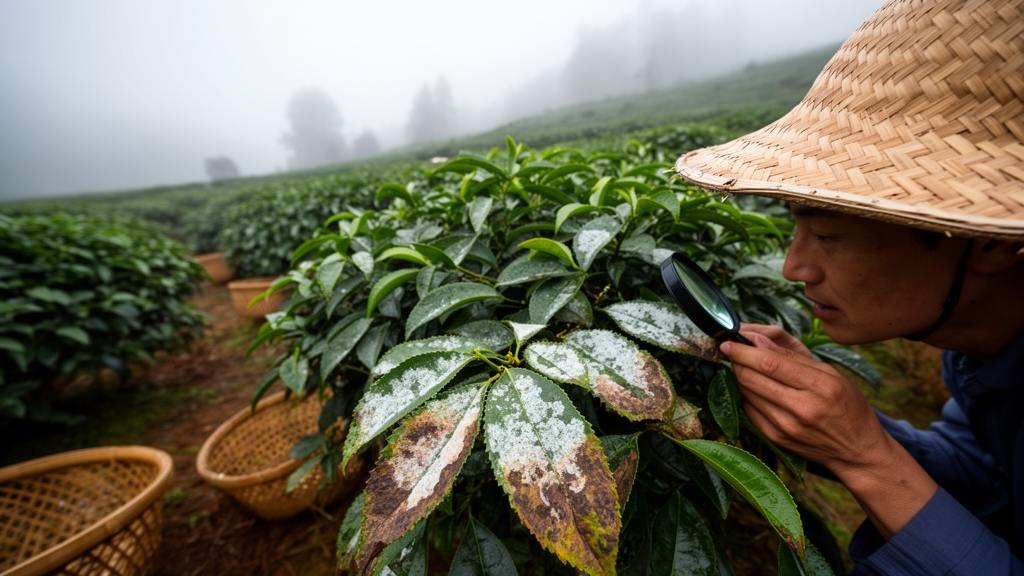
In the misty mountain plantations of Enshi Tujia and Miao Autonomous Prefecture in Hubei Province, China, the vine tea plant Nekemias grossedentata (syn. Ampelopsis grossedentata) has long been prized as both an edible and medicinal crop. Its leaves, processed into Enshi Vine Tea, are one of China’s National Geographical Indication Products, and the plant is the leading agricultural product of the prefecture. But in 2025, a severe foliar disease swept through cultivated vine tea fields, prompting a team of Chinese mycologists to launch an investigation that would ultimately reveal three fungal species entirely new to science.
The research, published in MycoKeys, isolated pathogenic fungi from diseased leaves collected across multiple sites in Enshi Prefecture at approximately 575 metres above sea level. A total of 83 samples with clear disease symptoms were obtained and transported to the laboratory, where tissue segments containing both necrotic and healthy tissue were excised, surface-sterilised in 75% ethanol and 2% sodium hypochlorite, and cultured on potato dextrose agar. From these, 116 pure cultures were preserved and deposited in the Yangtze University Fungal Herbarium in Jingzhou, Hubei. The team then set out to determine exactly what these organisms were using a modern integrative taxonomic framework.
Fungal taxonomy has evolved dramatically from its early reliance on conidial phenotypic characters alone. High morphological similarity amongst species makes accurate identification based solely on phenotype challenging, and DNA sequence-based phylogeny has become the core approach, using standardised genus-specific multi-locus barcodes. For Coniella, the researchers sequenced ITS, LSU, RPB2 and TEF1; for Colletotrichum, ITS, CHS, ACT, CAL and TUB2; and for Pestalotiopsis, ITS, TEF1 and TUB2. Genomic DNA was extracted from fresh mycelia using the CTAB method, PCR amplifications were performed in 25 microlitre reaction volumes, and products were bidirectionally Sanger-sequenced. Yet even concatenated tree topologies have inherent limitations and a non-negligible risk of false positives, so the team went further, combining phylogenetic networks, SNP-based PCA and gene flow detection with cross-validation of GCPSR, DBSR and CBSR species recognition criteria.
The phylogenetic results were striking. For Coniella, a dataset of 2793 aligned characters revealed that four strains formed a distinct monophyletic clade as a sister group to C. castanea, with highly supported Maximum Likelihood bootstrap and Bayesian posterior probability values of 100/1.0 and no internal reticulate branches in phylogenetic networks. For Colletotrichum, 2344 aligned characters showed that two strains formed a distinct monophyletic clade within the Colletotrichum gloeosporioides species complex as a sister to Col. fructicola and Col. mengyinense. For Pestalotiopsis, 1276 characters placed two strains in the Pestalotiopsis rosea species complex as a stable independent clade closely related to P. rhodomyrti. All analyses consistently resolved the three species as independent taxa with highly-supported evolutionary lineages, distinct genetic clustering and significant nucleotide divergence.
Species delimitation was carried out using a hierarchical decision framework. Genealogical Concordance Phylogenetic Species Recognition evaluated topological congruence across individual single-gene genealogies, with recombination events assessed via the Pairwise Homoplasy Index test. Concordance-Based Species Recognition used Poisson Tree Processes and Bayesian PTP analyses running for one million MCMC generations, while Distance-Based Species Recognition applied Automatic Barcode Gap Discovery and Assemble Species by Automatic Partitioning under the K2-P model. A species boundary was formally accepted if corroborated by at least three independent delimitation methods. Notably, single-locus distance-based methods showed limited resolution in some cases; ABGD for LSU merged the Coniella target isolates with close congeners, and ASAP analyses failed to resolve boundaries within the Pestalotiopsis complex, highlighting the varying evolutionary resolution of individual barcode markers and the high sequence conservation within these genera.
SNP-based principal component analysis provided fine-scale genetic differentiation. SNPs were extracted from the concatenated multi-locus alignments using SNP-sites, and PCA conducted in R consistently revealed significant genetic differentiation between the present strains and their closely-related species. All tested strains formed distinct, well-separated clusters in PCA plots, fully concordant with the multi-locus phylogenetic and species delimitation results. This convergence of evidence across morphology, phylogeny, coalescent algorithms and genomic SNP data unambiguously validated three novel species: Coniella ampelopsidis, Colletotrichum enshiense and Pestalotiopsis ampelopsidis.
Morphologically, each species carries diagnostic characters. Coniella ampelopsidis produces hyaline, leguminiform to oblong conidia averaging 17.28 × 2.32 micrometres with a remarkably high length/width ratio of 7.54, clearly distinguishing it from C. castanea and C. quercicola. Colletotrichum enshiense, placed within the C. gloeosporioides species complex, is readily distinguished by its remarkably small, compact, ellipsoidal to ovoid conidia averaging 5.15 × 3.04 micrometres, far smaller than the elongated cylindrical conidia exceeding 11 micrometres typical of Col. fructicola. Pestalotiopsis ampelopsidis produces fusiform conidia with 3–4 septa averaging 22.50 × 6.22 micrometres, with barrel-shaped, verrucose, uniformly brown median cells and 2–3 apical tubular appendages, a unique combination separating it from P. rhodomyrti, P. oryzae, P. trachycarpicola and P. guiyangensis.
Pathogenicity assays fulfilled Koch’s postulates for all three species, confirming them as causal agents of leaf disease. Plants were acclimatised in a greenhouse at 25 °C with a 12-hour photoperiod, and living leaves were inoculated with 7-day-old mycelial plugs under high humidity exceeding 85%. Coniella ampelopsidis exhibited the strongest virulence, causing irregular yellowish-brown lesions with an average diameter of 20.8 ± 0.32 millimetres that spread rapidly and resulted in leaf necrosis. Pestalotiopsis ampelopsidis and Colletotrichum enshiense induced distinct leaf spot symptoms with average lesion diameters of 9.8 ± 0.10 and 10.2 ± 0.17 millimetres respectively, with no significant difference in virulence between them. Lesion area differences amongst strains were compared using one-way ANOVA and Tukey’s HSD post hoc test, and the pathogenicity was confirmed by re-isolation and ITS sequencing.
The phylogenetic patterns help clarify the evolutionary origins of these foliar pathogens. The closest relatives of Coniella ampelopsidis are primary pathogens on Fagaceae hosts, and as Fagaceae species form the dominant forest canopy in the mountainous ecosystems of Enshi Prefecture, spatial overlap and shared microclimates between oak forests and vine tea plantations likely facilitated ecological contact. In phytopathogenic fungi, sympatric proximity frequently provides opportunities for host jumping or host shifts, driving adaptive divergence and speciation. Similarly, Colletotrichum enshiense and Pestalotiopsis ampelopsidis are sister to broad-host-range pathogens, suggesting that ecological spill-over and host adaptation may have driven their lineage separation. Notably, this is the first formal report of a Pestalotiopsis species infecting plants from the genus Ampelopsis, expanding the known host range of the genus.
From an epidemiological perspective, the plausible origin via cross-host transmission from surrounding forest vegetation indicates that integrated disease management of vine tea should extend beyond field sanitation to incorporate surveillance of adjacent wild vegetation. The study enriches the inventory of foliar fungal pathogens infecting Nekemias grossedentata, which previously documented only four species, and demonstrates the effectiveness of an integrative taxonomic framework in resolving cryptic fungal pathogens on economic crops. Three phylogenetically distant fungal pathogens from three distinct orders co-occurring on a single host is a remarkable finding, and the scientific foundation it provides for regional disease monitoring and integrated management of vine tea may prove critical as this valuable medicinal crop faces mounting pressure from fungal disease.
,
Subject of Research: Taxonomy and pathogenicity of three novel foliar fungal pathogens on Nekemias grossedentata in China
Article Title: Integrative taxonomy reveals three novel pathogens belonging to Coniella , Colletotrichum and Pestalotiopsis on Nekemias grossedentata in China
Article References: Chen, S.-Q., Zhou, X.-T., Mou, X., Zhou, S.-X., Deng, Q., Deng, J.-X., Luo, H., Chen, Q.-H., Liu, H.-F., & Zhang, C.-Y. (2026). Integrative taxonomy reveals three novel pathogens belonging to Coniella, Colletotrichum and Pestalotiopsis on Nekemias grossedentata in China. MycoKeys, 140, 49-77. https://doi.org/10.3897/mycokeys.140.200783
Image Credits: AI Generated
DOI: 10.3897/mycokeys.140.200783
Keywords: mycology, plant pathology, fungi, integrative taxonomy, phylogenetics, agriculture, Integrative, taxonomy, reveals, three, novel, pathogens
News Source: Alan Morgan. (October 17, 2026). Three New Fungal Pathogens Threaten China’s Medicinal Vine Tea Crop. Scienmag.