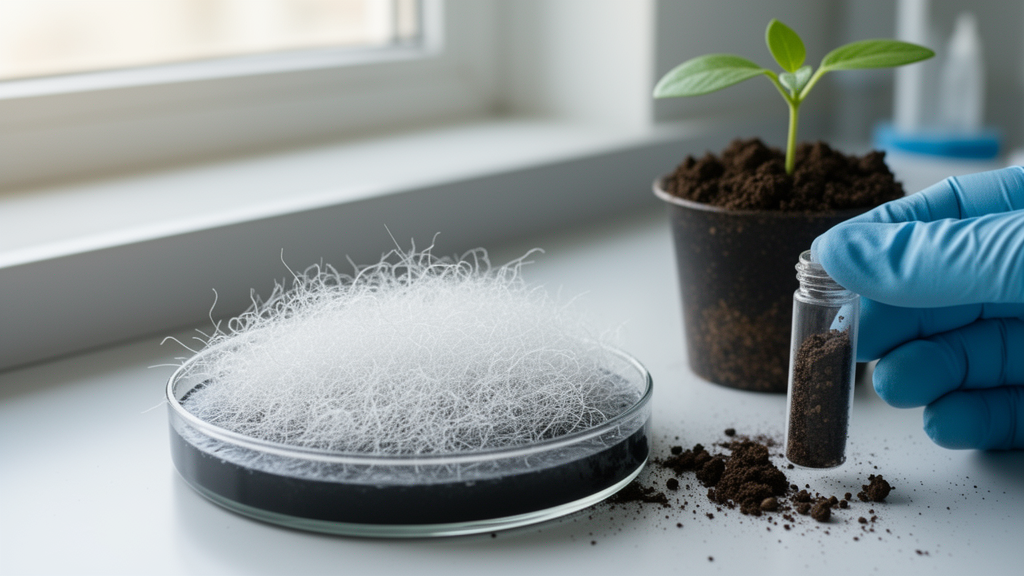
Deep in the soil, a little-known fungus is quietly doing the work of a fertilizer factory, a pesticide plant, and a cleanup crew all at once. The genus Gongronella, a member of the ancient fungal lineage Mucoromycota, has spent decades in the shadow of famous plant partners such as arbuscular mycorrhizal fungi and Trichoderma. Now a comprehensive review published in IMA Fungus argues that this overlooked genus deserves a starring role in sustainable agriculture, thanks to its remarkable ability to colonize plant roots, unlock soil nutrients, suppress pathogens, and even degrade plastics and pesticides.
The story of Gongronella begins nearly a century ago, on the Malay Peninsula, where the first known species was recovered from the roots of coconut palm. Originally described in 1926 under the genus Absidia, the fungus was later recognized as distinct enough to warrant its own genus, and taxonomists have shuffled its placement several times since. Modern molecular tools eventually settled the matter: analyses of ribosomal DNA sequences placed Gongronella squarely within the family Cunninghamellaceae, in the order Mucorales of the subphylum Mucoromycotina. This lineage is far from obscure in evolutionary terms. Mucoromycotina fungi are among the earliest fungal partners of land plants, with fossil and molecular evidence indicating that they formed mutualistic associations with the first plants to colonize terrestrial environments hundreds of millions of years ago, supplying them with phosphorus and nitrogen in exchange for carbon.
To sharpen the evolutionary picture, the authors of the review reconstructed a phylogenomic tree using the Universal Fungal Core Genes pipeline, extracting 58 shared marker genes from 38 genomes and concatenating nearly 35,000 amino acid positions for maximum-likelihood inference. The analysis, rooted with the outgroup Mortierella polycephala, confirmed the close relationship between Gongronella and two Absidia species within Cunninghamellaceae. Notably, only two strains of Gongronella butleri currently have publicly available genome sequences, a stark reminder of how little genomic attention this genus has received compared with agricultural workhorses like Trichoderma or the arbuscular mycorrhizal fungi. The genus itself is evolutionarily young by fungal standards, having diverged roughly 23 million years ago, yet it has already spread across a striking range of habitats, a testament to its physiological flexibility.
One of the most revealing findings from the phylogenomic analysis concerns sucrose metabolism. Sugar transporters of the SUT family are found throughout Mucoromycotina, but the invertase genes of glycoside hydrolase family 32, which cleave sucrose into its component sugars, show a patchy distribution. They are retained in Cunninghamellaceae, Umbelopsidaceae, Lichtheimiaceae, Phycomycetaceae, and Backusellaceae, but lost in Mucoraceae, Chaetocladiaceae, Choanephoraceae, Mycotyphaceae, Rhizopodaceae, and Endogonaceae. This pattern echoes earlier work suggesting that GH32 genes were present in the common ancestor of zygomycete fungi but were repeatedly lost as lineages diversified. The functional consequence is significant: in Mucoromycota fungi lacking invertase activity, direct utilization of sucrose becomes impossible, and the fungus must depend on host-mediated hydrolysis to access monosaccharides. Gongronella butleri strain w5, which carries both SUT and GH32 genes, has been experimentally shown to use sucrose directly, making it one of the few taxa in the analysis with a validated carbon assimilation phenotype.
This biochemical capability has ecological implications. Sucrose is the dominant carbon currency that plants export to their root zones, and a fungus that can independently cleave and absorb it gains a degree of independence from host processing. For a root-colonizing symbiont, that autonomy could influence the balance of the partnership, potentially allowing Gongronella to establish itself in the rhizosphere with less immediate demand on plant photosynthate. The authors caution, however, that most taxa in their phylogeny lack experimental phenotypic data, so the association between gene presence and sucrose utilization remains an inference for many lineages. The case of G. butleri w5 demonstrates what careful physiological validation can add to genomic annotation, and it highlights a broader gap in fungal biology: genome sequences are accumulating far faster than the laboratory studies needed to interpret them.
Morphologically, Gongronella is distinguished by a swollen apophysis at the tips of its sporangiophores, along with transparent to pigmented, highly branched hyphae and rhizoids that grow slowly on culture media. These unassuming traits explain in part why the genus has been easy to overlook. But one of its most intriguing features is invisible to casual observation: certain strains, including G. butleri w5, harbor large communities of endohyphal bacteria living within their hyphae. The review describes how researchers used live-dead fluorescent staining to visualize these DNA-containing bacterial cells inside fungal structures, taking care to confirm fungal viability and hyphal integrity with independent stains so that the bacterial signals could not be dismissed as artifacts.
Endohyphal bacteria are increasingly recognized as hidden architects of fungal ecology. In other systems, bacterial symbionts living inside fungi have been shown to modulate host metabolism, enhance nutrient acquisition, produce bioactive compounds, and even determine whether a fungus behaves as a pathogen or a mutualist. The presence of such bacteria in Gongronella raises the possibility that some of the plant growth-promoting effects attributed to the fungus may actually be delivered by its bacterial passengers, or by the combined metabolic activity of the consortium. The review notes that Gongronella can secrete soil enzymes directly or recruit functional bacterial partners to cooperatively decompose urea and organic phosphorus, two of the most important nutrient pools in agricultural soils. This division of labor between fungus and bacteria is an emerging theme in rhizosphere biology and may prove central to understanding how Gongronella achieves its nutrient-mobilizing prowess.
The phosphorus question is particularly consequential for agriculture. A large fraction of phosphorus applied as fertilizer is rapidly converted in soil to organic forms that plants cannot absorb, and phosphate rock reserves are finite. Microorganisms that can release phosphate from organic matter offer a biological route around this bottleneck. Similarly, urea, the world’s dominant nitrogen fertilizer, is vulnerable to volatilization losses unless it is efficiently hydrolyzed and incorporated into the soil microbial biomass. A fungus that accelerates the breakdown of both substrates, whether through its own enzyme secretion or through recruited bacterial partners, addresses two of the largest inefficiencies in modern crop nutrition simultaneously.
Beyond nutrition, the review positions Gongronella as a candidate for bioremediation and pathogen suppression. Its tolerance of environmental stresses, including contaminated soils, suggests utility in remediating sites degraded by heavy metals or organic pollutants. The capacity of root-associated fungi to buffer plants against soil toxicity has been documented in other systems, and Gongronella’s ecological breadth makes it a plausible candidate for such applications. Its role as a biocontrol agent remains less well characterized than that of Trichoderma, which has decades of commercial development behind it, but the general principle that benign root colonizers can exclude or antagonize pathogens is well established in plant pathology.
The evolutionary context adds another layer of interest. Arbuscular mycorrhizal fungi, the most widespread plant mutualists, are obligate biotrophs that cannot be cultured apart from their hosts, which has long complicated their commercial production. Gongronella, by contrast, belongs to a lineage of predominantly free-living fungi that can complete their life cycles independently, grow on artificial media, and presumably be mass-produced by conventional fermentation. If its plant growth-promoting effects can be reliably reproduced in the field, this culturability would give it a practical advantage over obligate symbionts in the biofertilizer market.
Yet the review is candid about the obstacles. Knowledge of Gongronella’s functional mechanisms and symbiotic strategies remains fragmented, built on a small number of strains and scattered studies. Only two genomes are publicly available, experimental validation of carbon metabolism is limited to a handful of taxa, and the contribution of endohyphal bacteria to observed phenotypes has not been disentangled from fungal effects. Field performance, dose-response relationships, compatibility with different crops and soil types, and regulatory pathways for deployment all remain to be established. The gap between promising greenhouse observations and dependable agricultural technology is one that many biocontrol and biofertilizer candidates have failed to cross.
What the review ultimately offers is a research agenda. Systematic genome sequencing across the genus would reveal the true distribution of key metabolic genes and the prevalence of endohyphal bacteria. Controlled experiments separating fungal from bacterial contributions to nutrient mobilization would clarify mechanism. Comparative studies against established biofertilizers would benchmark performance. And ecological surveys would establish where Gongronella naturally thrives, informing where inoculation is likely to succeed. The genus spent its first century as a taxonomic footnote; the coming decade will determine whether it becomes a working component of sustainable farming systems, a role its ancient lineage first pioneered when plants first stepped onto land.
Subject of Research: Agricultural and bioremediation applications of the fungal genus Gongronella
Article Title: The application potential of Gongronella in agriculture: Status and challenges
Article References: Fang, J., Li, L., Li, F., Zhu, Y., Wang, T., Sun, T., Liu, X., Wang, X., & Fang, Z. (2026). The application potential of Gongronella in agriculture: Status and challenges. IMA Fungus, 17, Article e181825. https://doi.org/10.3897/imafungus.17.181825
Image Credits: AI Generated
DOI: 10.3897/imafungus.17.181825
Keywords: Gongronella, Mucoromycota, plant growth promotion, biofertilizer, biocontrol, rhizosphere microbiome, sucrose metabolism, bioremediation, chitosan, heavy metal tolerance, sustainable agriculture, endophytic fungi
News Source: Roger Howard. (October 17, 2026). Gongronella: The Overlooked Fungus That Could Feed Crops and Clean Polluted Soil. Scienmag.