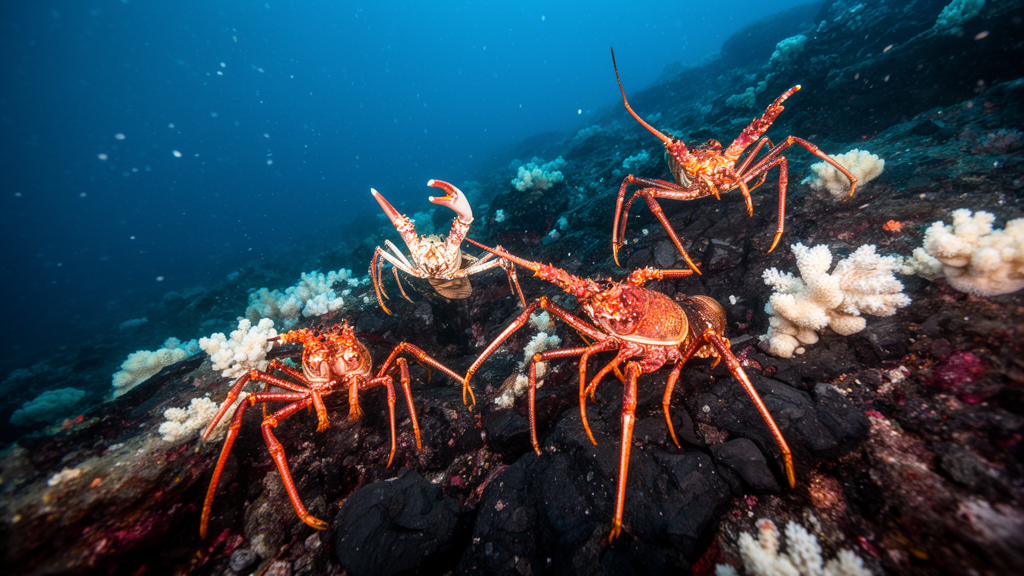
Deep beneath the surface of the southeastern Pacific, an underwater mountain world is quietly surrendering its secrets. During 2024, an international team of researchers aboard the research vessel Falkor (too) surveyed the seamounts and oceanic islands of the Nazca, Salas y Gómez, and Juan Fernández ridges, performing 56 dives with the remotely operated vehicle SuBastian and reaching depths of up to 4,500 meters. The expeditions, designated FKT240108, FKT240224, and FKT240708, traversed both the Chilean Exclusive Economic Zone and the adjacent high seas, collecting an extraordinary array of deep-sea benthic fauna. Among the most remarkable finds were squat lobsters of the family Munidopsidae, a group of decapod crustaceans whose diversity in these isolated waters had remained almost entirely unexplored until now.
The results of this extensive sampling effort, published in the journal Zoosystematics and Evolution, describe four species new to science: one species of the genus Leiogalathea and three species of the genus Munidopsis. The collection also comprises one species of Galacantha and six species of Munidopsis in total, three of which are considered new. The use of combined morphological and molecular data confirmed the validity of the new species and documented occurrences of species previously known only from the eastern Indo-West Pacific, the southwestern Pacific, and the northeastern Pacific. For a family with more than 280 species worldwide, the southeastern Pacific had been represented by surprisingly few records, making these discoveries a significant addition to the known biodiversity of the region.
The seamounts of the Salas y Gómez and Nazca ridges are recognized as one of the regions with the highest levels of marine endemism on the planet. In recent years, sampling efforts in these systems have intensified, driven in part by their designation as a priority Ecologically or Biologically Significant Area. As a result of these expeditions, numerous new species have been described, including squat lobsters and other groups of benthic invertebrates. The technological capabilities of the ROV SuBastian, operated by the Schmidt Ocean Institute, enabled the documentation of new species and records, as well as the acquisition of high-definition imagery that provides valuable insights into ecological associations and habitat use of deep-sea benthic fauna.
The molecular analysis followed established protocols for DNA extraction, amplification, and sequencing. DNA was extracted from the fifth pereopod of each specimen using a commercial tissue kit, and integrity was verified on 2 percent agarose gels with purity assessed using the A260/280 ratio. A fragment of the mitochondrial cytochrome c oxidase subunit I gene, the standard COI barcode for animal identification, was amplified using universal primers and sequenced in both directions. Raw sequences were assembled, edited, and aligned in Geneious Prime, and only high-quality sequences without stop codons or indels were retained. Uncorrected p-genetic distances were calculated among species groups using MEGA v. 11, providing quantitative measures of divergence between the new species and their closest relatives.
Phylogenetic analyses were performed using sequences retrieved from previous publications in NCBI, which included morphologically related species to the specimens examined here. Leiogalathea was considered an outgroup for the Munidopsinae. Two approaches were used: Bayesian inference and maximum likelihood. The maximum likelihood tree was inferred using W-IQ-TREE online, with branch support assessed through ultrafast bootstrap approximation using 1,000 pseudoreplicates. Bayesian phylogenies were inferred in MrBayes v. 3.2 on XSEDE, with two runs of four chains, 100 million generations, and sampling every 10,000 generations. Convergence was verified by checking that the average standard deviation of split frequencies remained below 0.01. The resulting trees showed congruent topology, with high support for the placement of the species collected from the seamounts of the Nazca, Salas y Gómez, and Juan Fernández ridges.
The new species of Leiogalathea, named Leiogalathea rosula in reference to the rose-like color of the carapace, was recovered as part of a clade related to species discovered recently in the central and eastern Pacific. This species was previously identified in a phylogenetic study of Leiogalathea from New Caledonia, where two specimens were sequenced. Genetic divergences between L. rosula and related species ranged from 12 to 13 percent for the COI marker, well beyond the boundaries typically considered intraspecific variation. The species is morphologically related to L. anchises from Papua New Guinea and the Solomon Islands and L. creusa from French Polynesia, but can be distinguished by the length of the walking legs, which are clearly longer in the new species, and by differences in the pleonal tergites. The new species was observed in crevices and pores of volcanic bedrock partially covered by a thin sand veneer at depths between 646 and 1,130 meters.
Among the three new species of Munidopsis, Munidopsis amnos, named from the Greek word for sand in reference to the numerous small granules on the body, was collected from Guyot Baral at the intersection of the Nazca and Salas y Gómez ridges at 705 meters. The species is characterized by numerous granules and tubercles on the carapace and pereopods, unarmed lateral margins of the carapace, immovable eyes with globular corneas, and the absence of epipods on the pereopods. The closest species is Munidopsis dispar from the seamounts of the Mariana Trench and Carolina Plate, later recorded in Hawaii and Johnston Atoll. The genetic divergence between M. dispar and M. amnos is 9 percent for COI. The new species is also morphologically and genetically close to M. sonne from the western Pacific and M. granosicorium from California, but both of those species possess epipods on the first three pereopods, whereas they are absent in the new species.
Munidopsis molinai, dedicated to Abate G.I. Molina, who published the first contribution to Chilean carcinology in 1782, was recorded at the intersection of the Nazca and Salas y Gómez ridges within the Nazca-Desventuradas Marine Park between 687 and 748 meters. The species belongs to a group with well-exposed corneas, an eyespine at the dorsomedian end of the eyestalk, and first pereopods usually twice or more the carapace length. The closest relatives are M. scabra, from Oregon to Peru, and M. tanneri, from Panama to Chile, but the new species can be distinguished by the presence of epipods on the first pereopods, a rostrum that is 1.7 to 2.0 times as long as wide rather than approximately 2.5 times, less prominent granules on the dorsal surface of the carapace, and the absence of numerous spines on the extensor margins of the walking legs. The analyses of the new species together with specimens identified as M. scabra from the northeastern Pacific confirmed the existence of hidden diversity and a species complex, as already suggested by previous authors.
Munidopsis oryza, named from the Greek word for rice in reference to the granules of the body, was described from a single female specimen collected at 2,092 meters on an unnamed seamount in the Nazca Ridge. The species belongs to a group with epipods on the first three pereopods, unarmed and immovable eyes, and a telson with seven to eight plates. The closest species is M. hawaii, from a seamount off Hawaii, and the two can be distinguished by the rostrum, which is 2.8 times as long as broad and directed upward in the new species compared with 1.6 times and horizontal in M. hawaii, by the size of the dorsolateral process of the antennular article, and by the proportions of the walking legs. The genetic divergence between the two species is 5.2 percent for COI. The new species was recorded solitarily in a vertical position on volcanic bedrock microhabitats characterized by a granular substrate with high rugosity and small vesicles or cavities that form sand-filled pockets.
Beyond the new species, the expeditions documented significant range extensions. Munidopsis tiburon, previously known only from off Oregon and in the Monterey Bay Canyon, was recorded at Dragon Back seamount in the Nazca Ridge at 2,253 meters, extending its distribution to the southeastern Pacific. Munidopsis comarge, originally described from southeastern and southwestern Australia and New Zealand and later collected in southern Java and American Samoa, was found to be the most abundant species across the studied seamounts. This species occurs in groups on coral colonies from different families, including Anthothelidae, Madreporidae, and Muriceidae, as well as on solitary hard corals, but was also observed solitarily on volcanic rock within crevices, indicating that association with habitat-forming organisms is facultative rather than obligate. Coloration appears to vary according to the host coral, with a paler form associated with white corals and an orange form associated with darker-colored corals. The species was recorded between 509 and 817 meters depth, at temperatures ranging from 4.9 to 5.9 degrees Celsius and under oxygen conditions above 2 milliliters per liter.
These findings suggest a closer relation of the fauna of the central and western Pacific with the fauna of the Nazca and Salas y Gómez area, as other authors have observed in fish and echinoderms. This would confirm the extreme faunal isolation between the eastern Pacific and the central-western Pacific, due to the great distance between both basins, approximately 5,000 to 8,000 kilometers, considered the world’s most effective barrier to larval dispersal. With the exception of Galacantha rostrata, none of the species found in the seamounts of the Nazca and Salas y Gómez ridges had been recorded on the continental shelf and slope of Chilean waters east of the Juan Fernández Archipelago. Three species are also found in the Indian Ocean and western Pacific, and M. tiburon is also found in California waters. Overall, the discovery of new species and the extension of distributional ranges for deep-sea taxa such as Munidopsidae are critical for advancing the understanding of biodiversity patterns in the southeastern Pacific. This knowledge is particularly relevant in the context of Areas Beyond National Jurisdiction, where baseline data remain scarce but are essential to inform conservation and management efforts under the framework of the BBNJ Agreement.
Subject of Research: Taxonomy and biogeography of deep-sea squat lobsters from Southeast Pacific seamounts
Article Title: Squat lobsters of the family Munidopsidae Ortmann, 1898 ( Decapoda , Galatheoidea ) from the seamounts of the Southeast Pacific Ocean ridges
Article References: Gallardo-Salamanca, M. D. L. A., Rodríguez-Flores, P. C., & Macpherson, E. (2026). Squat lobsters of the family Munidopsidae Ortmann, 1898 (Decapoda, Galatheoidea) from the seamounts of the Southeast Pacific Ocean ridges. Zoosystematics and Evolution, 102(4), 949-972. https://doi.org/10.3897/zse.102.196673
Image Credits: AI Generated
Keywords: squat lobsters, Munidopsidae, seamounts, Nazca Ridge, Salas y Gómez Ridge, new species, deep-sea biodiversity, Schmidt Ocean Institute, Squat, lobsters, family, Ortmann
News Source: Drew Townsend. (October 17, 2026). Four new squat lobster species revealed on remote Pacific seamounts. Scienmag.