Deep beneath the red dirt of Western Australia’s Pilbara, a scorpion has been quietly evolving in the dark for millions of years. Researchers report the first troglobitic members of the scorpion family Bothriuridae ever documented anywhere in the world, recovered from the subterranean voids of an iron-rich geological formation. The discovery, published in the journal Subterranean Biology, not only adds a startling new predator to Australia’s underground menagerie but also rewrites what scientists thought they knew about which scorpion lineages can make the leap into permanent subterranean life.
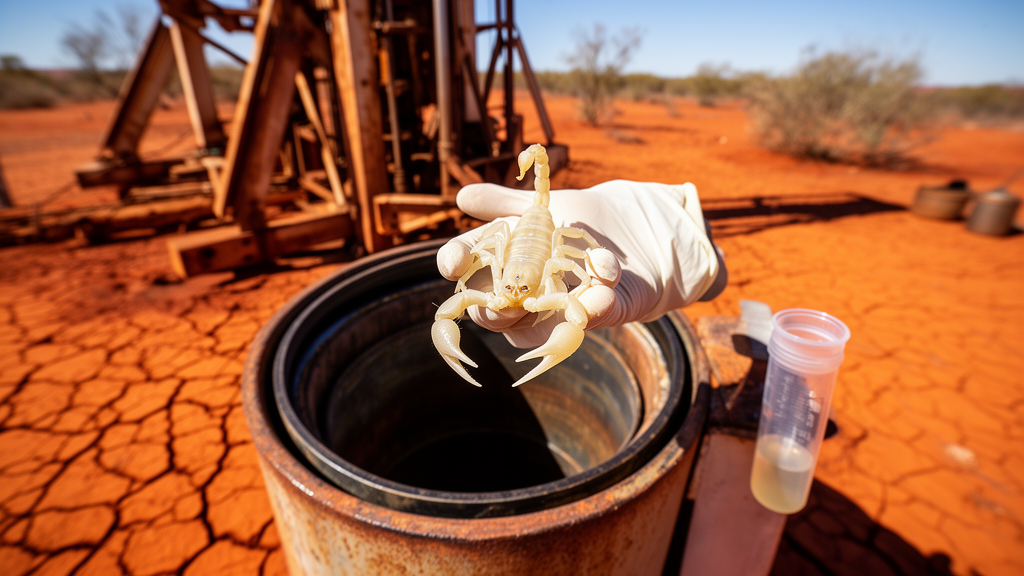
Scorpions are extraordinarily rare in subterranean ecosystems worldwide. Only 28 species had ever been recorded living underground before this study, a striking figure given how common scorpions are on the surface of arid Australia. The Pilbara specimen, catalogued as Bothriuridae sp. Biologic-SCOR002, was collected on 23 February 2021 from an uncased vertical mineral exploration hole, using a modified plankton net lowered and raised four times through the bore before the contents were elutriated, washed and preserved in chilled 95% ethanol. Together with a previously collected undescribed bothriurid from the Hamersley Range, held at the Western Australian Museum since 2012, the find pushes the global count of troglobitic scorpions to 30 and marks the first confirmed troglobitic members of the family Bothriuridae on the planet.
The specimen’s body tells the story of its underground life unambiguously. Measuring 13.7 millimetres from the tip of the telson to the front edge of the prosoma, the scorpion displays the classic suite of troglomorphic traits that define obligate cave-dwellers: a complete absence of eyes, total loss of pigmentation, and pronounced weakening and diminishment of the appendages, including the pedipalps that surface scorpions use to seize prey. The sternum is subpentagonal with posterior emargination and well-developed lateral lobes connected medially, a configuration the authors note shares similarities with juvenile specimens of Cercophonius sulcatus, Australia’s only previously known bothriurid genus. Under the ecological classification framework for troglomorphic scorpions established by Prendini and colleagues, these characters together support its designation as a hypogean troglobite, an animal that cannot survive outside its dark, humid realm.
Confirming the scorpion’s family ties required both morphology and molecules. Genomic DNA was extracted from tissue removed from the second left leg, and three genes were amplified and sequenced: cytochrome c oxidase subunit I, a 454-base-pair fragment; 16S rRNA, at 528 base pairs; and 28S rRNA, at 354 base pairs. BLAST searches against the GenBank nucleotide collection returned members of Bothriuridae as the closest matches for every gene independently. For 28S, all fifty top hits were bothriurids. The phylogenetic analyses, built with RAxML using the GTR+GAMMA model and 1,000 bootstrap replicates, consistently recovered the specimen as sister to Cercophonius sulcatus, the only Australian representative of the family included in the comparison. While individual gene trees showed low to moderate support, the concatenated tree placed the Pilbara scorpion firmly within Bothriuridae with strong bootstrap support of 97.
That genetic relationship carries a deep evolutionary echo. The pairwise COI distance between the new specimen and Cercophonius sulcatus is 16.52%, a level of divergence consistent with substantial evolutionary separation. Applying an approximate molecular divergence rate of 1.4% per million years, the authors estimate the two lineages split roughly 11 to 12 million years ago, a timing that aligns with the progressive aridification of the Australian continent. As mesic forests contracted and fragmented over the past 20 million years, Gondwanan taxa adapted to humid conditions retreated to refugia, including southern coastal regions and, apparently, subterranean environments. The Pilbara scorpions may be climatic relicts, living fossils of a wetter Australia that survived underground while their surface relatives were pushed to the continent’s green fringes.
There is, however, a second and more provocative interpretation. The non-transverse subpentagonal sternum of the new specimen is a character otherwise seen only in South American genera such as Tehuankea and Mauryius and African genera such as Lisposoma and Brandbergia, not in Cercophonius. If this anatomical signature means the Pilbara taxon lies outside the Australian genus, its divergence may predate Australian aridification entirely and reflect a much deeper Gondwanan history. Dated phylogenomic analyses of Bothriuridae based on ultraconserved elements and transcriptomic datasets suggest a deep split of roughly 94 million years between South American and Australian bothriurids, consistent with dispersal through temperate Gondwana before the final breakup of the South America–Antarctica–Australia connection. Distinguishing between these two scenarios will require a more comprehensive molecular clock analysis with broader taxon sampling.
The habitat itself is as unusual as the animal. Unlike the vast karst cave systems that host subterranean communities elsewhere in the world, the Pilbara’s underground realm consists mostly of vugs and voids, meso- and micro-caverns threaded through rock rather than human-accessible caverns. The specimen was recovered from between the surface and 34 metres depth, within pisolithic detritals and calcrete layers whose pore spaces are suitable for troglofauna. Critically, these cavernous units are underlain by the relatively impermeable West Angelas Shale of the Wittenoom Formation, a geological floor that may provide the structural stability necessary for long-term persistence of larger hypogean species. In the Brockman Syncline, where the collection site lies, geomorphology is shaped by the erosional resistance of the Brockman and Marra Mamba iron formations, creating iron-rich detrital systems that appear particularly favourable for underground life.
The rarity of the find is underscored by the sheer scale of the sampling effort behind it. Approximately 3,500 subterranean fauna samples have been collected from mineral exploration holes in the Brockman Syncline and Jeerinah Anticline system, and roughly 50,000 from the Pilbara region more broadly, most of them gathered during environmental impact assessments for resource developments. Yet across all that drilling, only two troglobitic scorpions have ever been documented. The authors suggest several reasons why: limited habitat connectivity and resource availability may prevent larger animals from colonising and persisting underground, borehole sampling methods likely bias against detecting bigger troglobitic taxa, and Bothriuridae would hardly be considered an obvious candidate for subterranean specialisation. Globally, most bothriurids are fossorial burrowers, and no troglobitic representatives were known even from the family’s diversity epicentres in Andean and Brazilian cave systems.
Conservation concerns follow naturally from the discovery. Obligate troglofauna in the Pilbara are typically short-range endemics, and both the new specimen and the 2012 Hamersley Range individual are currently known from single sites, provisionally regarded as short-range endemics pending further data. The two records are separated by about 48 kilometres and by Caves Creek, a major drainage channel, and preliminary morphological comparison suggests apparent differences between them, leading the authors to propose that they likely represent distinct species. Because these scorpions are relatively large-bodied and likely occupy higher trophic positions, they may be ecologically significant components of subterranean food webs, making their protection a priority in a region where mining activity and subterranean biodiversity collide.
What comes next is a combination of taxonomy and technology. Formal taxonomic treatment of the new scorpion will follow in a dedicated study, while the researchers point to predictive three-dimensional habitat modelling, wet pit traps deployed down mineral exploration holes, and environmental DNA sampling as promising tools for mapping the species’ true range. Genetic sequencing of the older Hamersley Range specimen, which has so far resisted multiple attempts at the WA Museum, would help clarify patterns of gene flow and colonisation between the two populations. For now, the blind, pale scorpion of the Pilbara stands as a reminder that even some of the most intensively surveyed landscapes on Earth can still conceal entirely unexpected predators, and that the evolutionary legacy of Gondwana may be hiding just beneath the drill bit.
Subject of Research: Discovery of the first troglobitic scorpions of the family Bothriuridae in the Pilbara, Western Australia
Article Title: First record of troglobitic Bothriuridae ( Scorpiones ) in Australia from the Pilbara
Article References: Curran, M., Rodman, S., Huey, J., Floeckner, S., Gunawardene, N., Lythe, M., & Main, D. (2026). First record of troglobitic Bothriuridae (Scorpiones) in Australia from the Pilbara. Subterranean Biology, 56, 85-101. https://doi.org/10.3897/subtbiol.56.190758
Image Credits: AI Generated
DOI: 10.3897/subtbiol.56.190758
Keywords: troglobite, Bothriuridae, scorpion, Pilbara, subterranean fauna, troglofauna, Western Australia, troglomorphy, Gondwana, phylogenetics, calcrete, short-range endemism
News Source: Gavin Prescott. (October 17, 2026). Blind, Pale Scorpion Pulled From Pilbara Borehole Is a Global First. Scienmag.