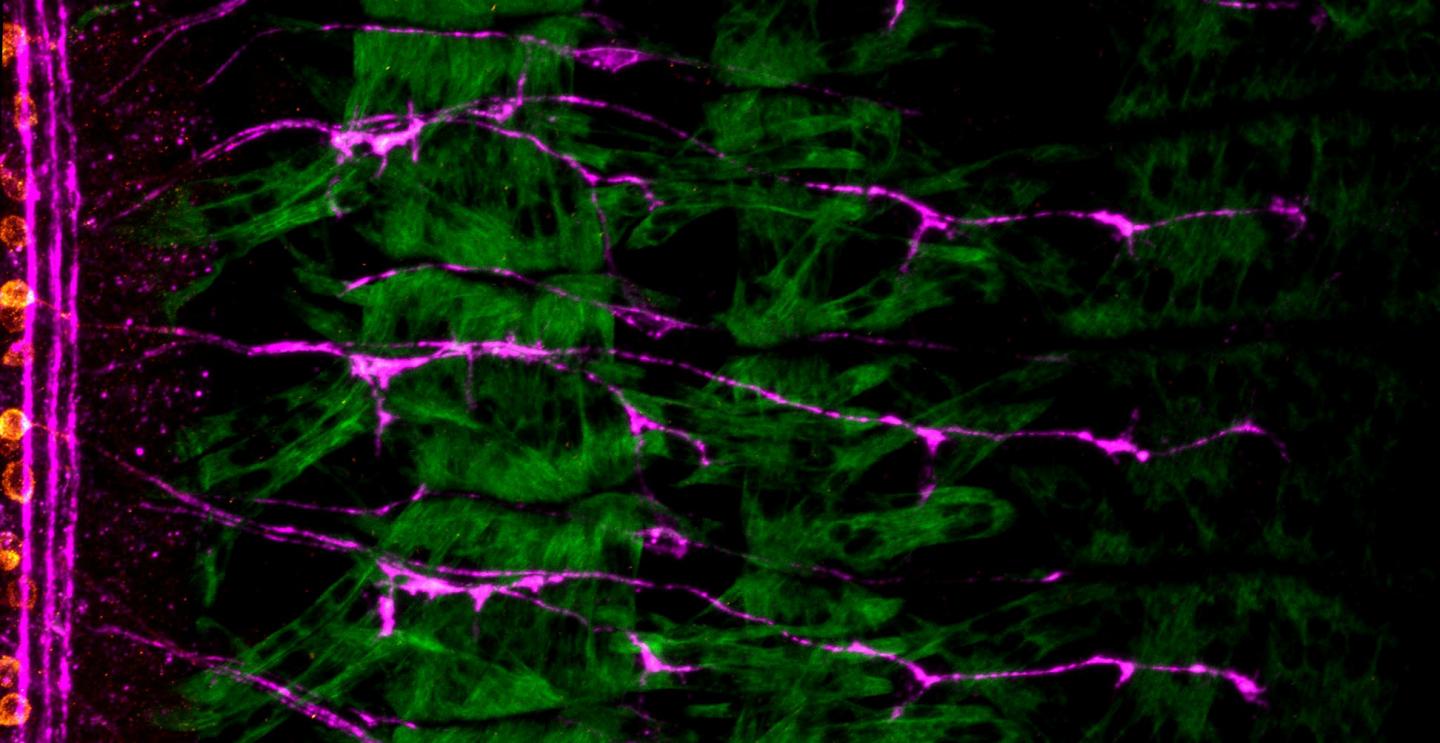
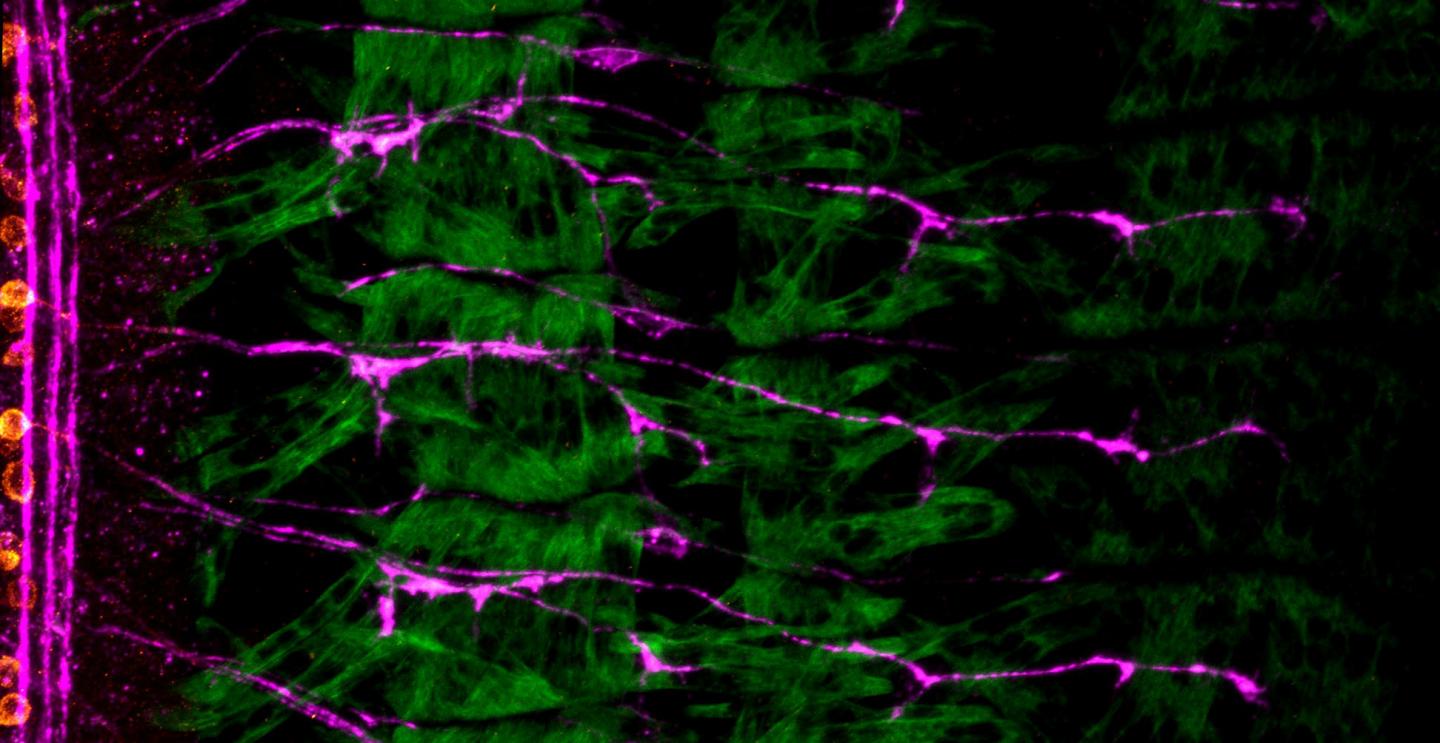
Credit: Professor Juan Pablo Labrador, Trinity College Dublin.
Scientists have identified a large group of biological 'labels' that guide nerves to ensure they make the correct connections and control different parts of the body. Although their research was conducted with fruit flies, the findings offer hope that we could one day reestablish nervous connections in people living with debilitating injuries or diseases that affect the nervous system.
The key to achieving that lies in identifying more of these labels and working out which ones attract specific nerves in humans. In theory, delivering the right labels to the site of an injury may spark the re-formation of the all-important nervous connections.
The nervous system is essentially a very complex network of wires or 'axons', which are arranged into different bundles of nerves. All these axons make specific connections with other axons in different parts of our bodies to control them. Although the 'neuron' cells within each bundle are more similar to each other than to those in different bundles, they are still unique. And this is true for each one of the tens of thousands of individual neurons in a fly to the several billion in a human.
Nerves are assembled through the biological labels that are present on their surfaces, and are also directed towards their final destination by other labels present throughout the body. The instructions on these labels are sensed or 'read' by the axons through specific receptors present on them.
Assistant Professor in Genetics at Trinity College Dublin, Juan Pablo Labrador and his collaborator Prof. Kai Zinn at the California Institute of Technology (CALTECH, CA, USA), led the research that has just been published in leading international journal eLIFE (DOI: 10.7554/eLife.28111).
Professor Labrador said: "These labels are like traffic lights, guiding the nerves. The labels tell them not to go to certain places and instead tell them to go where they are supposed to. It is the job of the guidance receptors to sense these labels and steer the nerves towards or away from them based on the information on them."
"These labels are therefore very important. They dictate how the nervous system is built in a developing embryo, but they are also critical in disease and regeneration. For example, severed nerve connections in a spinal cord injury could be reestablished if the right labels that attract axons are provided at the site of injury."
Using the Bio-Plex Interactome Assay, a novel method developed at Caltech, Professor Labrador and his colleagues have just identified how a whole family of molecules that work as labels (the sidestep family) bind to a large family of receptors (the beaten path family of receptors). Beat receptors are present in axons of motor nerves, and guide them so that they can establish the right connections with specific muscles by detecting different Side labels present on them.
We are still a long way away from using this knowledge to help people with nervous system issues, but these labelling systems work in the same fashion in humans.
Professor Labrador added: "Our work builds on our understanding of how the nervous system is wired by complex codes of molecules. This understanding has already proven essential to understand various nervous system diseases and will one day open doors to treating people."
###
Media Contact
Thomas Deane
[email protected]
353-189-64685
@tcddublin
http://www.tcd.ie/
Original Source
https://www.tcd.ie/news_events/articles/nerve-guiding-labels-may-one-day-help-re-form-broken-nervous-connections/8081 http://dx.doi.org/10.7554/eLife.28111