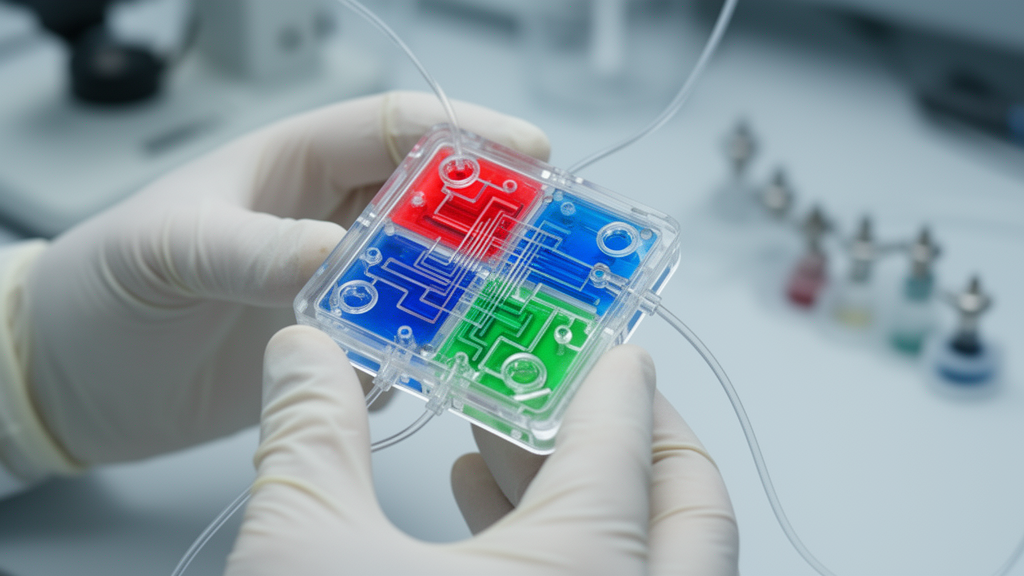
Microfluidic devices promise to shrink entire laboratories onto chips the size of a coin, accelerating CRISPR screenings, drug discovery, water analysis and material synthesis while consuming tiny amounts of reagents. Yet a new comparative review published in Heliyon by Mohammad Zein, Sousso Kelouwani and Marie Hébert argues that the component most often overlooked by researchers is the one that can make or break the technology: the actuation system, the pump or pressure source that actually moves fluids through the chip. The authors, affiliated with research groups in Québec and funded by the Natural Sciences and Engineering Research Council of Canada, shift the spotlight away from the chip itself and onto the plumbing, compressors, motors and valves that surround it.
The review takes an unusual and pragmatic stance. Rather than cataloguing the countless actuation concepts that exist only in academic papers, Zein and colleagues deliberately restrict their analysis to commercial products and open-source projects. Technologies described solely in research articles, they reason, are effectively inaccessible to the biologists, chemists and clinicians who are the ultimate end users of microfluidic tools. This accessibility lens, the authors contend, represents a crucial barrier to the widespread adoption of lab-on-a-chip technology, and their goal is to identify the gaps that prevent actuation solutions from reaching the people who need them.
At the heart of the analysis lies a deceptively simple physical relationship. Flows in microfluidic channels obey the Hagen–Poiseuille law, which states that the pressure drop across a channel is proportional to the volumetric flow rate, with the hydraulic resistance of the channel as the proportionality constant. That resistance depends on channel dimensions and fluid viscosity. Every actuation method, the review explains, is essentially a strategy for controlling one of the two variables in this equation. Pressure-driven pneumatic systems set the pressure differential and let the flow rate follow, while positive-displacement actuators such as syringe and peristaltic pumps set the flow rate and let the pressure differential emerge as a consequence.
Pneumatic actuation emerges as the performance leader in the comparison. A typical pressure system comprises a compressor, a pressure regulator, a liquid reservoir with an air–liquid interface that transmits air pressure to the sample while preventing cross-contamination, and the chip itself. The authors highlight studies showing concrete advantages of this approach: Zeng and colleagues generated droplets at a T-junction with significantly less polydispersity using a pressure pump than with a syringe pump, and Sullender’s team demonstrated that flow fluctuations from pressure pumps are more stable and reliable than those from syringe pumps, even recommending that evaluations of laser speckle contrast imaging replace syringe pumps with pressure-driven systems. Commercial pressure pumps such as the Elveflow OB1 achieve response times down to 50 milliseconds and stability figures of 0.005 percent of full scale, while the Fluigent Flow EZ reaches pressures up to 7 bar.
However, the review is candid about the costs of this performance. Most commercial pressure pumps contain only the regulation components, leaving users to source compression separately. The authors compiled a detailed comparison of compressors, from the VIAIR 90 Series at roughly 100 dollars to the Jun-Air LVF-PVS-P-02-110 at 2,500 dollars, and found that few options exceed 100 psi while most sit below 50 psi. Piston compressors deliver higher pressures but are bulky and noisy, whereas diaphragm pumps offer smaller form factors at lower cost but with limited pressure and shorter lifespans. The complete pneumatic chain, the review notes, comes at a premium price, with commercial pressure pumps ranging from 4,000 to 13,000 dollars, and the mass and volume of the full system are substantial when compression is included.
Positive-displacement actuation, by contrast, requires only electrical power and remains the workhorse of the field. Syringe pumps drive a plunger with a motor and lead screw, delivering precise flow rates that make it easy to vary the Capillary number, a key parameter in droplet and mixing studies. Yet the review identifies a fundamental weakness: persistent oscillations. Korczyk and colleagues showed that flow unsteadiness from syringe pumps negatively impacts droplet volume consistency, and Zeng’s team traced these fluctuations to the mechanical oscillations of the pump motor itself. The review presents an equation for the mechanical frequency of a syringe pump, showing that design choices such as flow rate, syringe diameter and lead screw pitch can mitigate but never completely eliminate the oscillations. Peristaltic pumps suffer from the same problem, with the period of the main flow peaks determined by the number of rollers and the motor’s rotational speed.
The review also surveys actuation methods that rely on external forces, including human power and gravity. Finger-actuated devices dispense roughly 2 to 4 microlitres per push and can generate pressures up to about 75 millibar, making them attractive for point-of-care blood analysis and concentration gradient generation. Gravity-fed pumps are similarly independent of electrical power, but a one-metre water column generates only 0.1 bar of pressure, severely limiting their power density. An alternative approach leveraging a syringe piston area instead of hydrostatic pressure increases pressure capability up to 7 bar. These methods score highly on efficiency and cost in the authors’ comparison but fall short on hydraulic power and response time, which the review identifies as particularly hindering for active microfluidic applications.
Microactuation, the smallest category, may hold the key to the field’s future. Commercial micropumps such as Bartels Mikrotechnik’s piezo-driven double diaphragm pumps deliver up to 5 milliwatts of hydraulic power, and a micro diaphragm pump has been used for cell transport with back pressure up to about 500 millibar and a flow rate of 12.5 millilitres per minute. The review points out that typical microfluidic requirements are surprisingly modest: a maximum pressure of 15 psi and a flow rate of 15 microlitres per minute correspond to just 0.025 milliwatts, while a complex passive microfluidic network operating at about 500 millibar requires only 0.005 milliwatts. The greatest advantage of microactuators is their small form factor, which favours light and compact integration into portable systems. However, the authors lament that limited commercial availability and a lack of open-source projects severely restrict their adoption.
To bring order to this landscape, the review establishes a framework of key performance indicators: hydraulic power, response time, stability, efficiency, density and cost. Pressure pumps score best on power, response time and stability but worst on efficiency, density and cost. Syringe and peristaltic pumps offer a middle path with good power and moderate density but poor stability and slow response. Gravity and human-powered approaches excel on efficiency and cost but provide limited power. Microactuation scores best on density and cost while offering sufficient power for most microfluidic needs. The authors note that the framework has limitations, particularly the omission of environmental operating factors such as temperature, humidity, particle contamination and vibration, which become more pertinent for mobile or field-deployed devices.
The review’s conclusion is a call to action for the microfluidics community. Current actuation approaches, the authors argue, are mostly tailored to laboratory passive microfluidic applications, prioritizing stability and high pressure while assuming the availability of an external compressed air source. When requirements differ, for example in point-of-care diagnostics, space-limited applications or untethered soft robotics, there is a substantial gap in available solutions. The authors advocate for future development of smaller form factors that sacrifice some power while retaining the fast response times and good stability of pressure pumps, a gap they identify as especially important for active microfluidics and soft robotics researchers. They also stress that robust software development kits, whether for open-source or commercial systems, are required for integration into feedback loops that control active systems. Knowledge transfer from actuation technology to microfluidic tool developers and users, the review concludes, must be achieved through an accessibility lens, ensuring that the invisible engine of lab-on-a-chip technology finally gets the attention it deserves.
Subject of Research: A comparative review of actuation methods for Microfluidic systems
Article Title: A comparative review of actuation methods for Microfluidic systems
Article References: Zein, M., Kelouwani, S., & Hébert, M. (2026). A comparative review of actuation methods for Microfluidic systems. Heliyon, 12(16), Article e45574. https://doi.org/10.1016/j.heliyon.2026.e45574
Image Credits: AI Generated
DOI: 10.1016/j.heliyon.2026.e45574
Keywords: comparative, review, actuation, methods, Microfluidic, systems, scientific research
News Source: Eric Holt. (October 17, 2026). The hidden engine of lab-on-a-chip: how actuation decides microfluidics’ future. Scienmag.