For patients battling nasopharyngeal carcinoma, the radiation that attacks their tumor often wages a second, quieter war inside their mouths. Moderate-to-severe oral mucositis—painful inflammation and ulceration of the oral lining—remains one of the most dreaded consequences of head and neck radiotherapy, even in the era of sophisticated intensity-modulated radiation techniques. Now, a retrospective cohort study from a Chinese cancer center suggests that something as simple as swishing ozonated water could meaningfully blunt this burden, offering a potential low-cost weapon against a complication that can derail cancer treatment itself.
The research, published in Supportive Care in Cancer, examined 65 patients with non-keratinizing nasopharyngeal carcinoma receiving curative-intent chemoradiotherapy at a single center. Thirty-four of these patients had documented use of ozonated water mouthrinses during their radiation course, while 31 served as controls receiving standard oral care alone. The primary endpoint was the time to first development of WHO grade 2 or worse oral mucositis, measured on a fraction-based time scale that tracked each radiation session individually.
The results were striking. In a time-dependent Cox model that treated ozonated water exposure as a time-varying covariate, documented use was associated with a 65 percent lower hazard of developing moderate-to-severe oral mucositis, with a hazard ratio of 0.35 and a confidence interval of 0.20 to 0.63, reaching statistical significance at P less than 0.001. A 10-fraction landmark analysis, which restricted the cohort to patients who remained event-free at fraction 10 and started follow-up from that point, showed a directionally consistent association with a hazard ratio of 0.47. By fraction 30—the end of the planned 33-fraction course—only 50 percent of ozonated water users had developed grade 2 or worse mucositis, compared with 90.3 percent of controls.
Beyond the mucositis endpoint itself, the ozonated water group reported significantly lower peak oral pain scores on a 0-to-10 visual analogue scale, with a Cliff’s delta of −0.39 indicating a clinically relevant reduction. The study also found a nonsignificant trend toward a shorter post-radiotherapy mucosal healing interval, with a median difference of 3.9 days favoring the ozonated water group. The number needed to treat decreased from approximately 4 at fraction 15 to approximately 2 at fraction 30, suggesting increasingly meaningful absolute benefits as treatment progressed.
The preparation protocol behind these results was anything but casual. Medical oxygen served as the feed gas, and ozone was generated at a concentration of 10 micrograms per normal milliliter using a German medical ozone therapy device. The ozone was bubbled through 250 milliliters of double-distilled water for 5 minutes, yielding a dissolved-ozone concentration of 2.5 micrograms per normal milliliter. Solutions were stored in sealed glass bottles with silicone stoppers at 4 to 6 degrees Celsius and used within 30 minutes of preparation, with any solution exceeding this limit or stored above 8 degrees Celsius discarded.
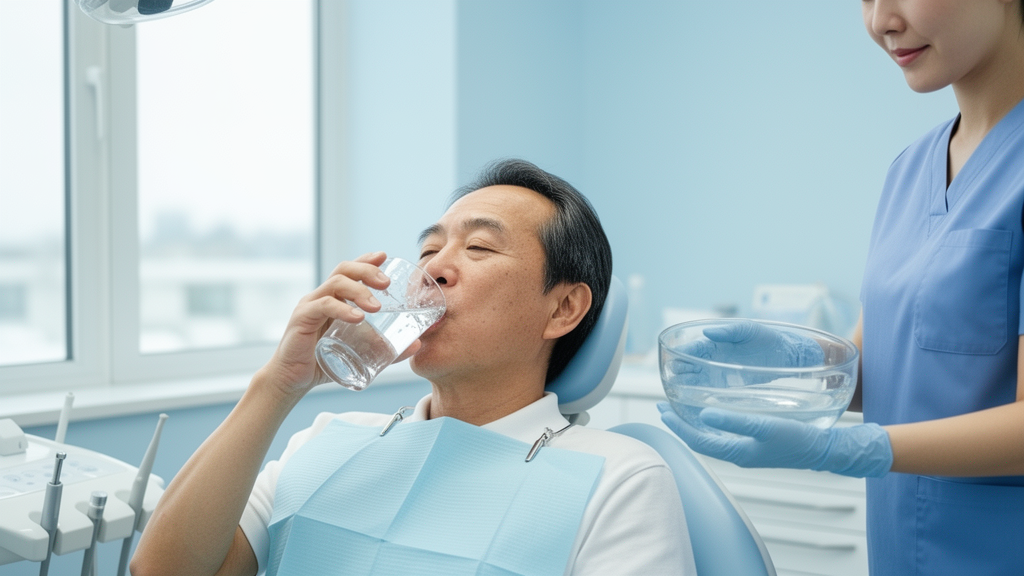
Patients performed one rinse 15 to 30 minutes before and one 15 to 30 minutes after each radiation fraction, with additional rinses upon waking, after each of three meals, and at bedtime while on the ward—amounting to at least five sessions per day. Each session used 20 to 30 milliliters with repeated swishes to cover the entire oral cavity, lasting 5 minutes per session. Patients were advised to avoid swallowing and to maintain at least a 15-minute interval between toothbrushing and rinsing. Once initiated, the ozonated water course continued through the end of radiotherapy, with possible extension for 7 to 14 days if mucositis or pain persisted.
The biological rationale for these findings rests on several converging mechanisms. Dissolved ozone can rapidly reduce oral microbial and biofilm burdens, a property that matters because the oral mucosal microenvironment in radiation patients is often characterized by dysbiosis, chronic inflammation, and impaired repair capacity. Ozone also attenuates mucosal inflammation by activating the Nrf2 pathway and inhibiting NF-κB, while promoting epithelial repair and microcirculatory perfusion—thereby dampening the inflammatory cascade and ulcer progression that drive mucositis severity.
The study team was careful to address the methodological pitfalls inherent in observational research. Because ozonated water initiation occurred after radiotherapy had started in some patients, fixed exposure classification by ever-use could introduce immortal time bias. The researchers therefore emphasized time-aware analyses, including the time-dependent Cox model and the landmark analysis, while retaining propensity score-based models as supportive analyses. Stabilized inverse-probability-of-treatment weighting produced a hazard ratio of 0.48, and additional sensitivity analyses—including propensity score matching, weight truncation, overlap weighting, and a stage-based specification—showed directionally consistent estimates throughout.
Yet the authors are unequivocal that these findings cannot be interpreted as proof of causal efficacy. The retrospective design, modest sample size, optional and time-varying ozonated water uptake, residual confounding, and chart-based exposure and outcome ascertainment all limit the strength of the conclusions. E-values quantifying the potential impact of unmeasured confounding ranged from 3.54 to 5.38, suggesting that a hypothetical unmeasured factor would need to be associated with both ozonated water use and mucositis outcomes by substantial margins to explain away the observed associations. The researchers also noted that abstraction and verification were not blinded to exposure status, and undocumented ozonated water use among controls cannot be excluded.
Against the backdrop of existing supportive interventions—photobiomodulation with its higher-level evidence but significant equipment and training costs, cryotherapy with restricted applicability in concurrent chemoradiotherapy, and heterogeneous conclusions for glutamine and zinc—ozonated water emerges as a candidate adjunctive approach that could be readily embedded into routine care pathways. The authors call for prospective multicenter studies with standardized protocols, objective adherence monitoring, and blinded outcome assessment to determine whether this simple rinse can deliver on the promise suggested by these exploratory real-world associations.
Subject of Research: Oncology
Article Title: Ozonated water mouthrinse for radiation-induced oral mucositis in non-keratinizing nasopharyngeal carcinoma: a retrospective cohort study
Article References: Yu, J., Ou, X., Tong, F., Su, Q., Zeng, W., Wang, Z., & Li, X. (2026). Ozonated water mouthrinse for radiation-induced oral mucositis in non-keratinizing nasopharyngeal carcinoma: a retrospective cohort study. Supportive Care in Cancer, 34(11), Article 1111. https://doi.org/10.1007/s00520-026-11343-0
Image Credits: AI Generated
DOI: 10.1007/s00520-026-11343-0
Keywords: oral mucositis, nasopharyngeal carcinoma, ozonated water, radiotherapy, supportive care, head and neck cancer, Ozonated, water, mouthrinse, radiation-induced, oral, mucositis
News Source: Nathaniel Bowman. (October 17, 2026). Ozonated water mouthrinse shows promise against radiation-induced oral mucositis in nasopharyngeal cancer patients. Scienmag.