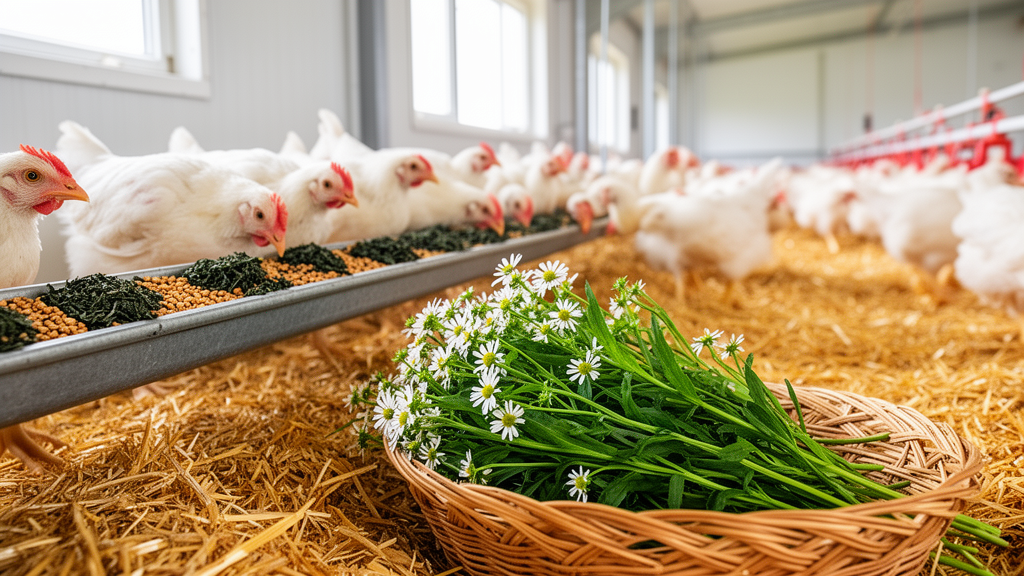
In a finding that could reshape how farmers raise premium poultry, researchers in Guangxi, China have shown that a humble flowering herb long used in traditional Chinese medicine can make chickens grow faster, eat more efficiently, and produce noticeably better meat. The plant, known scientifically as Eclipta prostrata and in herbal pharmacopoeias as Ecliptae herba, was added in powdered form to the diets of Lingshan chickens, an indigenous breed prized across southern China for its tender texture and rich flavor. Over a 49-day feeding trial, the herb did more than just nudge growth statistics upward. It fundamentally altered the microbial ecosystem of the birds’ guts and rewired their intestinal metabolism, suggesting that the benefits flow from a complex dialogue between plant chemistry, gut bacteria, and host physiology.
The research team, led by scientists at Guangxi Vocational University of Agriculture and Guangxi University, set out to address a persistent challenge in indigenous poultry production. Lingshan chickens, while celebrated for their meat quality, grow more slowly and convert feed less efficiently than commercial fast-growing broilers. At the same time, the global phase-out of antibiotic growth promoters, driven by mounting concerns over antimicrobial resistance, has left farmers searching for safe and effective natural alternatives. Ecliptae herba, derived from the dried aerial parts of Eclipta prostrata, caught the researchers’ attention because of its well-documented pharmacological profile, which includes potent immunomodulatory, antioxidant, hypolipidemic, and anti-inflammatory activities. Its phytochemical repertoire is remarkably diverse, encompassing coumestans, triterpenes, thiophenes, steroids, and flavonoids, each with distinct biological properties that could theoretically benefit livestock health and productivity.
To test the herb’s effects rigorously, the team recruited 72 healthy 60-day-old Lingshan chickens and randomly allocated them to four dietary groups. One group received a standard basal diet, while the other three received the same diet supplemented with Ecliptae herba powder at 0.2, 0.4, or 0.6 percent by weight. The powder was prepared by washing, drying at 60 degrees Celsius, grinding, and passing the material through a 60-mesh sieve before adding it as a top-dressing to the feed. All birds were reared under controlled conditions in a closed poultry house with ambient temperatures maintained between 18 and 25 degrees Celsius, relative humidity between 55 and 65 percent, and a 16-hour light and 8-hour dark cycle throughout the experimental period. The basal diet itself was formulated from corn, barley, soybean meal, peanut meal, rapeseed meal, corn gluten meal, rice bran meal, and a vitamin and mineral premix, providing 16.5 percent crude protein and 13.10 megajoules per kilogram of metabolizable energy.
When the researchers weighed the birds at the end of the trial, the differences were striking. Chickens receiving 0.4 or 0.6 percent Ecliptae herba gained significantly more weight per day than controls, with average daily gain rising from 16.87 grams in the control group to 17.52 and 17.90 grams in the 0.4 and 0.6 percent groups respectively. Final body weights in those groups reached 1953.88 and 1962.07 grams, compared with 1913.64 grams in controls. Crucially, the improvement in growth was not driven by increased appetite. Average daily feed intake remained statistically similar across all groups, hovering around 98 to 100 grams per day. Instead, the herb enhanced feed conversion efficiency, with the feed conversion ratio dropping from 5.92 in controls to 5.59 and 5.51 in the 0.4 and 0.6 percent groups. This distinction matters enormously for poultry economics, because it means the herb helped birds extract more nutritional value from every gram of feed they consumed rather than simply encouraging them to eat more.
The benefits extended well beyond growth statistics into the realm of meat quality, a trait that defines the market value of indigenous breeds like the Lingshan chicken. When the researchers dissected breast and thigh muscles from slaughtered birds and subjected them to standardized tests, they found that both the 0.4 and 0.6 percent supplementation levels significantly reduced drip loss and cooking loss in both muscle types. Drip loss, which measures the fluid that escapes from meat during refrigerated storage, fell from 3.41 percent in control breast muscle to 2.18 and 2.08 percent in the 0.4 and 0.6 percent groups. Cooking loss, which quantifies moisture expelled during heating, dropped from 13.12 percent to 10.89 and 10.76 percent in the same groups. In thigh muscle, the pattern was even more pronounced, with drip loss falling from 2.23 percent to 1.34 and 1.36 percent, and cooking loss declining from 10.12 percent to 8.46 and 8.38 percent. Lower drip and cooking losses translate directly into juicier, more flavorful meat that retains its weight and appeal during processing and preparation.
Perhaps most intriguingly, the herb enhanced the redness of thigh meat, a trait measured by the a* value on the CIELAB color scale. Thigh muscle a* values rose from 3.99 in controls to 5.09 and 5.16 in the 0.4 and 0.6 percent groups. Redness in poultry meat is closely tied to myoglobin content and its oxidative state, and consumers generally associate redder thigh meat with freshness and superior eating quality. The researchers speculate that the antioxidant properties of Ecliptae herba’s bioactive constituents, particularly its flavonoids and coumestans, may have delayed myoglobin oxidation in the muscle tissue, though they acknowledge that direct measurements of oxidative stress markers and antioxidant enzyme activities were not performed in this study. Other meat quality parameters, including lightness, yellowness, shear force, and pH at 45 minutes postmortem, remained statistically unchanged across groups, suggesting the herb’s effects were selective rather than indiscriminate.
To understand how a dietary herb could produce such comprehensive benefits, the team turned to cutting-edge molecular tools. They collected cecal contents from the control group and the 0.4 percent supplementation group, which had shown the most consistent improvements in the phenotypic trial, and subjected them to 16S rRNA gene sequencing to map the gut microbial community. The analysis revealed that Ecliptae herba did not disrupt the core gut microbiota, as the two groups shared 302 core amplicon sequence variants. However, principal coordinate analysis confirmed that the overall microbial community structure was significantly reshaped by the herb. At the phylum level, the herb increased the relative abundance of Synergistota while decreasing potentially pathogenic phyla such as Campylobacterota. At the genus level, the herb upregulated beneficial genera including Bacillus and Cloacibacillus, while downregulating inflammation-associated genera such as Paraprevotella and Negativibacillus. Linear discriminant analysis effect size further identified specific biomarker taxa, with the control group enriched in pathogen-related bacteria like Helicobacter pullorum, while the herb group was enriched in symbiotic bacteria with anti-inflammatory and digestion-promoting functions, including Phascolarctobacterium, Synergistota, and Bacillus.
The enrichment of Bacillus is particularly noteworthy from a mechanistic standpoint. Bacillus is a well-recognized probiotic genus that secretes various digestive enzymes, facilitating the degradation of dietary macromolecules, especially proteins. Cloacibacillus, meanwhile, is closely linked to nitrogen utilization efficiency in the gut. Conversely, the downregulation of Paraprevotella and Negativibacillus, which typically proliferate during intestinal inflammation, suggests that the herb mitigated a suboptimal gut health status in the birds. This microbial optimization was accompanied by metabolic changes, as evidenced by the enrichment of the protein digestion and absorption pathway in subsequent KEGG analysis. Although such enrichment indicates altered metabolite profiles related to protein metabolism, the researchers caution that it does not directly demonstrate improved protein digestion or nutrient absorption, and that causal relationships remain to be established through further experimentation.
Complementing the microbiota analysis, the team performed untargeted metabolomics on the cecal contents using ultra-performance liquid chromatography coupled with high-resolution mass spectrometry. Principal component analysis showed that samples from the control and herb groups formed distinct clusters, indicating a clear separation of metabolic profiles. Volcano plot analysis identified 109 up-regulated and 93 down-regulated differential metabolites. KEGG pathway enrichment analysis revealed that these metabolites were concentrated in several key pathways, including metabolic pathways, protein digestion and absorption, biosynthesis of amino acids, D-amino acid metabolism, ABC transporters, mineral absorption, aminoacyl-tRNA biosynthesis, and biosynthesis of plant secondary metabolites. Gene set enrichment analysis further confirmed the overall upregulation of three core pathways: biosynthesis of amino acids, protein digestion and absorption, and biosynthesis of plant secondary metabolites. Among these, the protein digestion and absorption pathway showed the highest enrichment score, indicating the strongest activation. The interaction network of the top 30 differential metabolites revealed extensive associations between amino acid metabolism and plant secondary metabolite-related compounds, collectively forming a core metabolic network under the herb’s regulation.
The convergence of microbiota and metabolomics data paints a coherent picture of how Ecliptae herba works. The herb appears to simultaneously target the gut microbial ecosystem and the intestinal metabolic landscape, enriching beneficial bacteria that secrete digestive enzymes while upregulating metabolic pathways involved in protein and amino acid processing. This dual action likely explains the improved feed conversion efficiency observed in the growth trial, as birds with optimized gut microbiota and enhanced protein metabolism extract more nutritional value from their feed. The reductions in drip loss and cooking loss may be related to the antioxidant properties of the herb’s bioactive constituents, which scavenge free radicals and protect cell membranes from oxidative damage, though the researchers note that direct measurements of oxidative stress markers in muscle were not performed. The increased thigh muscle redness might be associated with a potential delay in myoglobin oxidation, but this interpretation remains speculative and requires direct experimental evidence.
The researchers acknowledge several limitations that outline promising directions for future work. Only three supplementation levels were evaluated, and whether higher doses would provide additional gains or trigger adverse effects remains unclear. While the study elucidated regulatory mechanisms at both the gut microbiota and metabolomic levels, direct mathematical or biological associations between specific bacterial genera and differential metabolites have not yet been established. Definitive causal relationships between the altered microbiota and metabolic pathways still require verification through fecal microbiota transplantation or mono-colonization experiments. Additionally, only untargeted metabolomics was employed, without targeted quantitative validation of key metabolites, so the absolute concentration changes of crucial metabolites within the protein digestion and absorption and amino acid biosynthesis pathways remain to be confirmed. Finally, because Ecliptae herba possesses a complex mixture of multiple bioactive compound classes, it remains unclear whether the observed improvements are driven by a singular dominant monomer or by the synergistic cross-talk of multiple constituents. Future research should integrate bioassay-guided fractionation with targeted metabolomics to identify key bioactive monomers and decipher their interactions with specific gut microbes, advancing the application of Ecliptae herba from empirical utilization toward a precision feeding strategy.
Despite these caveats, the findings represent a significant step forward in the search for natural alternatives to antibiotic growth promoters in poultry production. The study demonstrates that a traditional Chinese medicine herb, long valued for its therapeutic properties in human health, can be repurposed as a functional feed additive that enhances both productivity and meat quality in indigenous chickens. As the global poultry industry continues to phase out antibiotics and consumers increasingly demand sustainably raised, high-quality animal protein, herbs like Eclipta prostrata may play an expanding role in green farming systems. The research provides a scientific basis for the potential application of Ecliptae herba in sustainable poultry production, offering farmers a natural tool to improve the growth performance and meat quality of indigenous breeds while maintaining the core microbiota stability that underpins intestinal health. For the Lingshan chicken, a breed that embodies the culinary heritage of Guangxi, this ancient herb may prove to be the key to unlocking its full productive potential in the modern era.
Subject of Research: Dietary Ecliptae herba improved growth performance and meat quality possibly associated with gut microbiota and metabolomic changes in Lingshan chickens
Article Title: Dietary Ecliptae herba improved growth performance and meat quality possibly associated with gut microbiota and metabolomic changes in Lingshan chickens
Article References: Xi, Y., Xiang, Y., Chen, M., Yang, C., Qin, S., Zhou, M., Hu, X., Zhang, B., Liu, R., Xiao, P., Chen, M., Sun, J., Li, W., & Huang, J. (2026). Dietary Ecliptae herba improved growth performance and meat quality possibly associated with gut microbiota and metabolomic changes in Lingshan chickens. Frontiers in Animal Science, 7, Article 1937601. https://doi.org/10.3389/fanim.2026.1937601
Image Credits: AI Generated
DOI: 10.3389/fanim.2026.1937601
Keywords: Ecliptae herba, Eclipta prostrata, Lingshan chickens, poultry nutrition, natural feed additive, growth performance, meat quality, gut microbiota, untargeted metabolomics, amino acid biosynthesis, protein digestion and absorption, sustainable poultry production
News Source: Morgan Morrow. (October 16, 2026). Ancient Chinese Herb Ecliptae Herba Boosts Chicken Growth and Meat Quality Through Gut Microbiota and Metabolic Changes. Scienmag.