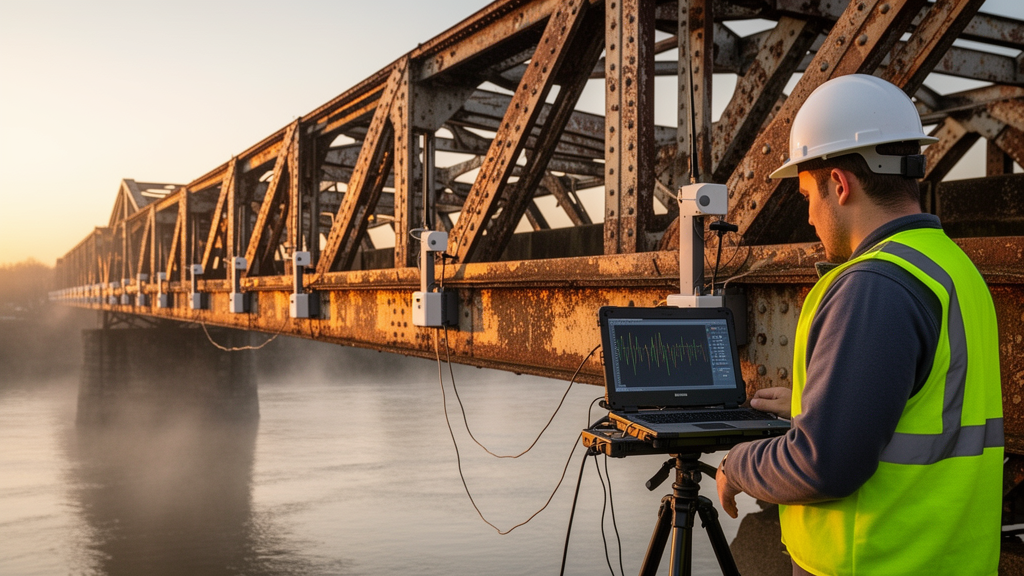
Deep inside every bridge, high-rise, and offshore platform, a quiet conversation is constantly taking place between the structure and the physical world. Sensors scattered across steel beams and concrete joints record the tiniest vibrations as wind, traffic, and temperature wash over the building. Structural health monitoring, as engineers call this practice, turns a building into something like a patient wearing a heart monitor: every gust of wind produces a heartbeat, and every hidden crack subtly changes its rhythm. The challenge has always been that the most dangerous ailments, the local damage that begins in a single weld or connection, often whisper rather than shout. A new study published in Scientific Reports by Bo Xie, Jian Cui, and Naiwei Lu of Changsha University of Science and Technology, working with Bo Xie’s industry affiliation at CCCC Road & Bridge South China Engineering, presents an artificial intelligence framework designed to hear exactly those whispers, and it does so with an accuracy that could reshape how infrastructure is watched over.
The core problem the researchers confronted is one that has frustrated structural engineers for decades. When damage appears in a steel structure, it rarely announces itself with dramatic changes in global vibration behavior. Instead, the dynamic response of the structure shifts in ways so subtle that they can be drowned out by measurement noise, environmental variability, and the sheer complexity of the signal itself. Traditional damage identification methods, which often rely on extracting specific features from vibration data such as natural frequencies or mode shapes, struggle when the damage is localized and the signal-to-noise ratio is poor. The research team’s answer was to stop treating vibration data as a stream of numbers and start treating it as an image, allowing the full pattern-recognition power of modern deep learning to be brought to bear on the problem.
The transformation from signal to image is accomplished through a technique called a Markov transition field, or MTF. To understand what this does, imagine taking a long vibration recording and dividing its amplitude range into a finite number of bands, a process the researchers carried out using approximate equal-frequency binning so that each band contains roughly the same amount of data. Every moment in the recording is then assigned to one of these states. The MTF image is built by asking, for every pair of time points in the signal, how likely is it that the system transitions from the state at one moment to the state at the other. The result is a two-dimensional grid, an image in which the hidden temporal dynamics of the vibration are laid bare as spatial patterns. Subtle damage signatures that would be nearly invisible in a raw time series become visible textures that a convolutional neural network can learn to recognize.
But the researchers did not stop at simply converting data into pictures. They recognized that not all parts of an MTF image are equally informative, and that a network capable of deciding where to look would outperform one that treats every pixel with equal weight. Their solution was to embed a mechanism called coordinate attention, or CA, directly into the residual blocks of a deep convolutional network. Coordinate attention is a refinement of the broader family of attention mechanisms that have transformed machine learning in recent years. Rather than compressing spatial information into a single global descriptor, coordinate attention decomposes the feature maps along one-dimensional directions, performing coordinate pooling separately along the height and width axes. This allows the network to jointly calibrate spatial and channel information, essentially teaching it both what features matter and where in the image those features are located.
The backbone of the framework is ResNet-50, a fifty-layer residual network whose skip connections allow gradients to flow through very deep architectures without vanishing. By weaving coordinate attention into the residual blocks, the researchers created a hybrid that combines the representational depth of a proven architecture with the selective focus of attention. The network was validated on two widely respected experimental platforms: the Qatar University Grandstand Simulator, known as QUGS, and the IASC-ASCE benchmark structure, a standardized testbed that has served the structural health monitoring community for years. These are not toy problems. They are physical structures with realistic geometry, realistic boundary conditions, and realistic damage scenarios, which makes the results far more meaningful than demonstrations on synthetic data alone.
The comparative experiments were thorough and revealing. The researchers pitted the Markov transition field against three other image-encoding methods: the Gramian angular difference field, which transforms time series into a matrix of angular relationships; the recurrence plot, which visualizes recurring patterns in dynamical systems; and the short-time Fourier transform, the classical tool for viewing a signal in both time and frequency. Across the benchmarks, MTF generally outperformed all three alternatives, suggesting that the probabilistic transition structure it captures is particularly well suited to the kind of subtle, local changes that damage produces in vibration data. This finding alone offers practical guidance to engineers choosing how to preprocess monitoring data for machine learning pipelines.
The attention mechanism itself also proved its worth in head-to-head comparisons. Under noise-free conditions, the full framework, ResNet-50 enhanced with coordinate attention, achieved an identification accuracy of 94.5 percent. More importantly, the model demonstrated strong robustness under noisy conditions, which is where many competing approaches falter. Real-world sensor data is never clean; it carries electrical interference, environmental fluctuations, and quantization artifacts. A damage detection system that only works in the laboratory is of limited value, so the noise robustness results may prove to be the most consequential finding of the study. The researchers also compared their approach against baseline models, confirming that the combination of MTF encoding and coordinate attention delivers benefits that neither component achieves alone.
One of the most compelling aspects of the study is the feature visualization analysis, which offers a window into what the network actually learns. The results show that coordinate attention suppresses irrelevant redundancy in the MTF images through coordinate-aware spatial modeling. In plain terms, the attention mechanism learns to ignore the parts of the image that carry no diagnostic information and to concentrate on the regions that distinguish damaged from undamaged states. The consequence is visible in the learned feature space: the network produces highly compact and nearly non-overlapping feature clusters, with the best discriminability among the configurations tested. When a model’s internal representations cleanly separate the classes it must distinguish, it is a strong sign that the model has learned something genuinely meaningful about the physics rather than memorizing artifacts of the training data.
The implications of this work extend well beyond the laboratory benchmarks on which it was validated. Civil infrastructure around the world is aging, and the cost of inspecting bridges, buildings, and industrial facilities by traditional means is enormous. Continuous monitoring systems generate torrents of vibration data, but the bottleneck has always been turning that data into actionable decisions about safety and maintenance. A framework that can automatically identify local damage from raw sensor streams, with high accuracy and resilience to noise, moves the field closer to that goal. The open-access publication of the study under a Creative Commons license also means that the methodology is freely available to researchers and practitioners worldwide, potentially accelerating adoption and further refinement.
There remain, of course, questions that future work must address, as with any method validated on two experimental platforms. Real structures face temperature swings, loading variability, and sensor degradation that no benchmark can fully reproduce. Yet the direction is clear and the results are striking. By teaching a deep neural network to look at vibration data as an image and to pay attention to exactly the right places, Xie, Cui, and Lu have shown that the faintest structural whispers can be amplified into clear, actionable signals. As cities grow taller and infrastructure grows older, the buildings that surround us may soon be watched over by algorithms that notice a crack long before any human eye could, and that quiet vigilance may one day be the difference between routine maintenance and catastrophe.
Subject of Research: Deep learning-based structural damage detection using Markov transition field image encoding and coordinate attention on structural health monitoring vibration data
Article Title: An attention-enhanced residual network framework for structural damage detection based on structural health monitoring data
Article References: Xie, B., Cui, J., & Lu, N. (2026). An attention-enhanced residual network framework for structural damage detection based on structural health monitoring data. Scientific Reports. https://doi.org/10.1038/s41598-026-73433-7
Image Credits: AI Generated
DOI: 10.1038/s41598-026-73433-7
Keywords: structural health monitoring, damage detection, deep learning, coordinate attention, Markov transition field, ResNet-50, vibration analysis, convolutional neural network, civil engineering, machine learning, structural dynamics, noise robustness
News Source: Blake Davidson. (October 16, 2026). AI That Watches Bridges Breathe: Attention-Enhanced Neural Network Spots Hidden Structural Damage. Scienmag.