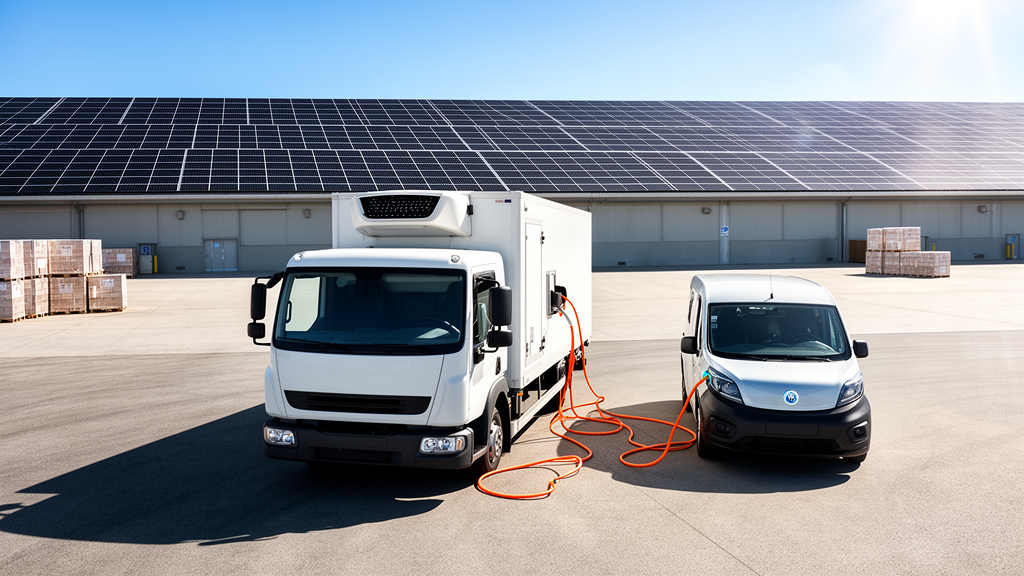
Every time a conventional freezer truck parks to make a delivery, its diesel engine keeps idling, burning fuel for hours just to keep the cargo bay cold. That hidden engine workload produces greenhouse gases, noise, and wear on machinery, and it has long been accepted as an unavoidable cost of the cold chain. A research team led by Ka Wai Eric Cheng of the University of California, Merced, together with Xiangdang Xue of The Hong Kong Polytechnic University, has now built and tested a working alternative: a solar-powered freezer truck that runs its refrigeration unit entirely from photovoltaic panels and batteries, eliminating refrigeration-related emissions and dramatically cutting noise. Their study, published in Frontiers in Electronics, also adds a surprising twist drawn from connected vehicle technology: the trucks can share stored energy with one another, effectively turning a fleet of delivery vehicles into a distributed, mobile cold-storage network.
The scale of the problem the researchers set out to address is considerable. Refrigeration units on conventional trucks draw their power from the vehicle’s fuel engine, which must run both while driving and while parked for extended loading or unloading periods. According to the authors, the greenhouse gas emissions from diesel-driven vapor compression refrigeration units can reach as much as 40 percent of a vehicle’s total automobile emissions. Beyond the climate impact, the constant idling wastes fuel, adds mechanical complexity, and generates noise pollution in urban delivery zones. With e-commerce and online grocery shopping driving explosive growth in last-mile cold delivery, the researchers argue that a cleaner architecture for transport refrigeration has become both technically feasible and urgently needed.
The heart of the new design is a multiple-input energy system that gives the truck unusual flexibility in how it sources and routes power. Four distinct energy inputs feed the system: solar energy captured by rooftop photovoltaic panels, energy stored in an onboard lithium-ion battery, plug-in alternating current from the grid, and battery energy transferred from an external source, which in testing was the onboard battery of another electric vehicle. The power electronics chain includes a maximum power point tracking (MPPT) controller that squeezes the maximum available DC power from the solar modules, a DC-AC inverter producing rated three-phase voltage of 380 volts, a variable speed drive (VSD) that regulates the compressor motor, and a bidirectional DC-DC converter that can move energy in either direction between the truck’s battery and an external battery pack.
That bidirectional converter is what enables the connected vehicle function. In the researchers’ concept, several freezer trucks can link their energy storage systems so that batteries support one another, strengthening overall energy utilization across the fleet. The team argues this goes beyond mere convenience: because freezer storage in buildings is limited by high land and construction costs, a group of parked freezer trucks with shared energy could operate as a large-scale, relocatable food storage facility with separate compartments for different temperature requirements. The connected system can even integrate with the power distribution network, feeding surplus solar energy generated during the day back into the grid and allowing the grid to top up the trucks when needed.
Managing this web of energy flows requires a sophisticated control strategy, and the paper details an optimal energy management scheme built around fifteen distinct energy management modes. These modes fall into four categories: five modes for charging the onboard battery, four for powering the AC compressor, three for charging the battery and running the compressor simultaneously, and three for charging an external battery. The strategy pursues several objectives at once: matching energy supply to the compressor’s demand, maximizing photovoltaic output, keeping the battery operating within its high-efficiency state-of-charge window, and extending the battery’s service lifetime. The authors also present a set of design equations that relate the average freezer power, solar availability, door-opening durations, grid draw, and battery capacity, allowing engineers to size the energy storage for a given number of days of autonomous operation.
The prototype itself is a substantial piece of engineering. Two photovoltaic modules, with a combined maximum power of 2.52 kilowatts, are installed on the truck: one fixed on the roof and one movable, driven by an actuation unit. When the truck is being driven, only the fixed panel operates; when parked, the movable panel slides out beside the fixed one, expanding the collecting area. The refrigeration chamber holds 15 cubic meters and can reach a lowest temperature of minus 35 degrees Celsius. The onboard lithium-ion battery stores 9.6 kilowatt-hours of rated energy, supported by a 6.5-kilowatt MPPT controller, a 10-kilowatt inverter, a 7.5-kilowatt variable speed drive, and converters rated at 2.5 and 1.5 kilowatts. For a two-day storage design, the team calculated an average freezer power of 2.6 kilowatts against 5.8 hours of daily solar time.
Experimental validation of the prototype covered every major subsystem. The AC-DC converter charged the onboard battery from a plug-in supply at 100.6 volts and 24.9 amperes, while the DC-DC converter demonstrated the connected vehicle function in both directions, charging the truck’s battery from a 5-kilowatt-hour, 48-volt external battery taken from another electric vehicle, and conversely delivering power from the truck’s own battery back out to the external pack. The inverter delivered 5.8 kilowatts to the variable speed drive, which powered the compressor at 369 volts and 50 hertz. The fixed and movable solar panels produced outputs of roughly 122.5 and 120.7 volts respectively, and the chamber successfully cooled to the target minus 35 degrees Celsius. The researchers note that this vehicle-to-vehicle battery sharing capability has not been reported in existing commercial systems.
The comparative numbers against diesel refrigeration are striking. A conventional diesel-driven freezer truck consumes approximately 3 to 3.4 liters of diesel per hour of operation. Assuming 2,500 operating hours per year, that amounts to roughly 7,570 liters of diesel annually, which at an emission factor of 2.68 kilograms of CO2 per liter translates to about 20,300 kilograms of carbon dioxide per truck per year, all of it eliminated in the solar-powered design. Nitrogen oxide emissions, estimated at 0.232 grams per kilometer for a heavy-duty vehicle, would total around 5.8 kilograms per year on a 100-kilometer daily urban route operated 250 days a year, again reduced to zero for the refrigeration function. The team reports an operating cost reduction of 81 percent relative to the diesel counterpart, with solar energy contributing between 73 and 100 percent of the refrigeration demand. The prototype’s performance aligns with industry benchmarks such as the Sunswap Endurance trial, which achieved 22 hours of frozen cooling on a single charge.
The next stage of the project brings artificial intelligence into the control loop. The researchers plan to use AI algorithms to predict upcoming refrigeration demand based on driving routes, weather forecasts, and the number of planned door openings, optimizing battery usage so the unit never runs out of power. A predictive thermal load model is being developed in which learned coefficients, trained on historical trip data, estimate the freezer’s workload from factors such as the temperature difference between the ambient environment and the desired internal temperature, solar irradiance heating the truck’s walls, and the predicted number of door openings at delivery stops. Data collection for accurate predictive modeling is ongoing, and preliminary findings already show a marked decrease in overall fuel requirements.
The broader implications reach well beyond a single prototype. By decoupling the refrigeration unit from the vehicle engine, the design improves reliability, since an engine failure no longer threatens the cold chain, and reduces maintenance through fewer moving parts. Fleets of connected solar freezer trucks could, in the authors’ vision, replace fixed cold-storage warehouses with flexible, relocatable capacity, reducing licensing and approval requirements and shortening food transportation distances. As the demand for perishable goods and direct-to-consumer fresh delivery continues to climb, the study offers a concrete, experimentally verified template for how photovoltaics, battery storage, intelligent energy management, and vehicle-to-vehicle power sharing could together clean up one of the most energy-hungry corners of the modern food supply chain.
Subject of Research: Solar-powered freezer truck design with photovoltaic-battery energy management and connected vehicle energy sharing
Article Title: Examination of a solar-powered freezer truck with connected vehicle technology
Article References: Cheng, K. W. E., & Xue, X. (2026). Examination of a solar-powered freezer truck with connected vehicle technology. Frontiers in Electronics, 7, Article 1824841. https://doi.org/10.3389/felec.2026.1824841
Image Credits: AI Generated
DOI: 10.3389/felec.2026.1824841
Keywords: solar power, photovoltaics, freezer truck, refrigerated transport, energy management, connected vehicles, vehicle-to-vehicle, lithium-ion battery, emissions reduction, cold chain, power electronics, artificial intelligence
News Source: Faith Mcneil. (October 16, 2026). Solar-Powered Freezer Truck Ditches Diesel and Shares Battery Power Between Vehicles. Scienmag.