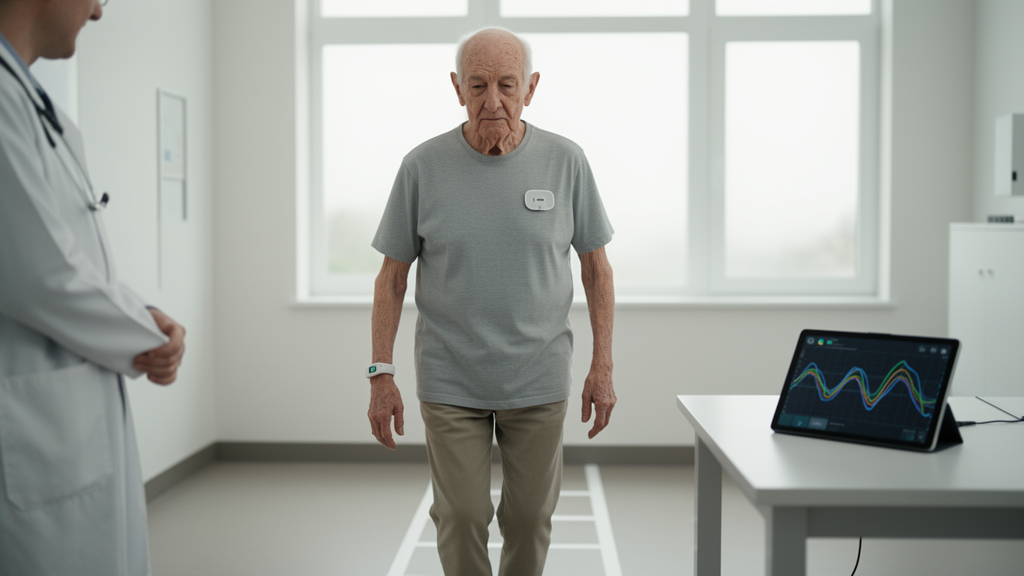
For two decades, researchers have been strapping motion sensors onto people with Parkinson’s disease in the hope of capturing what a brief clinic visit can never show: the minute-to-minute reality of tremor, slowness, freezing and medication-driven fluctuation as patients actually live with them. A new bibliometric analysis published in Frontiers in Neuroinformatics has now mapped that entire scientific enterprise for the first time at global scale, tracing more than 3,300 publications from January 2005 through early February 2026 and revealing a field that has quietly exploded from a niche engineering pursuit into one of the fastest-growing corners of digital neurology.
The study, conducted by Lan Xiong of the First People’s Hospital of Guangyuan in Sichuan, China, retrieved records from the Web of Science Core Collection and Scopus, merged and deduplicated them, and retained 3,332 publications for analysis. Roughly 94 percent were original research articles, a signal that the field remains driven by primary experimentation rather than consolidation. The growth curve is striking: annual output stayed below 100 papers per year before 2019, then accelerated sharply, exceeding 700 papers by 2025. The trajectory fits an exponential growth model with a coefficient of determination of 0.9442, a fit the author attributes largely to concurrent advances in artificial intelligence and the normalization of remote care.
The analytical machinery behind the mapping combined several established bibliometric tools. Microsoft Excel handled deduplication and annual trend summaries; VOSviewer 1.6.20 constructed co-authorship, co-citation and keyword co-occurrence networks; CiteSpace 6.4.R1 performed clustering, timeline visualization, centrality assessment and citation burst detection; and the bibliometrix R package computed source impact indicators such as the h-index, g-index and total citations. To make sure the underlying search was trustworthy, the author validated it against a benchmark cohort of eight highly relevant papers spanning continuous ambulatory tracking, freezing-of-gait detection and smartphone-based assessment; the query retrieved seven of the eight benchmark texts, a sensitivity of 87.5 percent across both databases.
The authorship landscape reveals how strongly the field is anchored by a small group of movement-disorder specialists. Martina Mancini of Oregon Health and Science University leads the rankings with 88 publications and 3,968 citations, followed closely by her longtime collaborator Fay Horak with 76 publications and 3,571 citations. Bastiaan Bloem of Radboud University, Jeffrey Hausdorff, Walter Maetzler, Lynn Rochester and Lori Chiari round out a dense collaborative network whose intellectual roots lie in quantitative gait analysis. Institutionally, Tel Aviv University emerges as the most prolific center with 123 articles, ahead of Oregon Health and Science University’s 101, with Radboud, the University of California System and Harvard forming prominent nodes in the collaboration network.
Geographically, the United States dominates, contributing 289 papers and 14,961 total citations, with China second at 206 publications; both nations accelerated notably after 2019. But the collaboration patterns differ in an instructive way. The U.S. and China show high proportions of single-country publications, reflecting strong independent domestic research bases, while European countries, particularly Italy, Germany and the United Kingdom, act as hubs of multinational collaboration. The author argues this reflects the demands of digital phenotyping itself: building robust sensor-based tools requires not only bioengineering expertise but also movement-disorder centers with well-characterized patient cohorts, a combination that European consortia have cultivated deliberately.
The journal analysis exposes a telling asymmetry at the heart of the field. Engineering venues dominate raw output: the journal Sensors alone published 311 of the 3,332 papers, followed by the Journal of Neuroengineering and Rehabilitation and a cluster of IEEE publications. Yet the most clinically influential journal, Movement Disorders, contributed fewer than 50 primary articles to the dataset while maintaining one of the highest citation impacts in the co-citation network. Dual-map overlay of citation flows confirms robust bridges between technical clusters, such as sensors, physics and bioengineering, and clinical domains like neurorehabilitation and movement disorders. In other words, technological feasibility is racing ahead while rigorous clinical validation in top-tier neurology journals remains comparatively scarce, and correspondingly precious.
The historiographic picture the study paints is one of three overlapping eras. The most-cited foundational papers, led by Shyamal Patel’s 2009 work on monitoring motor fluctuations with wearable sensors and Arash Salarian’s 2007 quantification of tremor and bradykinesia using an ambulatory monitoring system, established whether core Parkinsonian features could be measured reliably outside the exam room at all. Early keyword clusters centered on ambulatory monitoring, inertial signal acquisition and gait detection, with citation burst analysis showing the strongest early bursts for exactly those terms. From roughly 2015 to 2020, the emphasis shifted toward algorithms: support vector machines and other classifiers for detecting freezing of gait, falls and specific motor signs, evaluated through sensitivity, specificity and agreement with clinician ratings.
The most recent phase is unmistakably artificial intelligence. Keyword burst detection from 2024 through 2026 shows strong surges for artificial intelligence, digital biomarker and, perhaps most suggestively, local field potential. Deep learning models now attempt to translate continuous free-living sensor streams into clinically meaningful metrics, including remote estimation of MDS-UPDRS scores, and smartphone-based systems have reported promising performance for quantifying overall disease severity. At the same time, a prominent cluster around deep brain stimulation has risen alongside traditional kinematic assessment, pointing toward adaptive, closed-loop neuromodulation in which external kinematics fuse with internal brain signals to tailor stimulation dynamically to symptom fluctuations. The study cautions, however, that this frontier carries real technical hurdles, including real-time artifact rejection and multimodal data integration, and that its safety and long-term efficacy demand rigorous clinical validation.
Crucially, the analysis is explicit about what its maps do and do not prove. High publication volume signifies research enthusiasm and technical feasibility, not demonstrated clinical utility. Reported performance figures vary widely and resist direct comparison because studies differ in target symptoms, sensor configurations, datasets, reference standards, disease stages and validation strategies; a high accuracy figure from one laboratory cannot be assumed to generalize. Sensor-derived metrics are also highly susceptible to confounders, including disease stage, medication-induced fluctuations, comorbidities and even where the device sits on the body. The author therefore frames bibliometric prominence as evidence that concepts like digital biomarkers have become research priorities, not as evidence that they have achieved analytical validity, clinical validity or clinical utility, distinctions that regulatory initiatives such as digital endpoint qualification and the Critical Path for Parkinson’s Consortium are working to establish.
The roadmap that emerges from the study is less about building new gadgets and more about building trust. The author calls for standardized data collection and reporting protocols covering device placement, sampling frequency, preprocessing, task definitions and missing-data handling; multicenter real-world validation across diverse populations and medication cycles; and longitudinal studies that test whether digital measures actually track clinically meaningful change over time rather than merely agreeing with clinic-based scales at a single moment. Workflow integration is framed as the decisive bottleneck: clinicians need concise, interpretable summaries with uncertainty estimates rather than raw sensor streams, and patients need systems that minimize burden and protect privacy. Multimodal data fusion combining movement signals with physiology, imaging, electrophysiology and patient-reported outcomes, along with cautious exploration of closed-loop stimulation, marks the field’s higher-risk frontier. If the past twenty years were about proving sensors could see Parkinson’s disease in the wild, the next phase, on this evidence, will be about proving that what they see can safely change what doctors do.
Subject of Research: Bibliometric mapping of wearable sensor and digital health research in Parkinson's disease from 2005 to 2026
Article Title: Digital health meets Parkinson’s disease: a bibliometric exploration of wearable sensors research and emerging frontiers (2005–2026)
Article References: Xiong, L. (2026). Digital health meets Parkinson’s disease: a bibliometric exploration of wearable sensors research and emerging frontiers (2005–2026). Frontiers in Neuroinformatics, 20, Article 1937585. https://doi.org/10.3389/fninf.2026.1937585
Image Credits: AI Generated
DOI: 10.3389/fninf.2026.1937585
Keywords: Parkinson's disease, wearable sensors, digital biomarkers, bibliometric analysis, artificial intelligence, remote monitoring, freezing of gait, deep brain stimulation, machine learning, gait analysis, digital health, closed-loop neuromodulation
News Source: Cassandra Pierce. (October 16, 2026). Wearable Sensors and AI Are Rewriting How Parkinson’s Disease Is Measured, Landmark Study Finds. Scienmag.