The pharmaceutical industry has a dirty secret that has been hiding in plain sight for decades: the models it relies on to predict whether a new drug will work in humans are, more often than not, wrong. Only about 10% of drug candidates entering Phase I clinical trials ever reach approval, each failure burning through a budget that now exceeds $1 to $2 billion per drug over timelines of 10 to 15 years. The decline in research and development efficiency is so relentless that economists have dubbed it Eroom’s Law, the grim mirror image of Moore’s Law, with the number of new drugs approved per billion dollars invested falling roughly 80-fold in inflation-adjusted terms since the 1950s. Now, a sweeping systematic review published in the Journal of Pharmacy and Pharmaceutical Sciences offers the first rigorous, quantitative map of a technological alliance that many believe could break this curse: the pairing of microphysiological systems, the lab-grown organ-on-chip devices that mimic human organs, with computational digital twin models capable of predicting how a drug will behave in a living person.
The review, conducted by researchers at Western New England University, Princeton University, Jahrom University of Medical Sciences, and Kurdistan University of Medical Sciences, followed PRISMA 2020 guidelines and screened 2,044 records from PubMed and Europe PMC covering literature from January 2010 through December 2025. After a two-stage automated screening process verified independently by two researchers, 123 studies met the inclusion criteria, each one combining an experimental microphysiological system with a computational model such as physiologically based pharmacokinetic modeling, quantitative systems pharmacology, in vitro-to-in vivo extrapolation, or machine learning. What emerged from the synthesis is a portrait of a field in explosive adolescence: publication output has been compounding at roughly 35% per year, and nearly 38% of all qualifying studies appeared in 2024 and 2025 alone.
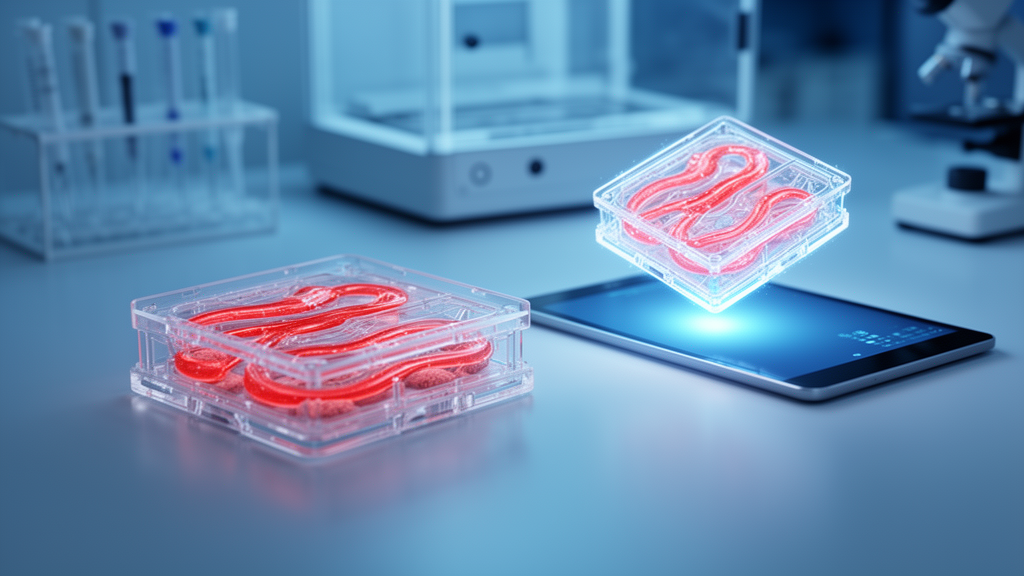
To understand why this integration matters, it helps to grasp what each half brings to the table. Microphysiological systems are multicellular culture platforms engineered to recreate the physiological conditions of specific organs, complete with three-dimensional tissue architecture, mechanical forces such as stretch and fluid perfusion, and the cell types that make an organ function, including parenchymal cells, endothelial barriers, and immune cells. The field’s founding moment came in 2010, when Donald Ingber and colleagues at Harvard’s Wyss Institute built a lung-on-a-chip that reproduced the alveolar-capillary interface and demonstrated that cyclic breathing motions amplified inflammatory and toxic responses, something no static petri dish could ever capture. In the years since, chips have been built for virtually every major organ, and sophisticated multi-organ platforms now link human heart, liver, bone, and skin niches through recirculating vascular flow, generating pharmacokinetic profiles that begin to resemble those of an actual body.
But even the most elegant chip produces data that must be translated into predictions about intact humans, and that is where the computational half comes in. Physiologically based pharmacokinetic models represent the body as a network of compartments connected by blood flow, mechanistically predicting absorption, distribution, metabolism, and excretion from a drug’s physicochemical properties. Quantitative systems pharmacology models go further, folding disease biology and drug mechanism into mathematical frameworks that can forecast therapeutic outcomes. The digital twin concept binds these two worlds together through bidirectional information flow: the virtual model is initialized and calibrated with measurements from the physical system, and its predictions, in turn, guide which experiments to run next. In principle, this creates a continuously learning loop in which a chip’s human-relevant biology feeds a model that can simulate thousands of virtual drug trials before a single animal is touched.
The systematic review reveals exactly where this synergy has matured and where it remains embryonic. The liver dominates the landscape, appearing in 30.9% of studies, followed by vasculature at 19.5%, the gut at 18.7%, and immune components at 17.1%. This distribution is no accident: hepatic metabolism is the single most important determinant of drug clearance, and drug-induced liver injury remains one of the costliest reasons for late-stage clinical failures. Crucially, a gap analysis showed that only two organ-model pairings qualify as genuinely established, defined as more than five studies each: liver with physiologically based pharmacokinetic modeling, and liver with pharmacokinetic modeling. Countless combinations, particularly involving the kidney, lung, brain, skin, and pancreas, remain unexplored. Kidney, brain, and tumor models each appeared in just over 10% of studies, while lung, heart, and pancreas hovered near 5%, and skin registered a mere 1.6%.
The technical infrastructure underpinning the field is equally revealing. Among commercial platforms, Emulate led with 55.8% of citations, followed by Mimetas at 23.3% and CN Bio at 19.2%, yet custom and academic-built platforms still accounted for 74.2% of systems used, a sign that innovation remains distributed and that standardization is incomplete. On the software side, MATLAB was the most frequently reported computational environment, appearing in 20% of full-text analyzed studies, ahead of dedicated pharmacokinetic suites such as Simcyp, GastroPlus, and PK-Sim. Microfluidic designs dominated platform architecture at 76.7%, with polydimethylsiloxane as the fabrication material of choice in roughly half of studies, and 48.3% of platforms described explicit multi-organ configurations. Notably, adoption of multi-organ systems accelerated sharply after 2021, reflecting a growing recognition that organ-organ interactions, such as enterohepatic recirculation between gut and liver, are essential for accurate whole-body pharmacokinetic prediction.
Perhaps the most encouraging finding concerns validation, the make-or-break criterion for regulatory acceptance. A striking 95.8% of studies discussed comparisons with clinical or human data, and 77.5% reported quantitative accuracy metrics such as average fold error, the same standard regulators apply to physiologically based pharmacokinetic model qualification. The benchmark here is the Emulate Liver-Chip, which in a blinded assessment of 27 compounds recommended by the industry’s Innovation and Quality consortium achieved 87% sensitivity and 100% specificity for predicting drug-induced liver injury, dramatically outperforming the 50 to 60% concordance typical of animal toxicity studies. Animal models fail so often because species-specific differences in drug metabolism, immune responses, and disease mechanisms make rodent and non-rodent data unreliable guides to human outcomes, and methodological weaknesses like inadequate randomization and publication bias compound the problem.
The regulatory ground has shifted beneath all of this in ways that would have seemed unthinkable a few years ago. The FDA Modernization Act 2.0, signed in December 2022, eliminated the federal mandate for animal testing that had stood since 1938, explicitly defining cell assays, organ chips, microphysiological systems, and computer modeling as acceptable nonclinical tests. In September 2024, the first organ-on-a-chip, a Liver-Chip designed to predict drug-induced liver injury, was accepted into the FDA’s ISTAND pilot qualification program, and in April 2025 the agency announced a roadmap for phasing out animal testing in preclinical safety studies, beginning with monoclonal antibodies. Economic modeling based on the Liver-Chip’s validated performance suggests that routine adoption could save the pharmaceutical industry more than $3 billion annually by catching hepatotoxic drugs earlier, rescuing safe compounds wrongly flagged by insensitive assays, and accelerating go/no-go decisions.
Yet the review also punctures some hype with unsparing honesty. Despite the digital twin branding, most studies sit at the lower rungs of a maturity spectrum: the majority perform one-directional parameter transfer or one-time model calibration rather than the closed-loop, continuously updated coupling that defines a true twin. A manual review of the twelve machine-learning studies found that only one actually trained a predictive model on chip-derived data, a neural network predicting oxygen transport from vascularized chip morphology, while most used machine learning for image analysis or discussed it without applying it. And on the economics, the picture is nearly blank: while 92.5% of studies mentioned efficiency gains and 73.3% invoked animal reduction, only 10.8% cited dollar figures and not a single study performed a formal cost-effectiveness or cost-benefit analysis. The authors argue that liver-focused applications are now mature enough to serve as a template, and that the priority frontiers are kidney, lung, and brain integration, multi-organ systems paired with multi-compartment models, standardized parameter extraction, uncertainty quantification, shared benchmark datasets, and the health-economic evidence that will convince pharmaceutical decision-makers to abandon a century of dependence on animal testing.
Subject of Research: Integration of microphysiological systems with digital twin computational modeling for pharmaceutical development
Article Title: Integration of microphysiological systems with computational and digital twin modeling for pharmaceutical development: a systematic review
Article References: Soheili, M., Gilzad Kohan, B., Rastegar, L., Moradi, Y., & Gilzad Kohan, H. (2026). Integration of microphysiological systems with computational and digital twin modeling for pharmaceutical development: a systematic review. Journal of Pharmacy & Pharmaceutical Sciences, 29, Article 16454. https://doi.org/10.3389/jpps.2026.16454
Image Credits: AI Generated
Keywords: microphysiological systems, organ-on-chip, digital twin, PBPK modeling, drug development, pharmacokinetics, drug-induced liver injury, FDA Modernization Act 2.0, machine learning, IVIVE, preclinical testing, systematic review
News Source: Ophelia Keating. (October 16, 2026). Organ-on-Chip Meets Digital Twin: Systematic Review Maps the Future of Drug Development. Scienmag.