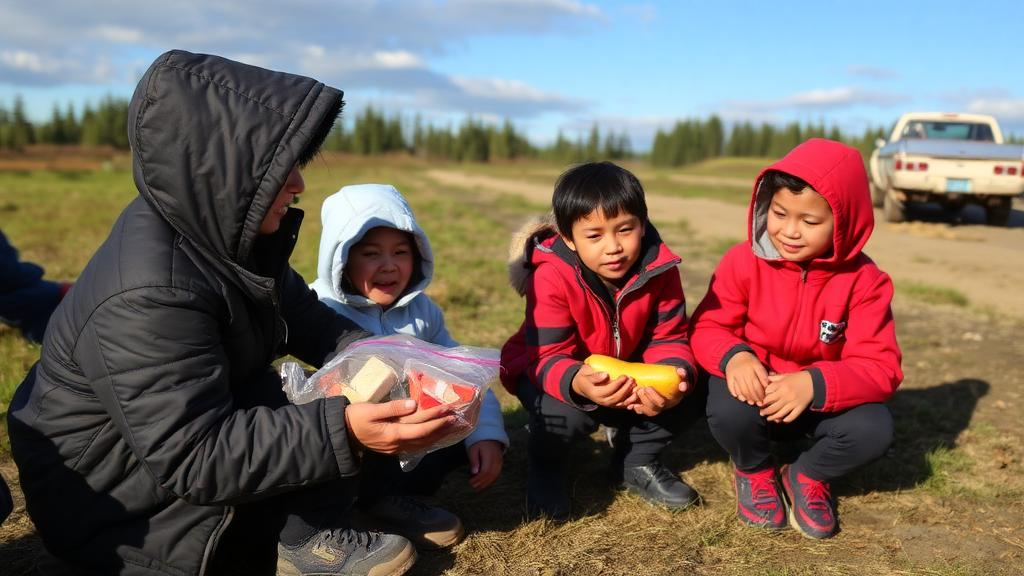
In the high latitudes of the planet, warming is not an abstract forecast but a lived daily reality. Permafrost thaws, sea ice retreats, river regimes shift, and the seasons that northern peoples have read for millennia grow less predictable. A new study published in BMC Medicine by Karsten Hueffer of the University of Alaska Fairbanks and a large interdisciplinary team, including researchers from the Center for Alaska Native Health Research and community partners, set out to answer a deceptively simple question: when rural Alaska Native communities themselves are asked what matters most for their health in a changing climate, what do they say? The answer, drawn from systematic community-engaged research conducted between August and December 2024, is both striking in its consistency and sobering in its implications for how climate and health research is usually done.
The methodological core of the study is Q-methodology, a mixed qualitative-quantitative technique that occupies a distinctive niche in the social and health sciences. Unlike conventional surveys that impose predetermined response categories on participants, Q-methodology presents individuals with a set of statements about a topic and asks them to rank these statements along a continuum, typically from most agreeable to most disagreeable. The resulting rankings are then analyzed statistically, often with factor analysis, to reveal clusters of shared viewpoints that exist across participants. The approach is powerful precisely because it lets the structure of opinions emerge from the data rather than from the assumptions of the researchers. In the context of this study, it allowed the team to engage community members directly, prioritize the issues most locally relevant, and identify concrete targets for future interventions, all while generating quantitative consensus data that can guide funding and policy decisions.
The research was carried out in four rural Alaska Native communities, places that have long navigated significant health disparities with limited resources and that sit on the front line of accelerated high-latitude climate change. The work was reviewed by the University of Alaska Institutional Review Board and by the Yukon Kuskokwim Health Corporation’s Executive Board of Directors, and it followed both the principles of the Helsinki Declaration and the supplemental guidance of the National Institutes of Health on the responsible management and sharing of American Indian and Alaska Native participant data. Every participant provided informed consent. These procedural details matter: research with Indigenous communities has a fraught history, and the study’s design reflects a growing movement toward community-driven science in which communities are partners and priority-setters rather than passive subjects.
What emerged from the rankings was a remarkably coherent picture. Three priorities rose consistently to the top across the participating communities: food security, Indigenous knowledge and practices, and the transmission of culture and traditional ways of living to younger generations. These are not three separate concerns but, as the authors emphasize, three strands of a single braid. Community perspectives reflected a holistic view of health in which climate change is understood not merely as an environmental stressor but as a force that connects individual health and community well-being through the social-ecological landscape. The land, the waters, the animals, and the practices that bind people to them form an integrated system, and threats to any part of that system ripple through all of it.
The centrality of food security in the findings deserves particular attention. In rural Alaska, subsistence harvesting of fish, marine mammals, caribou, moose, berries, and other wild foods is not a lifestyle preference; it is the material and cultural foundation of community nutrition and identity. Store-bought food in remote villages is expensive, often less nutritious, and logistically vulnerable to weather and supply-chain disruption. When climate change alters the timing of salmon runs, the stability of river ice, or the migration routes of game, it strikes directly at the food system that communities depend on to subsist and thrive. The study’s participants ranked these impacts on traditional ways of living from the land as their foremost climate-related health concern, a finding that reframes food security in the Arctic as inseparable from environmental stewardship and cultural continuity.
Equally significant is the prominence of Indigenous knowledge and practices in the consensus rankings. Indigenous knowledge systems encode detailed, place-based understanding of weather, ice, animal behavior, and seasonal cycles, refined over generations of observation and adaptation. This knowledge is not static; it is dynamic and adaptive, and it has allowed northern peoples to survive at the extremes of weather for thousands of years. But knowledge is only as resilient as its transmission. The study found that the well-being and futures of young people arose as a primary shared concern across communities, pointing toward interventions that engage youth in the transmission of traditional knowledge and practices on the land. In other words, the participants identified the next generation as both the most vulnerable link and the most promising point of intervention.
This youth-centered finding carries substantial implications for public health practice. Conventional climate-health frameworks often emphasize physical hazards such as heat, storm damage, or vector-borne disease, and these are certainly relevant in a warming North. Yet the communities in this study directed attention toward a different set of mechanisms: the psychological and social consequences of cultural disruption, the loss of intergenerational connection, and the erosion of the practices that give young people identity, purpose, and belonging. Research on Indigenous health has repeatedly shown that cultural continuity and self-determination are protective factors against a range of adverse outcomes. The Alaska findings align with that literature and suggest that climate adaptation programs which fail to invest in cultural transmission may miss the mechanisms that communities themselves consider most vital.
The study’s authors argue that a community-engaged approach of this kind can generate consensus data capable of steering research and interventions toward the highest needs and priorities of the communities most affected by climate change. That claim has practical weight. Funding agencies and health systems frequently design climate and health programs top-down, importing models developed in urban or temperate settings that map poorly onto Arctic realities. By contrast, a systematic, replicable method for eliciting and quantifying community priorities gives decision-makers a defensible, evidence-based mandate: place-based solutions that protect and preserve environmental resources, support subsistence livelihoods, and put young people on the land with elders who can pass on what they know. The study was supported in part by Phase I of the National Institutes of Health Agreement OT2HL158287, funded in 2023, indicating institutional investment in precisely this kind of community-partnered research infrastructure.
There is also a broader scientific lesson in the findings about how health itself should be conceptualized in the climate era. The holistic view expressed by participants, in which individual health, community well-being, food systems, and the social-ecological landscape form one connected whole, challenges the siloed structure of much biomedical research. Climate change acts on health through ecosystems, and ecosystems in the North are inseparable from the cultural practices that sustain both people and landscapes. A warming Arctic alters the resources embedded in local and Indigenous cultural practices, and those resources are, in the participants’ framing, precisely what health is made of. Understanding climate-health interactions therefore requires methods that can capture coupled human-environment systems, not just clinical endpoints measured in clinics.
As high-latitude warming continues to outpace the global average, the experience of rural Alaska Native communities offers a preview of challenges that will reach many other regions: destabilized food systems, threatened livelihoods, and the strain of environmental change on cultural continuity and mental health. What this study adds is a rigorous, community-driven demonstration of where those communities want the response to begin. Food security, Indigenous knowledge, and the futures of young people are not peripheral co-benefits of climate policy; in the communities at the extremes of weather and climate change, they are the core of health itself. The task now facing researchers, funders, and policymakers is to build interventions worthy of that clarity, grounded in place, sustained by partnership, and designed to keep both the land and the generations that depend on it whole.
Subject of Research: Community-identified climate change and health priorities in rural Alaska Native communities
Article Title: Health priorities for rural Alaska native communities at the extremes of weather and climate change
Article References: Hueffer, K., Brinkman, T., Robinson, H. D., Joseph, V., Chaliak, J. A., John, S., Clinton, M., Shaw, J., Peter, T., Bersamin, A., Allen, J., Azadda, R. D., Grogan-Kaylor, A., Lee, K., & Rasmus, S. (2026). Health priorities for rural Alaska native communities at the extremes of weather and climate change. BMC Medicine. https://doi.org/10.1186/s12916-026-05176-1
Image Credits: AI Generated
DOI: 10.1186/s12916-026-05176-1
Keywords: Alaska Native, climate change, health priorities, food security, Indigenous knowledge, Q-methodology, subsistence, cultural transmission, community-engaged research, Arctic, youth well-being, BMC Medicine
News Source: Sloane Callahan. (October 10, 2026). Climate Change Threatens Food, Culture and Youth in Rural Alaska Native Communities. Scienmag.