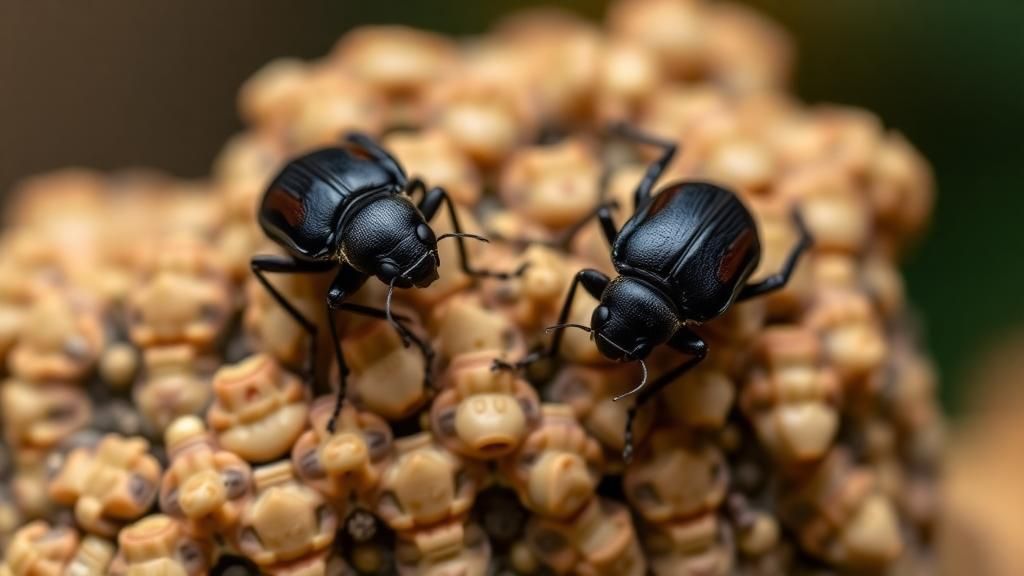
In one of the more striking examples of evolutionary recycling to emerge in recent years, scientists have discovered that tortoise beetles use a protein best known for painting the bodies of fruit flies to construct tiny protective capsules around the symbiotic bacteria their offspring need to survive. The finding, published in Nature Communications by researchers from the John Innes Centre, the Sainsbury Laboratory and the Max Planck Institute, reveals that a gene family studied for more than a century as a controller of pigmentation and behaviour has been quietly co-opted for an entirely different job: architecture.
The Yellow protein family has a storied history in biology. More than eighty years ago, scientists demonstrated that differences in yellow pigmentation were critical to courtship success and failure in fruit flies, one of the first clear demonstrations linking a specific gene to complex behaviour. Since then, the Yellow proteins that produce these shades in nature have remained a fruitful source of scientific inquiry, studied primarily as molecular painters that deposit pigment in tissues and influence how animals look, move and mate. The new study adds a surprising chapter to that long history, showing that in tortoise beetles the same protein has been repurposed as a structural building material.
The subject of the research is an intimate and ancient partnership. Tortoise beetles depend on a bacterium called Candidatus Stammera to digest their plant-based diet. The beetle feeds on plant tissue rich in pectin and cellulose, complex carbohydrates that the insect cannot break down on its own. Stammera supplies the digestive enzymes that make this diet possible, and in return it receives a home and a route into the next beetle generation. This mutualism is estimated to be around sixty million years old, and over that immense timescale the relationship has become so tight that neither partner can thrive without the other.
Stammera, in particular, has lost so much of its genome through the course of this partnership that it can barely survive independently. Its ability to spread is entirely dependent on the beetle. To transmit the symbiont, the female beetle packages the bacteria into small gelatinous spheres and glues them onto the outside of each of her eggs. There the encapsulated bacteria sit exposed to the outside world for around eleven days before the beetle larva hatches and eats the sphere along with its bacterial cargo, thereby acquiring the symbiont it will need for its own life on plants.
That exposed waiting period posed a puzzle. The research team wanted to know what these spherical structures were actually made from, and how the beetle manages to keep a fragile bacterium alive outside its body for so long. Bacteria are notoriously vulnerable to drying out, and an eleven-day exposure on the surface of an egg would ordinarily be lethal. Something in the composition of the spheres had to be providing protection, and identifying that something required a combination of genomic, biochemical and structural approaches.
To answer these questions, the researchers sequenced and assembled a reference genome for the tortoise beetle Chelymorpha alternans, the first reference genome ever produced for any tortoise beetle. Analysis of the genome showed that a gene coding for the Yellow protein is highly expressed in the ovary-associated glands of adult females, while its activity is almost undetectable in males. The gene is also highly conserved across multiple tortoise beetle species, a pattern consistent with an important and long-established function. This sex-specific, gland-specific expression pattern immediately suggested a role in the reproductive structures that house the symbiont.
The team then confirmed the connection using laboratory techniques combined with mass spectrometry, demonstrating that the Yellow protein was indeed present in the symbiont-bearing spheres. Structural modelling approaches went further, revealing that the spheres are built almost entirely from Yellow protein formed into a dense, glue-like matrix. In other words, the beetle manufactures its bacterial capsules from a single, abundant protein, one whose best-known relatives are famous for colouring insect bodies rather than constructing them.
The functional importance of the protein was tested directly. In experiments where the researchers knocked down the Yellow gene, the morphology of the spheres was disrupted, and the symbiont inside became more susceptible to drying out. The protein coat, it turns out, is not decorative but essential: it is what keeps the bacterium viable during its long wait on the egg surface. As Dr Hassan Salem, a group leader at the John Innes Centre, explained, a tortoise beetle mother wraps her bacterial partner in a protein coat, glues it to the outside of her egg, and that coat is what keeps the bacterium alive for over a week before her offspring can consume it and become infected. He described it as a nice example of evolution using an old tool for a completely new purpose.
The discovery did not come without surprise. Dr Salem noted that the team did not expect a gene from the Yellow family, best known for pigmentation and behaviour, to be responsible for something as physical as building a protective capsule around a bacterium. The finding adds to a growing pattern seen in insects, in which existing genes, often with a long evolutionary history, are repurposed to solve completely different challenges. Evolution, in this view, is less an engineer working from a blank page than a tinkerer who repurposes whatever parts are already on the workbench, and the Yellow protein’s second career as symbiont housing is a vivid illustration of that principle.
Beyond its evolutionary interest, the work has practical implications. Leaf beetles, the family to which tortoise beetles belong, are significant pests of crops, so the more researchers can reveal about how these insects function, the better they may be able to disrupt their activities. Because the beetles depend on Stammera to digest their food, the bacterial partner itself represents a potential vulnerability. The study may also inform strategies for engineering plants to resist herbivory by targeting the beetle’s bacterial symbiont, weakening the pest by undermining the digestion that makes its plant-feeding lifestyle possible. The next step for the research is to investigate how the Yellow protein forms the protective matrix at a biochemical level, work that could deepen understanding of both insect symbiosis and the remarkable versatility of this protein family.
Subject of Research: Co-option of the Yellow protein gene for building symbiont capsules in tortoise beetles
Article Title: Beetles build with a yellow pigment gene
Article References: Beetles build with a yellow pigment gene. (n.d.). Original publication
Image Credits: AI Generated
DOI: Not provided
Keywords: tortoise beetles, Yellow protein, symbiosis, Candidatus Stammera, leaf beetles, genome sequencing, pigmentation, evolutionary co-option, Nature Communications, insect pests, mass spectrometry, John Innes Centre
News Source: Juliet Wilcox. (October 10, 2026). Beetles Repurpose a Famous Pigment Gene to Build Homes for Their Bacteria. Scienmag.