Every year, roughly 400,000 children and adolescents under the age of 19 receive a cancer diagnosis, and while survival rates have improved dramatically over recent decades, the psychological and cognitive toll of treatment has become impossible to ignore. A sweeping new systematic review and meta-analysis published in Supportive Care in Cancer has now brought together the best available evidence on psychosocial interventions for young people with cancer, spanning everything from cognitive rehabilitation and virtual reality to animal-assisted therapy and physical activity. The verdict is nuanced but hopeful: these non-pharmacological approaches genuinely work for some outcomes, particularly memory, anxiety and pain, while for others, including depression, fatigue and overall quality of life, the evidence remains stubbornly inconclusive.
The research team, led by Catherine Paterson of Flinders University in Australia alongside collaborators from institutions across Australia, the United States, Norway and Singapore, screened nearly 3,000 articles and included 34 randomised or quasi-randomised trials involving 1,988 children and adolescents across 17 countries. Unlike previous syntheses that focused narrowly on long-term survivors, this review deliberately covered the entire cancer care continuum, from diagnosis through active treatment and into survivorship, and evaluated three distinct outcome domains: neurocognitive function, psychological wellbeing and health-related quality of life. The scale and breadth of the analysis make it, according to the authors, the most comprehensive of its kind for this population to date.
The clearest signal emerged for neurocognitive outcomes. Cognitive interventions, including structured cognitive rehabilitation and computerised training programmes, produced a significant moderate benefit, with a standardised mean difference of 0.51 and, remarkably, zero heterogeneity across studies, meaning the effect was strikingly consistent. The benefit was strongest for working memory, which showed a standardised mean difference of 0.54, followed by a composite of other cognitive domains including metacognitive skills, executive function, processing speed and attention. This consistency matters clinically because neurocognitive impairment affects nearly half of survivors treated with central nervous system-directed therapy, damaging precisely the attention, working memory and processing-speed systems that these interventions appear to target. The mechanistic logic is plausible: repetitive, structured cognitive training exercises the very neural circuits that chemotherapy and radiotherapy disrupt.
Psychological outcomes told a more complicated story. Interventions spanning play and creative therapies, animal-assisted therapy, self-management education and physical activity produced a significant overall improvement, with a standardised mean difference of 0.42, but the heterogeneity statistic of 70.1 percent revealed substantial variability between studies. Drilling down, the benefit was driven almost entirely by anxiety, which showed a significant reduction with a standardised mean difference of 0.57. Depression, coping and self-worth showed no statistically significant effects. The authors offer a compelling explanation: many psychosocial interventions act on acute, state-based arousal around procedures and treatment, which anxiety responds to readily, whereas depression and self-concept are more trait-like constructs that evolve over longer horizons and may require higher-intensity or longer-duration programmes. The null findings may also simply reflect insufficient statistical power, given the small number of studies per outcome.
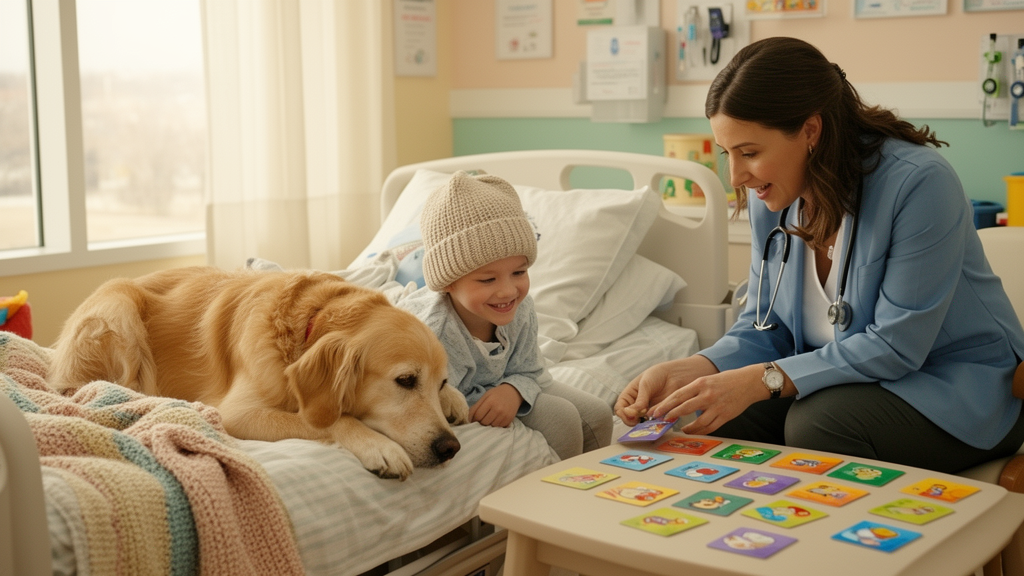
The largest pooled effect appeared for health-related quality of life, where animal-assisted therapy, play and creative therapies and physical activity interventions achieved a standardised mean difference of 0.80, a large effect by conventional benchmarks. Yet this headline number comes with a caveat: heterogeneity was very high at 87.1 percent, indicating that true effects varied enormously across contexts. Within this domain, pain showed the most dramatic benefit, with a standardised mean difference of 1.10, while fatigue and general quality of life showed no significant effects. The divergence between strong domain-specific pain relief and null effects on global quality of life likely reflects both measurement inconsistency, with generic and disease-specific instruments capturing different constructs, and the inherent difficulty of shifting a multidimensional construct with single-modality interventions delivered over short periods.
The interventions themselves were remarkably diverse. The included trials tested art therapy, jewellery making, cognitive rehabilitation, child life services, aqua therapy, web-based and game-based physical activity, immersive virtual reality, self-management education, massage, music therapy and complementary therapies, with durations ranging from a single session to 24 weeks. Study populations were similarly heterogeneous, mixing clinically diverse cancer samples with cohorts focused specifically on leukaemia or brain tumours. This diversity is both a strength, demonstrating the breadth of approaches being trialled worldwide, and a limitation, because pooling across such varied modalities means the estimates speak to the promise of psychosocial intervention as a category rather than to the precise efficacy of any single therapy.
Perhaps the most sobering finding concerns what has not been tested. Not a single trial in the review targeted the pre-treatment window, the prehabilitation phase where early psychosocial support could theoretically prevent rather than react to treatment-related harm. The authors note that while urgent treatment initiation often precludes preparation time, solid-tumour pathways frequently allow lead time during which coordinated, interprofessional psychosocial input could begin. Equally striking was the absence of theory: most included studies did not report using any theoretical framework to guide intervention design, and only four explicitly referenced models such as Social Cognitive Theory, self-efficacy theory or Lazarus’ transactional model of stress and coping. Co-design with children, families and clinicians was almost entirely absent, and many trials applied a one-size-fits-all approach across age spans as wide as 1 to 18 years, despite the profound developmental differences between a toddler and a teenager.
Methodological quality was moderate overall: 44 percent of studies were judged at low risk of bias, 53 percent at moderate risk and one at high risk. The main concerns centred on blinding, an inherent challenge for behavioural interventions where participants and providers inevitably know what treatment is being delivered, rather than on retention or statistical conduct, which were generally well handled. The authors also acknowledge that publication bias could not be formally assessed because each meta-analysis included fewer than ten studies, and that non-English-language research may have been missed. Developmental age could not be explored quantitatively because most trials reported age only as aggregate data across broad, overlapping ranges, making age-stratified analysis statistically underpowered and potentially misleading.
For clinicians and families, the practical takeaways are reasonably clear. Cognitive remediation is a credible candidate for integration into survivorship pathways for children treated with CNS-directed therapy, though optimal timing, dose and delivery format remain undefined. Brief psychosocial interventions show the most promise for state anxiety around procedures and treatment, while symptom-targeted approaches for procedural pain represent the most mature near-term application. Durable effects on mood, self-concept and global quality of life, by contrast, will likely require sustained, multimodal, theory-driven models of supportive care rather than short, single-modality programmes. The authors also call for wider adoption of paediatric oncology core outcome sets to improve comparability across future trials.
The review ultimately paints a field in transition: one where the promise of psychosocial care for young cancer patients is real and measurable in specific domains, but where the evidence base remains fragmented by small samples, inconsistent measures and atheoretical design. Future trials, the authors argue, should identify optimal intervention timing, dosage and delivery format, stratify outcomes by age, diagnosis and treatment intensity, and embrace implementation science to ensure that effective interventions actually reach routine clinical practice. For the hundreds of thousands of children diagnosed each year, and for the survivors who carry cognitive and psychological scars long into adulthood, the message is that help exists and works, but the science of exactly what to deliver, when and to whom is still being written.
Subject of Research: Effectiveness of psychosocial interventions for neurocognitive, psychological and quality-of-life outcomes in children and adolescents with cancer across the care continuum
Article Title: Psychosocial interventions for children and adolescents across the cancer care continuum: A systematic review and meta-analysis
Article References: Paterson, C., McCarthy, M. C., Sansom-Daly, U. M., Wakefield, C. E., Turner, M. R., Christina, J., Roberts, C., Moss, C., Thamm, C., Carmichael, M.-A., Johansen, S., Atkinson, M., Osborn, M., Singh, B., & Ramsey, I. (2026). Psychosocial interventions for children and adolescents across the cancer care continuum: A systematic review and meta-analysis. Supportive Care in Cancer, 34(10), Article 995. https://doi.org/10.1007/s00520-026-11176-x
Image Credits: AI Generated
DOI: 10.1007/s00520-026-11176-x
Keywords: psychosocial interventions, pediatric oncology, systematic review, meta-analysis, cognitive rehabilitation, working memory, anxiety, pain management, quality of life, animal-assisted therapy, cancer survivors, supportive care
News Source: Nathaniel Bowman. (October 10, 2026). From Therapy Dogs to Memory Training: What Really Helps Children With Cancer. Scienmag.