Pancreatic ductal adenocarcinoma, the most common and most lethal form of pancreatic cancer, has long been known to manipulate the nervous system inside the gland itself. Tumor cells crowd around and invade pancreatic nerves, a hallmark called perineural invasion that is linked to agonizing back pain and to poor survival. What has remained far less clear is whether the cancer’s influence extends to nerves lying outside the pancreas, in the surrounding tissue that surgeons must cut through to remove the tumor. A new prospective study from a pancreatic center in China now provides some of the most direct evidence yet that these extra-pancreatic nerves are structurally remodeled in cancer patients, and that the degree of remodeling differs measurably between malignant and benign disease.
The research, conducted at the Pancreas Center of the First Affiliated Hospital of Nanjing Medical University, enrolled patients undergoing pancreatoduodenectomy, the complex operation also known as the Whipple procedure, between April 2019 and December 2019. Rather than sampling nerves inside the pancreatic parenchyma, where tumor involvement makes interpretation difficult, the team deliberately targeted two anatomical landmarks outside the gland: the point where the gastroduodenal artery enters the head of the pancreas and the point where the common bile duct does the same. Nerve fibers travel alongside both structures, and because these sites lie at the boundary between the pancreas and adjacent tissues, they offer a window into how nerves behave in tissue that the tumor has not directly overrun.
In total, 92 surgical specimens were collected and analyzed. Based on the final pathology, the patients fell into three comparison groups. The largest, 54 patients, had pancreatic ductal adenocarcinoma. A second group of 26 patients had other malignant tumors in the same region, such as cancers of the bile duct or duodenum, which allowed the investigators to ask whether nerve changes are specific to pancreatic cancer or a general feature of malignancy in this anatomical neighborhood. A third group of 12 patients had benign pancreatic lesions, providing a non-cancerous baseline against which both malignant groups could be judged.
The central measurement was nerve density, quantified in the tissue surrounding the gastroduodenal artery and the common bile duct. The results were striking. Patients with pancreatic ductal adenocarcinoma had significantly higher nerve density at both sampling sites than either comparison group. At the gastroduodenal artery, the difference was highly significant relative to both the non-PDAC malignant group and the benign group, with reported P values of 0.002 and 0.0003 respectively. At the common bile duct, the pancreatic cancer group again showed greater nerve density, with P values of 0.04 against the other cancer group and 0.0009 against the benign group. In plain terms, the nerves outside the pancreas were conspicuously more abundant in patients whose disease was pancreatic cancer specifically, not merely cancer in general.
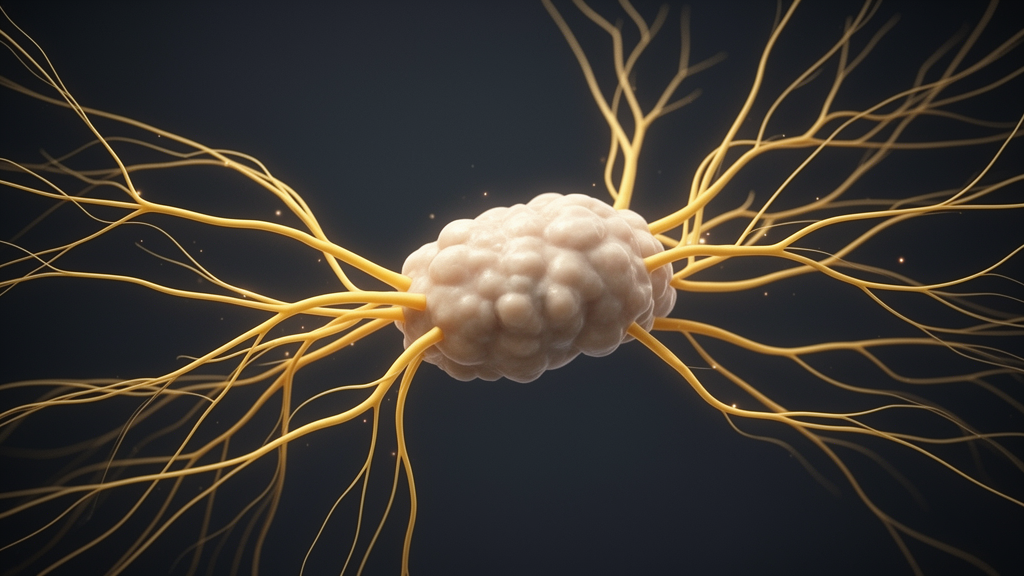
This finding matters because it reframes how scientists think about the tumor-nerve relationship. Much of the existing literature has treated nerves as passive victims that tumor cells invade on their way to distant sites. The new data are consistent with a more dynamic picture, in which pancreatic cancer is associated with nerve proliferation, or at least nerve accumulation, even in tissue beyond the pancreatic capsule. Whether the tumor actively drives this growth by secreting neurotrophic factors, or whether the change reflects a shared response of the peripancreatic environment to the cancer, cannot be settled by density measurements alone. But the comparative design of the study strengthens the case that the phenomenon is tied to pancreatic ductal adenocarcinoma rather than to inflammation, obstruction, or surgery alone, since both benign lesions and other malignancies served as controls.
The team then asked the clinically urgent question: does nerve density predict how long patients live? Among the 54 pancreatic cancer patients, 53 had follow-up data suitable for survival analysis, and the outlook was grim, as it usually is with this disease. Forty-one of those patients, or 77.4 percent, died from tumor progression during the observation period. When the investigators split patients by nerve density at the gastroduodenal artery, they observed a tantalizing trend. Those with higher nerve density at that site appeared to survive longer, with median disease-specific survival of 24.0 months compared with 12.0 months in the lower-density group. The difference, however, did not reach statistical significance, with a P value of 0.13, meaning it could plausibly have arisen by chance in a sample of this size.
To account for the many factors that influence survival in pancreatic cancer, the researchers performed a multivariate Cox regression, a statistical technique that estimates the independent effect of each variable while holding the others constant. The result was sobering: the only factor that emerged as an independent predictor of disease-specific survival was poor tumor differentiation, a measure of how abnormal and aggressive the cancer cells look under the microscope. Poorly differentiated tumors, which grow and spread more erratically than well-differentiated ones, carried a worse prognosis regardless of nerve density. The nerve-density signal, already weakened by the modest sample size, was therefore not robust enough to stand on its own as a prognostic marker.
The authors are appropriately cautious about these limits, and the study design makes the caveats easy to see. With 92 specimens divided across three groups, and only 53 patients in the survival analysis, the statistical power to detect moderate effects is limited, particularly for a trend with a P value as close to significance as 0.13. The sampling was restricted to two anatomical sites, chosen for surgical accessibility, and nerve behavior at other locations around the pancreas may differ. The single-center, prospective design is a strength, reducing variability in how specimens were collected and processed, but it also means the findings await confirmation in larger and more diverse cohorts before they can influence clinical practice.
Even so, the study opens a potentially important line of investigation. If extra-pancreatic nerve remodeling proves to be a reproducible feature of pancreatic ductal adenocarcinoma, it could eventually serve several purposes. As a biomarker, nerve density at the pancreatic margin might help pathologists characterize the tumor environment beyond what conventional staging captures. As a mechanistic clue, it points to the nervous system as an active participant in pancreatic cancer biology, echoing a broader movement in cancer research that treats nerves as part of the tumor microenvironment rather than bystanders. And as a therapeutic target, it raises the possibility that interventions aimed at tumor-nerve crosstalk, an idea already being explored in other cancers, might one day have a role in pancreatic disease, where treatment options remain desperately scarce.
For now, the immediate takeaway is descriptive but consequential: pancreatic ductal adenocarcinoma leaves a measurable signature in the nerves outside the pancreas, one that distinguishes it from both benign pancreatic disease and other cancers of the same region. The survival signal, though not statistically significant, hints that this signature may carry information about disease course, and the identification of poor differentiation as the sole independent risk factor for death reinforces the established pathological predictors that guide prognosis today. Larger studies with more patients and longer follow-up will be needed to determine whether nerve density at the gastroduodenal artery or common bile duct can mature from an intriguing observation into a clinically useful tool. The work was funded by the National Natural Science Foundation of China and the Natural Science Foundation of Jiangsu Province, and it was approved by the institutional review board with written informed consent from all participants, underscoring the rigorous ethical framework behind a study that may help explain one of pancreatic cancer’s most distinctive and least understood behaviors.
Subject of Research: Extra-pancreatic nerve density alterations in pancreatic ductal adenocarcinoma
Article Title: Non-invasive alterations of extra-pancreatic nerves in pancreatic ductal adenocarcinoma: a comparative study
Article References: Lu, X., Huang, S., Dai, Y., Jiang, L., Lou, J., Huang, L., Zhang, K., Jiang, K., Miao, Y., Li, M., & Wei, J. (2026). Non-invasive alterations of extra-pancreatic nerves in pancreatic ductal adenocarcinoma: a comparative study. BMC Cancer. https://doi.org/10.1186/s12885-026-17099-4
Image Credits: AI Generated
DOI: 10.1186/s12885-026-17099-4
Keywords: pancreatic ductal adenocarcinoma, extra-pancreatic nerves, nerve density, perineural invasion, pancreatoduodenectomy, gastroduodenal artery, common bile duct, disease-specific survival, Cox regression, tumor microenvironment, pancreatic cancer prognosis, prospective study
News Source: Nathaniel Bowman. (October 9, 2026). Pancreatic Cancer Reshapes Nerves Beyond the Tumor, Study Finds. Scienmag.