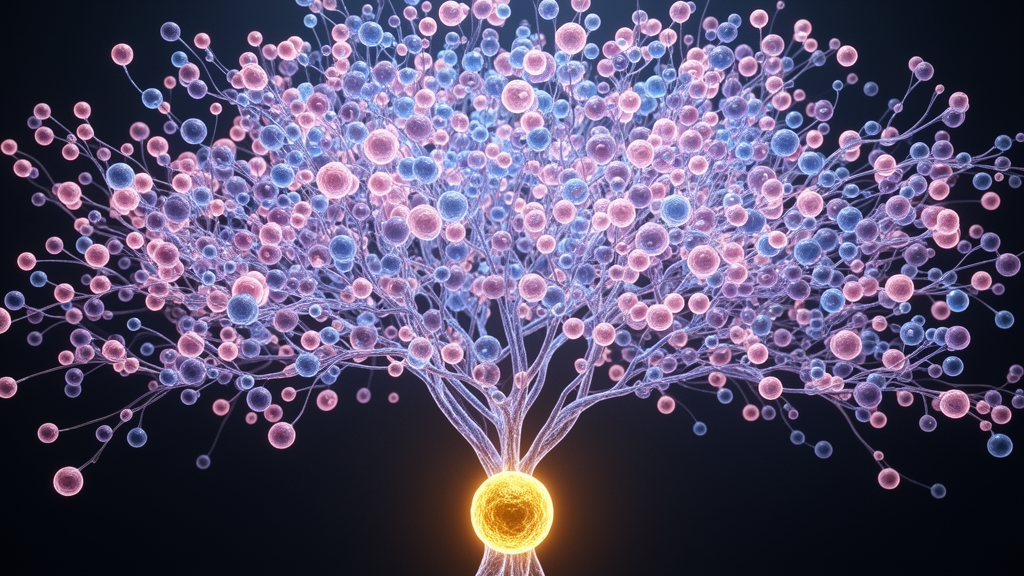
Every complex animal begins as a single fertilized egg, yet how that one cell multiplies into millions of specialized descendants has remained one of biology’s most stubborn mysteries. A team at the Seattle Hub for Synthetic Biology—a collaboration between the Allen Institute, UW Medicine, and Biohub—has now delivered the most complete answer ever achieved for a mammal. In a study published in the journal Science, the researchers reconstructed a time-calibrated lineage tree showing how a single cell gave rise to 1.28 million cells, roughly ten percent of all the cells in a two-week-old mouse embryo. It is by far the largest cell lineage tree ever assembled for any mammal, and it demonstrates that a complete, dense record of mammalian development can be captured and read within a single experiment.
The technology behind the achievement is called DNA Typewriter, a genome-editing-based recording system that works like a microscopic journal embedded in the DNA itself. As cells divide, the system inserts sequential genetic stamps into the genome. Each stamp is copied faithfully into every daughter cell—the cell that results when a parent cell divides—and because the stamps are written in chronological order, they preserve a running log of each division event. When researchers later sequence the genomes of individual cells, they can read back through this molecular archive to determine which cell descended from which, and roughly when each branching event occurred during development.
To deploy the system, the scientists injected the DNA Typewriter machinery into a fertilized mouse egg and allowed the embryo to develop for 13.5 days, approximately two-thirds of the way through mouse gestation. At that point, the embryo was well into organogenesis, the period in which tissues and organs take shape. The team then measured the accumulated genetic stamps in 1.58 million individual cell nuclei and used that information to reconstruct the family tree of cells composing the embryo. The resulting map traces how more than 1.28 million cells emerged from the very first division and progressively diversified into the cell types that form the body’s tissues and organs.
One of the study’s most striking findings came at the very beginning of the lineage. The researchers identified multiple unique marks—genetic fingerprints that allow scientists to distinguish one cell from another—written by DNA Typewriter at the first cell division, the moment the fertilized egg split into two cells. This early and robust marking proved to be an unexpected analytical gift. “We were surprised by just how robustly marking happened right at the very first division,” said Haedong Kim, co-first author of the study. “It gave us two naturally occurring, independent copies of the same experiment, within a single embryo, so we could check every finding twice.”
That natural duplication meant the two daughter cells of the first division functioned as parallel, independent lineages whose histories could be compared against each other. As the two branches continued to divide along separate tracks, the researchers found that they contributed different total numbers of cells to the embryo—one branch accounting for about 57 percent of the sampled cells and the other for about 42 percent. Remarkably, despite this imbalance in raw cell numbers, both branches provided the same proportion of every cell type. The finding suggests that early developmental decisions about cell fate may be governed by rules that operate independently of how many descendants each founding cell ultimately produces, a nuance that would have been invisible without a lineage tree of this scale.
Lineage tracing at this resolution matters because the origins of disease often lie in the earliest chapters of cellular history. All cell types have their origins in development, and errors in the branching process—when a cell takes the wrong path, divides at the wrong time, or lands in the wrong tissue—can underlie birth defects and developmental disorders. By mapping the normal trajectory from one cell to millions, researchers now possess a reference model against which abnormal development can be measured. When something goes wrong, the tree makes it possible to identify when and where the normal path diverged, opening the door to strategies for preventing abnormal cellular development or intervening when cells go astray.
The implications extend well beyond embryology. Cancer, at its core, is a disease of cell lineage: tumors arise when individual cells accumulate changes and their descendants proliferate and spread through the body. The same recording logic that captured embryonic divisions could be applied to track how cancer cells disseminate, offering a way to reconstruct the migration and expansion history of a malignancy within an organism. The technology could likewise illuminate how stem cell therapies engraft and differentiate after transplantation, and how aging progressively alters the lineage structure of cells in various organs—questions that are difficult to answer with snapshot measurements alone.
“Our success in putting DNA Typewriter into a developing embryo, together with the resulting cell lineage, brings us closer to our dream of comprehensively mapping mammalian development,” said Jay Shendure, scientific director of the Seattle Hub for Synthetic Biology and professor of genome sciences at UW Medicine. “All cell types have their origins in development, and such maps may enable insights into the thousands of genetic disorders that arise during development.” Shendure’s framing underscores the broader ambition: if lineage trees can be built routinely and at scale, they could become a standard tool for connecting developmental history to the genetic disorders that emerge when that history is disrupted.
“This work brings us closer to understanding one of biology’s fundamental questions on how a single cell gives rise to the extraordinary complexity of a living organism,” said Garabet Yeretssian, director of extramural research and partnerships at Biohub, which has provided ongoing funding for the Seattle Hub. “We are proud to support the Seattle Hub team in developing technologies that make it possible to trace that process at an unprecedented scale and open new ways to understand how those trajectories change during development and disease.” The funding model behind the project reflects a growing recognition that ambitious, technology-driven biology often requires sustained institutional support before it can deliver clinical payoffs.
The complete lineage tree from the study has been made publicly available, and the team has released an interactive browser called NextCell that allows anyone to explore the cellular family tree of mouse development. By recovering biological answers directly from lineage data, the approach could compress research timelines that would otherwise stretch over years, replacing indirect inference with a direct record of what actually happened as one cell became a body. For a question that has hung over science for decades—how a single fertilized egg produces every cell in an animal—the era of reading the answer straight from the genome has now begun.
Subject of Research: Reconstruction of a mammalian cell lineage tree using DNA recording technology in a developing mouse embryo
Article Title: From a single cell to 1.2 million: Scientists successfully create the largest cellular “family tree” for a mammal
Article References: From a single cell to 1.2 million: Scientists successfully create the largest cellular “family tree” for a mammal. (n.d.). Original publication
Image Credits: AI Generated
DOI: Not provided
Keywords: cell lineage, DNA Typewriter, mouse embryo, developmental biology, Seattle Hub for Synthetic Biology, Allen Institute, genome editing, birth defects, cancer research, stem cells, single-cell analysis, Science journal
News Source: Juliet Wilcox. (October 9, 2026). Largest Ever Mammal Cell Family Tree Traces 1.2 Million Cells to a Single Origin. Scienmag.