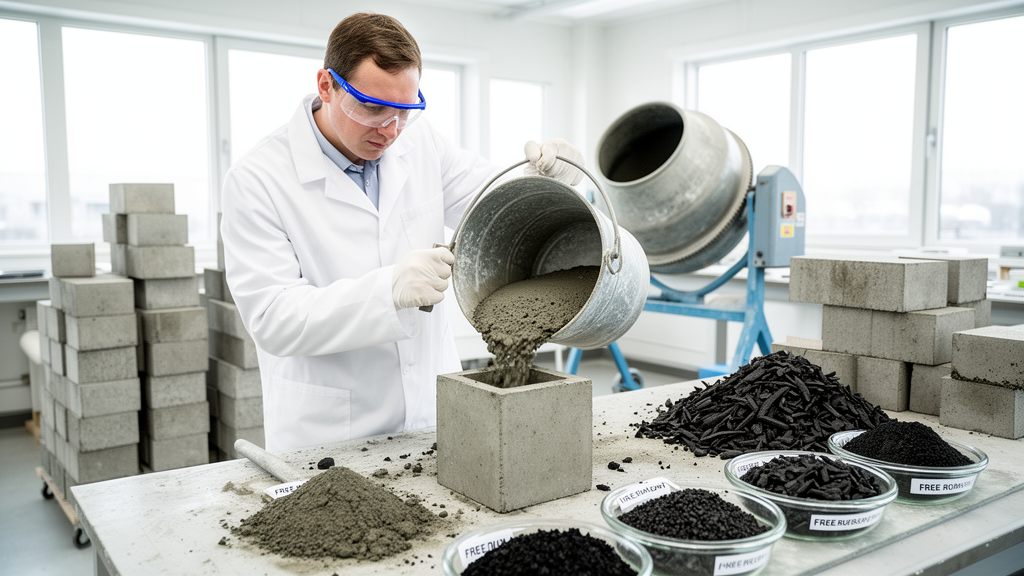
Every year, more than one billion tires reach the end of their lives, and most of them end up in landfills where their vulcanized rubber, which can make up as much as 55 percent of the tire, persists for centuries and slowly contaminates soil and groundwater. At the same time, Portland cement production is responsible for roughly 7 to 8 percent of global carbon dioxide emissions, driven by the energy-hungry clinker process at the heart of cement manufacturing. A new study published in Results in Engineering tackles both problems at once by grinding waste tires into crumb rubber and embedding it in alkali-activated concrete, a cement-free binder made from industrial by-products such as fly ash and slag that cuts carbon emissions by 40 to 70 percent compared with conventional concrete. The researchers, led by Yousef Elbaz of United Arab Emirates University, systematically varied both the size of the rubber particles and the amount used, and their findings reveal a striking truth: when it comes to rubberized concrete, particle size is not a detail. It is the deciding factor.
The material at the center of the study, rubberized alkali-activated concrete, or RuAAC, combines two waste streams in a single matrix. The binder forms through a chemical reaction between an alkaline activator solution and aluminosilicate precursors, avoiding the high-temperature clinker process entirely. In this work, the binder comprised ground granulated blast furnace slag and Class F fly ash in a one-to-three ratio, activated by a blend of sodium silicate and 12 molar sodium hydroxide. The team tested three rubber gradations, a fine-graded fraction spanning 0 to 0.8 millimeters, a medium-graded fraction of 1 to 3 millimeters, and a wide-range blend covering 0 to 3 millimeters, each incorporated at 5, 10, and 20 percent replacement of fine aggregate by volume. Crucially, the rubber was used exactly as received from the tire recycling plant, with no chemical pre-treatment, a deliberate choice to preserve the environmental and economic case for the material, since soaking and rinsing procedures consume reagents, water, and generate effluent of their own.
The results on strength tell a story of trade-offs. The control mix, with no rubber, reached an impressive 72.3 megapascals at 28 days, reflecting the rapid reaction kinetics of the slag-rich binder. Adding rubber reduced compressive strength across the board, with losses ranging from 21 to 35 percent at 5 percent replacement, 30 to 46 percent at 10 percent, and 36 to 56 percent at 20 percent. But the gradation made an enormous difference. The fine-graded mixes retained the highest strengths at every dosage, reaching 57.1 megapascals at just 5 percent rubber, while the wide-range mixes performed worst, falling to 31.7 megapascals at 20 percent. The reason lies at the microscopic interface between the hydrophobic rubber particles and the hydrophilic alkali-activated gel. Residual zinc stearate from the tire vulcanization process repels the polar activator, entraining air voids at the interface and creating weak interfacial transition zones that act as flaws under load. Larger particles create larger, more critical defects, while sub-millimeter particles distribute the damage into smaller, less consequential discontinuities.
One of the most intriguing findings concerned early-age behavior. At just one day, the rubberized mixes were 40 to 72 percent weaker than the control, but this deficit narrowed substantially by 28 days. The rubber particles, it turns out, delay rather than suppress the alkali-activation reaction. The fine- and medium-graded mixes more than doubled their strength between one and seven days, recovering much of the early loss as the matrix densified around the inclusions. Statistical analysis using two-way analysis of variance confirmed this interpretation: the interaction between rubber content and gradation was significant at one day but not at later ages, meaning the gradation-specific early damage faded as the reaction progressed. By contrast, the medium-graded mix at 20 percent replacement gained almost no strength after seven days, suggesting that failure in that mix was governed by the weak interfaces around its uniform 1 to 3 millimeter particles rather than by the still-reacting matrix.
Where rubber genuinely shines is in deformation capacity. The control concrete failed in classic brittle fashion, with a sharp post-peak drop in the stress-strain curve. The rubberized mixes, by contrast, softened gradually and kept carrying load at strains approaching 0.8 percent or more. The ductility index, a measure of how much a material can deform before failure, rose by 44 percent in the fine-graded mix at 20 percent replacement compared with the control. The elastic rubber particles store strain energy and delay the coalescence of microcracks into macrocracks, transforming a sudden fracture into a controlled, gradual failure. This exchange of strength for toughness is precisely the property profile needed for applications such as crash barriers, pavement slabs, and industrial floors, where energy absorption and crack resistance matter as much as raw load capacity.
The study also broke new ground by measuring direct shear strength, load-slip response, and shear toughness of RuAAC for the first time at the material level, a gap with real safety implications. Shear failures in structural elements such as flat slabs, corbels, and deep beams occur with little warning, and design codes estimate shear capacity as a function of the square root of compressive strength using coefficients calibrated to Portland cement concrete. The team found that shear strength declined by up to 45 percent with rubber incorporation, less severely than flexural strength, which fell by as much as 67 percent, because confining stresses developed during shear testing provided mechanical interlock that partially compensated for the weak rubber-matrix bonding. Notably, at 5 percent fine-graded rubber, the shear toughness index was 25 percent higher than the control, suggesting that modest rubber dosages can genuinely improve energy dissipation along crack planes.
The durability results delivered some of the study’s most surprising wins. Water absorption in the fine-graded mix at 20 percent replacement was 9 percent lower than the control, and its capillary absorption depth at six hours was 39 percent lower, because the densely dispersed hydrophobic particles interrupt continuous capillary pathways and force water to take longer, more tortuous routes through the matrix. Bulk electrical resistivity, a proxy for resistance to chloride ingress and rebar corrosion, was 12 percent higher than the control in the same mix. Abrasion resistance told a dramatic gradation-dependent story: the fine-graded mix at 20 percent lost 29 percent less mass than the control after 500 tumbling cycles, while every medium-graded mix disintegrated completely, with the 20 percent medium-graded specimen failing by just 200 cycles. The uniform 1 to 3 millimeter particles, poorly bonded to the matrix, acted as discrete weak points that accelerated crack propagation under surface wear.
The authors distilled their findings into two practical application regimes, both built on fine-graded rubber. A mix with 5 percent fine crumb rubber retained 57.1 megapascals of compressive strength, a 25 percent higher shear toughness index, and better abrasion resistance than the control, making it suitable for pavement slabs, industrial floors, curbs, and precast panels. A mix with 20 percent fine rubber offers lower strength, 46.1 megapascals, but a 44 percent higher ductility index, reduced density, and improved workability, pointing toward crash barriers and non-structural cladding. The researchers caution that the reduced elastic modulus, between 14.2 and 19.2 gigapascals compared with 24.3 for the control, means deflection rather than strength will likely govern member sizing, and that shear-governed elements require member-scale testing before RuAAC can be deployed in them.
What makes this work resonate beyond the laboratory is its reframing of a familiar sustainability equation. Simply dumping waste into concrete is not enough; the form of the waste determines whether the resulting material is an engineering asset or a liability. By demonstrating that sub-millimeter tire rubber can simultaneously cut cement demand, divert landfill waste, improve ductility, and even enhance durability, the study offers a credible pathway for rubberized cement-free concrete to move from non-structural novelty toward genuine structural relevance. The authors call for microstructural examination of the rubber-matrix interface, extended durability testing covering chloride penetration, carbonation, freeze-thaw and creep, full-scale element testing, and a life cycle assessment quantifying embodied carbon per unit of strength. Until then, the message is clear: if you want tires to strengthen the future of concrete, grind them fine.
Subject of Research: Effect of recycled crumb rubber particle size and replacement level on the mechanical and durability properties of cement-free alkali-activated concrete
Article Title: Effect of recycled rubber particle size and replacement level on the properties of rubberized alkali-activated concrete
Article References: Elbaz, Y., Mwafy, A., El-Maaddawy, T., & El-Hassan, H. (2026). Effect of recycled rubber particle size and replacement level on the properties of rubberized alkali-activated concrete. Results in Engineering, 32, Article 113326. https://doi.org/10.1016/j.rineng.2026.113326
Image Credits: AI Generated
DOI: 10.1016/j.rineng.2026.113326
Keywords: alkali-activated concrete, crumb rubber, waste tires, geopolymer, compressive strength, shear strength, ductility, durability, water absorption, abrasion resistance, sustainable construction, fly ash slag binder
News Source: Denise Maddox. (October 9, 2026). Shredded Tires Meet Cement-Free Concrete: Particle Size Decides Everything. Scienmag.