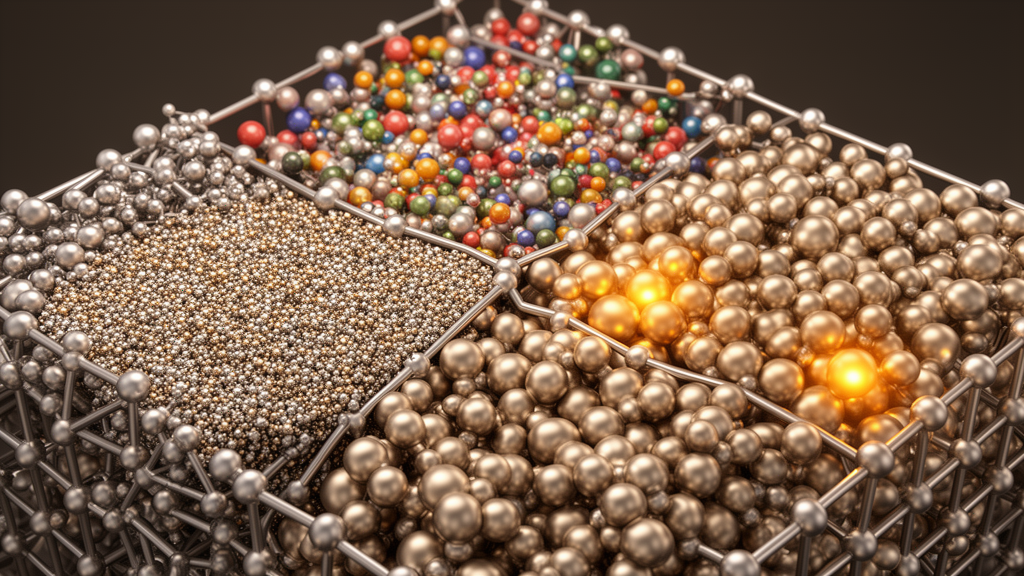
When materials scientists set out to design metals that are stronger, tougher, and more resistant to extreme environments, few families of alloys have generated as much excitement as high-entropy alloys, or HEAs. Unlike conventional alloys, which are built around one dominant element with small additions of others, HEAs mix four or five principal elements in roughly equal proportions, producing a crystalline lattice so chemically chaotic that atoms of different species sit side by side in seemingly random arrangements. A new computational study published in the Journal of Materials Science has now taken an extraordinarily close look at one such alloy family, CoCuFeNiPd, and mapped out precisely how grain size, palladium content, and temperature control its mechanical behavior when a tiny indenter presses into its surface at the nanometer scale.
The research, carried out by Thi-Nhai Vu of Nha Trang University and Van-Trung Pham and colleagues at the University of Danang – University of Science and Technology in Vietnam, relies on molecular dynamics simulations, a technique that tracks the motion of every individual atom in a material by solving the classical equations of motion under an interatomic potential. Rather than testing bulk samples in a mechanical testing frame, the team simulated nanoindentation, the process of pushing a hard, sharply pointed tip into a material and measuring its resistance. Nanoindentation is the standard method for probing hardness and elastic modulus at very small length scales, and by reproducing it atom by atom, the researchers could watch dislocations nucleate, grain boundaries slide, and stacking faults spread in real time, something no laboratory microscope can capture with such completeness.
The first major finding concerns the celebrated Hall-Petch relationship, one of the oldest rules in metallurgy. For more than half a century, engineers have known that shrinking the grains of a polycrystalline metal makes it harder, because grain boundaries act as obstacles that block the glide of dislocations, the line defects responsible for plastic flow. The simulations confirmed this classic strengthening trend in CoCuFeNiPd alloys with larger grains, where plastic deformation was dominated by dislocation activity nucleated near the indenter tip and propagating through the crystal interior. But when the grain size was reduced into the ultrafine nanocrystalline regime, the trend reversed dramatically. Hardness and the reduced Young’s modulus began to fall rather than rise as grains became smaller, a phenomenon known as inverse Hall-Petch behavior.
The reason for this reversal, revealed directly by the atomic-scale trajectories, is a change in the dominant deformation mechanism. In the inverse Hall-Petch regime, grains have become so small that dislocations can no longer pile up effectively against boundaries; instead, the material deforms by grains sliding past one another along their shared boundaries and by whole grains rotating under the indenter’s pressure. Grain boundary sliding and grain rotation allow the material to accommodate strain without the intense dislocation activity that characterizes conventional plasticity. This mechanistic crossover has been observed in other nanocrystalline metals and ceramics, but the present study pins down how it plays out in a chemically complex, five-element high-entropy system, where the rugged energy landscape created by chemical disorder adds further obstacles to dislocation motion.
The second variable the team explored was the palladium concentration, denoted by the subscript x in CoCuFeNiPdx. Palladium is the largest and heaviest of the five elements in this alloy family, and adding it increases what metallurgists call lattice distortion: the local warping of the crystal lattice caused by atoms of different sizes trying to share the same lattice sites. The simulations showed that increasing Pd content enhances both hardness and indentation resistance. The mechanism is twofold. First, stronger lattice distortion raises the frictional resistance that dislocations experience as they move through the lattice, effectively making the entire crystal a rougher terrain for defect motion. Second, higher palladium levels promote short-range ordering, a subtle chemical phenomenon in which atoms of particular species preferentially occupy neighboring sites, creating local patterns within the nominally random solid solution. These ordered domains act as additional barriers that significantly impede dislocation glide, a strengthening route that has attracted intense interest since recent experimental and computational work demonstrated that short-range order can simultaneously boost the strength and ductility of high-entropy alloys.
However, the study also uncovered a cautionary limit. When the palladium content becomes excessive, the alloy begins to undergo local phase separation, with palladium-rich regions segregating from the rest of the matrix. This chemical inhomogeneity suppresses the material’s ability to accommodate strain, undermining the very ductility and damage tolerance that make high-entropy alloys attractive in the first place. The message for alloy designers is that palladium is a powerful strengthening agent only up to an optimum concentration; beyond that point, the benefits of lattice distortion and short-range ordering are outweighed by the embrittling effects of compositional segregation. This kind of composition-property trade-off is exactly the information needed to guide the rational design of Pd-containing HEAs for real applications.
Temperature emerged as the third decisive factor. As the simulation temperature increased, the alloys exhibited pronounced thermal softening, with both hardness and elastic modulus declining. Elevated temperature promotes structural disorder, thermally shaking atoms out of their ideal lattice positions and weakening the short-range order that had helped block dislocations. At the same time, the increased atomic disorder interferes with the propagation of dislocations in a different way, scattering and absorbing them before they can carry plastic deformation efficiently across grains. The net result is a material that yields more easily and deforms more diffusely at high temperature, an important consideration for any application in which nanoscale contact occurs under thermal load, such as microelectromechanical systems, high-temperature coatings, or cutting tools.
Perhaps the most valuable contribution of the work is its unified atomic-scale picture of how these mechanisms couple. The researchers demonstrate that nanoindentation-induced deformation in CoCuFeNiPdx alloys is never governed by a single process but by the simultaneous evolution of grain boundary activity, dislocation nucleation, stacking fault formation, and amorphous transformation, the latter being the local loss of crystallinity under the extreme contact pressures beneath the indenter tip. Stacking faults, which are planar packing defects in the face-centered cubic lattice, appear as intermediate carriers of plasticity between perfect dislocation slip and full amorphization. Which of these channels dominates depends on grain size, composition, and temperature, and the simulations show how shifts in one variable can redirect the entire deformation pathway. This mechanistic map gives experimentalists concrete signatures to look for, for example in transmission electron microscopy of indented regions, and gives modelers benchmarks against which to validate larger-scale simulations.
The study also situates itself within a rapidly growing literature on high-entropy alloys, a field launched in 2004 when independent groups led by Jien-Wei Yeh and Brian Cantor first reported the surprising stability and properties of multi-principal-element alloys. In the two decades since, HEAs have been explored for structural, cryogenic, irradiation-resistant, and high-temperature applications, and concepts such as the four core effects of high-entropy materials, including severe lattice distortion and sluggish diffusion, have been progressively clarified. Recent work has highlighted chemical short-range order as a tuning knob of exceptional power, and the present results extend that theme to the specific case of palladium-bearing CoCuFeNiPd, an alloy system that earlier simulations had already flagged as one where short-range ordering and grain boundary segregation can inhibit the onset of inverse Hall-Petch softening.
For engineers thinking about applications, the relevance is direct. Nanoscale contact governs the performance and reliability of micro- and nanoelectromechanical devices, thin-film coatings, wear-resistant surfaces, and precision machining processes. A material that maintains high hardness and elastic resilience while tolerating strain at elevated temperature is the ideal candidate for such roles, and the new results indicate how to move toward that target: choose grain sizes on the Hall-Petch side of the crossover, tune palladium content high enough to maximize distortion and ordering but low enough to avoid phase separation, and account for thermal softening in any environment where heat is present. The Vietnamese team’s atomistic tour of CoCuFeNiPd thus delivers both fundamental insight into how chemically complex crystals deform under contact and practical guidance for the next generation of high-entropy alloys designed for nanoscale service. As simulation tools and interatomic potentials continue to improve, studies of this kind are expected to play an ever larger role in screening alloy compositions before a single ingot is melted, accelerating the path from atomic-scale understanding to real-world materials.
Subject of Research: Atomic-scale simulation of grain size, palladium composition, and temperature effects on the nanoindentation behavior of CoCuFeNiPdx high-entropy alloys
Article Title: Atomic-scale investigation of grain-size, Pd composition, and temperature effects on the nanoindentation behavior of CoCuFeNiPdx high-entropy alloys
Article References: Vu, T.-N., Pham, V.-T., Tran, N.-H., Luu, D.-B., Tao, Q.-B., & Nguyen, T.-T. (2026). Atomic-scale investigation of grain-size, Pd composition, and temperature effects on the nanoindentation behavior of CoCuFeNiPdx high-entropy alloys. Journal of Materials Science. https://doi.org/10.1007/s10853-026-13891-6
Image Credits: AI Generated
DOI: 10.1007/s10853-026-13891-6
Keywords: high-entropy alloys, nanoindentation, molecular dynamics, Hall-Petch, grain boundary sliding, palladium, short-range ordering, lattice distortion, dislocations, thermal softening, hardness, CoCuFeNiPd
News Source: Neil Sanderson. (October 9, 2026). Atomic-Scale Simulations Reveal How Palladium and Grain Size Shape the Strength of High-Entropy Alloys. Scienmag.