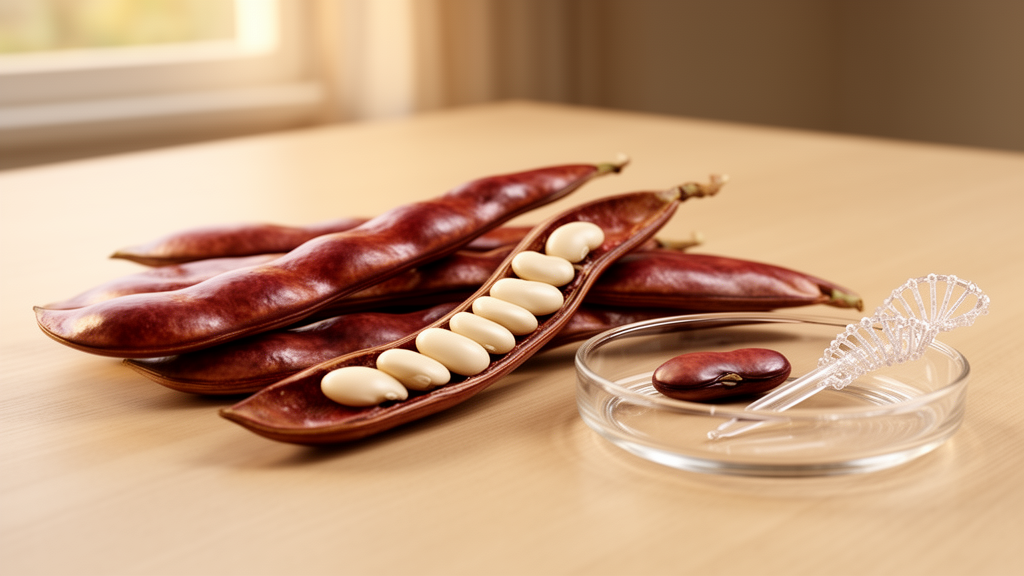
For decades, the sword bean has sat quietly at the margins of agricultural science. Canavalia gladiata, a climbing legume cultivated across tropical Asia and Africa, packs seeds that are between 26 and 30 percent protein by weight and produces an oil unusually rich in unsaturated fatty acids. Yet the crop has never attracted the breeding attention lavished on soybean, common bean, or peanut, and one of the main reasons was simple: nobody had a complete map of its genome. That gap has now been closed. A research team from Yunnan University and BGI Research in Wuhan has assembled the first gap-free telomere-to-telomere genome of the species, an achievement that reads the genome from one physical end of every chromosome to the other, leaving none of the stubborn repetitive territory unresolved. The work, published in the Journal of Systematics and Evolution, pairs the new reference with an integrated transcriptomic and metabolomic portrait of developing seeds, turning a neglected crop into a genetically legible one.
The significance of a telomere-to-telomere, or T2T, assembly is best understood by considering what earlier genome projects routinely missed. Standard short-read sequencing struggles with the highly repetitive DNA that forms centromeres, the structures that anchor chromosomes during cell division, and telomeres, the protective caps at chromosome ends. These regions are not genetic dead weight; as Yi Wang, first author of the study, explained, they often hold key information about genome stability and phenotypic variation. The previous assembly of C. gladiata left centromeric and telomeric regions unresolved, which meant that any attempt to link DNA sequence to traits of agronomic importance was working from an incomplete blueprint. A T2T assembly was therefore essential, in the authors’ view, for functional genomics and breeding. With the complete sequence in hand, researchers can now ask precise questions about how genes are organized, how repeats shape chromosome behavior, and which genomic features underlie the seed chemistry that makes sword bean nutritionally interesting.
Building the assembly required a combination of technologies, each compensating for the weaknesses of the others. The team used Oxford Nanopore ultra-long reads, which can span repetitive DNA tracts that defeat shorter reads, together with Hi-C scaffolding, a method that uses the physical proximity of chromosomes in the nucleus to order and orient sequence contigs correctly. Multiple assembly strategies were applied and reconciled. The result is an eleven-chromosome genome containing all 22 telomeres and 11 centromeres, a complete chromosomal set for the species. Within the centromeres, the researchers found the characteristic architecture of tandemly repeated DNA, but with an instructive twist: a single repeat family, a 504-base-pair sequence designated TR504, dominates the centromeres of six chromosomes, while the remaining chromosomes carry distinct repeat families of their own. This mosaic of centromeric repeats offers a natural experiment in how centromere DNA evolves, and it provides markers that will help chromosome biologists track centromere identity across legume species.
Placing the new genome in an evolutionary framework revealed where sword bean sits on the legume family tree. Comparative genomics identified C. gladiata as a basal member of the tribe Phaseoleae, the group that also includes soybean and several other major crops. The analysis estimated that sword bean diverged from soybean approximately 45 million years ago, a deep split that predates much of the diversification within the tribe. The distribution of synonymous substitution rates, a standard measure known as Ks analysis, showed that C. gladiata shares an ancient whole-genome duplication with soybean, a doubling event inherited from a common ancestor. Crucially, however, sword bean did not undergo the additional, more recent genome duplication that occurred specifically in the soybean lineage. This makes the sword bean genome a valuable reference for reconstructing ancestral legume karyotypes, because it preserves a simpler genomic structure that has been scrambled and reduplicated in soybean. Researchers seeking to understand what the genome of the last common ancestor of the Phaseoleae looked like now have a cleaner template to work from.
The genome alone would have been a substantial contribution, but the team went further by asking how the genetic blueprint plays out during seed development. They sampled seeds at three stages: 40 days after flowering, designated S1 and representing early development; 60 days after flowering, designated S2 and representing the middle phase; and 80 days after flowering, designated S3 and representing maturity. Widely targeted metabolomics, a technique that quantifies hundreds to thousands of small molecules simultaneously, detected 2,723 metabolites across the samples, with flavonoids emerging as the most abundant chemical class. In parallel, transcriptomic profiling identified 14,016 differentially expressed genes across the three developmental stages, a strikingly large fraction of the genome’s coding capacity that shifts in activity as the seed matures. Together, the two datasets allowed the researchers to connect metabolic changes to the genes that drive them.
The integrated analysis revealed a clear metabolic phase transition during seed development, a kind of molecular switch that redirects the plant’s carbon economy. In the early stage, S1, the seed is a site of active starch and sucrose metabolism, branched-chain amino acid degradation, and flavonoid biosynthesis. At the center of this early program sits glucose-6-phosphate, or G6P, a hub metabolite that links sugar breakdown to downstream biosynthetic pathways. G6P showed a remarkably strong correlation, with a coefficient of 0.99, with the transcription factor CgKNAT7, suggesting that this regulatory protein plays a role in carbon allocation, deciding how the seed partitions its sugar resources among storage, structure, and defense chemistry. Twelve flavonoid metabolites, including the well-known compounds catechin and quercetin, accumulated at the early stage alongside the coordinated expression of structural genes in the flavonoid pathway, including CHS, F3H, DFR, LAR, and ANR. This tight coupling of metabolite accumulation and gene expression gives breeders a concrete set of targets if they wish to modulate flavonoid content in the seed.
By the middle and late stages, S2 and S3, the picture changed decisively. Carbon flux that had earlier fed starch and flavonoid production was redirected toward fatty acid accumulation, consistent with the seed’s shift toward building its oil reserves. Free fatty acids, including the oxygenated lipid species 13(S)-HODE and 9(S)-HODE, peaked at the mature stage, and their accumulation was consistent with the expression of genes involved in linoleic acid metabolism, notably CgLOX5 and CgMMS19. The transition from a sugar-and-flavonoid program to a lipid-accumulation program mirrors patterns documented in other oilseed crops, but seeing it mapped gene by gene in sword bean converts a general principle into an actionable roadmap. Genes whose expression tracks the lipid shift become candidates for manipulation, whether the goal is increasing oil yield, altering the fatty acid profile toward more unsaturated species, or stabilizing seed composition across environments.
Why does this matter beyond the laboratory? Underutilized legumes are increasingly discussed as assets in a food system facing climate stress and protein demand. Crops that fix their own nitrogen, tolerate marginal conditions, and deliver high-quality seed protein can diversify agriculture away from a narrow set of staple commodities. Sword bean fits that profile on paper, with its 26 to 30 percent seed protein and unsaturated-fatty-acid-rich oil, but paper is where it stayed as long as breeders lacked the genomic tools to work with it efficiently. A complete reference genome changes the calculus. It enables molecular marker development, accelerates the identification of genes controlling nutritional quality, and allows comparative genomics to transfer knowledge from well-studied legumes like soybean to this orphan crop. The candidate genes surfaced by the multi-omics analysis, from CgKNAT7 and the flavonoid pathway genes to the lipid metabolism genes CgLOX5 and CgMMS19, provide a starting catalog for that effort.
The study also signals a broader shift in plant genomics. T2T assemblies, once a tour de force reserved for a handful of model organisms, are becoming the expected standard for new crop genomes, and this project demonstrates why. Repetitive centromeric and telomeric regions, far from being ignorable filler, carry information about genome stability, chromosome evolution, and potentially phenotypic variation. Combined with time-resolved transcriptomics and metabolomics, a complete genome becomes a dynamic portrait of a developing organ rather than a static parts list. The authors have deposited the T2T assembly, transcriptome data, and metabolome data in public databases, making the resource available to the global research community. For C. gladiata, the release of a gap-free genome marks the moment a neglected legume joins the ranks of genetically tractable crops, and for legume biology more broadly, it supplies a basal Phaseoleae reference that will sharpen evolutionary reconstructions across the entire tribe.
Subject of Research: Telomere-to-telomere genome assembly and multi-omics analysis of the legume Canavalia gladiata
Article Title: First telomere-to-telomere genome of Canavalia gladiata released: Multi-omics analysis uncovers candidate genes for nutritional composition
Article References: First telomere-to-telomere genome of Canavalia gladiata released: Multi-omics analysis uncovers candidate genes for nutritional composition. (n.d.). Original publication
Image Credits: AI Generated
DOI: Not provided
Keywords: Canavalia gladiata, sword bean, T2T genome, genomics, transcriptomics, metabolomics, seed development, legumes, flavonoids, fatty acids, molecular breeding, Phaseoleae
News Source: Juliet Wilcox. (October 9, 2026). Sword Bean Gets Its Full Genetic Blueprint in First Complete Telomere-to-Telomere Genome. Scienmag.