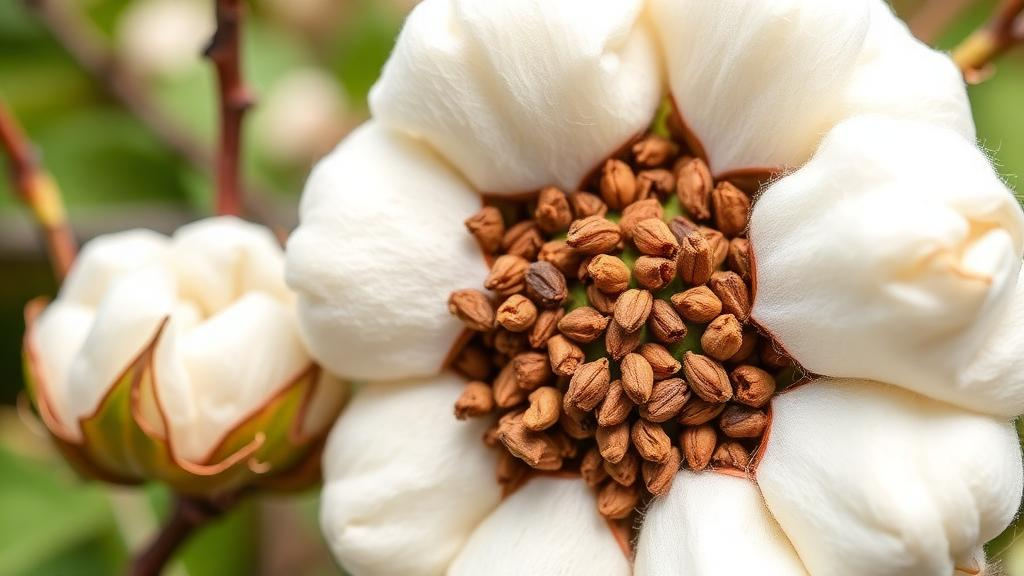
For decades, cotton breeders have wrestled with one of agriculture’s most stubborn biological compromises. Push a cotton plant to produce longer, finer, stronger fibers, and the seeds it carries tend to suffer — less oil, weaker germination, poorer vigor. Improve the seeds instead, and fiber quality often slides backward. This developmental tug-of-war has constrained the world’s most important natural textile crop for generations, forcing breeders to choose which trait to sacrifice. Now, a research collaboration in China has identified the molecular machinery behind that compromise, and in doing so has opened a credible path toward cotton plants that no longer have to choose.
A joint team from Zhengzhou University, the Institute of Cotton Research of the Chinese Academy of Agricultural Sciences, the National Nanfan Research Institute and partner institutions has dissected an antagonistic regulatory module built from two proteins, GhRCD1 and GhMYC3. Their work, published in Science China Life Sciences, shows that this protein pair acts as a timing-sensitive switch governing how a developing cotton ovule allocates its finite resources between two competing outputs: the elongating fiber cell that will become textile fiber, and the seed itself, which must accumulate oil reserves and the physiological robustness needed to germinate and establish a healthy plant. The study combined CRISPR-Cas9 genome editing, RNA interference, and a suite of biochemical assays to establish both the genetic roles of the two regulators and the physical interaction that ties them together.
The biology at the heart of the discovery begins with a simple anatomical fact: cotton fibers and cotton seeds are not independent organs. Both develop synchronously from the same ovule tissue, sharing a common pool of nutrients, signaling molecules, and cellular building blocks. When breeders select for superior fiber, they are, in effect, bidding up the price the seed must pay. What remained mysterious until now was the molecular currency exchange that mediates this trade. The new work identifies GhRCD1, a protein that promotes fiber elongation while suppressing seed vigor, and GhMYC3, a transcription factor with precisely the opposite portfolio of effects, as the central players in that exchange.
The mechanism hinges on a direct protein-protein interaction. The researchers demonstrated that GhRCD1 physically binds GhMYC3 through its RST protein domain, and that this binding weakens GhMYC3’s ability to repress its downstream target genes. In other words, GhRCD1 does not simply oppose GhMYC3 through parallel pathways; it sequesters the transcription factor and muzzles it. This antagonism is deployed with exquisite developmental timing. During the fiber elongation phase, spanning roughly the first twenty days after anthesis (DPA), GhRCD1 accumulates to high levels in the developing fibers. There it forms heterodimers with GhMYC3, relieving GhMYC3-mediated repression of peroxidase-encoding genes and of fatty acid biosynthetic genes including GhKCS12, GhCUT1, and GhFAD7A-1.
The downstream consequences of that relief are elaborate and, ultimately, decisive for both organs. Freed from repression, peroxidase activity rises, which lowers levels of reactive oxygen species (ROS) in the elongating fiber and simultaneously boosts the activity of pectin methylesterase (PME). Low-methyl-esterified pectin forms calcium-dependent cross-linked structures — so-called egg-box configurations — that stiffen the seed coat and restrain germination. At the same time, the GhRCD1-GhMYC3 complex lifts repression of the fatty acid synthesis genes, elevating production of very-long-chain fatty acids and linolenic acid that fuel robust fiber cell expansion. The net result of the early developmental window is a fiber that grows long and a seed coat that remains relatively hard and dormant.
Then the program flips. After twenty DPA, as the seed enters its oil-accumulation and vigor-establishment phase, GhRCD1 expression declines. Freed GhMYC3 now binds directly to the promoters of peroxidase genes and fatty acid biosynthetic genes, suppressing them. Peroxidase activity falls, ROS accumulate, and the oxidative surge represses PME activity. The pectin in the seed coat shifts to a highly methyl-esterified state that disrupts the egg-box cross-links, softening the coat and improving seed vigor. The same ROS buildup, however, directly suppresses further fiber elongation, and GhMYC3’s repression of fatty acid genes curtails very-long-chain fatty acid production, slowing fiber growth in parallel. One regulatory flip simultaneously softens the seed and halts the fiber — the trade-off, executed at the molecular level.
A crucial nuance in the findings is that ROS are not simply harmful. The researchers emphasize that reactive oxygen species act in a dose-dependent manner: moderate levels benefit fiber cell expansion and seed germination, while excess levels trigger oxidative damage. The GhRCD1-GhMYC3 module therefore functions less like an on-off switch and more like a fine-tuning rheostat, continuously adjusting ROS concentration, pectin methylesterification, seed coat mechanical properties, and the partitioning of fatty acid resources between fiber and seed. This rheostat model explains why the trade-off has been so difficult to breed around: the two traits are coupled not by a single shared resource but by an integrated signaling network that responds to developmental timing.
“This work reveals how cotton balances limited biological resources for two key organs,” said Dr. Zhi Wang, a corresponding author of the study. “Rather than a simple on-off switch, this module responds to developmental timing. We can take advantage of the spatial and temporal separation of fiber growth and seed maturation stages for precision breeding.” That observation points directly at the translational strategy the team proposes. Because fiber elongation and seed maturation occupy distinct developmental windows, breeders can in principle intervene in one window without disturbing the other. Tissue-specific and stage-specific genetic modification becomes the logical tool: fiber-specific overexpression of GhRCD1 could extend fiber length without penalizing seed quality, while seed-stage-specific manipulation of GhMYC3 could enhance seed vigor and oil content without any cost to fiber traits.
The practical stakes are considerable. Cotton fiber remains the backbone of the global natural textile industry, while cottonseed is simultaneously the planting material for the next crop and a significant feedstock for edible oil and other seed-derived products. A cultivar that combines premium fiber with high-oil, high-vigor seeds would deliver gains across the entire value chain, from the field to the gin to the oil press. The GhRCD1-GhMYC3 module supplies concrete gene targets for such molecular design breeding, moving the problem from statistical trait selection toward mechanistic engineering. Corresponding author Fuguang Li framed the significance in strategic terms: “Cotton is a strategic crop for China. Decoding this trade-off mechanism fills a critical gap in cotton developmental biology and supports molecular design breeding for sustainable cotton production.”
The authors are careful to note that laboratory mechanism does not yet equal field performance. Further multi-omics analyses and multi-season field trials will be required to translate the GhRCD1-GhMYC3 discovery into commercial cotton varieties that reliably deliver both traits under real agronomic conditions. Even so, the study marks a conceptual turning point. What breeders have long treated as an immutable law of cotton biology — that fiber and seed quality must trade against each other — now appears to be a tunable regulatory program, one whose timing and tissue specificity can be rewritten. If the precision-breeding strategy holds up in the field, the oldest compromise in cotton improvement may finally be negotiable.
Subject of Research: Molecular regulation of the developmental trade-off between fiber quality and seed traits in cotton
Article Title: Breaking cotton’s developmental trade‑off: GhRCD1‑GhMYC3 module enables concurrent improvement of fiber quality, seed oil, and seed vigor
Article References: Breaking cotton’s developmental trade‑off: GhRCD1‑GhMYC3 module enables concurrent improvement of fiber quality, seed oil, and seed vigor. (n.d.). Original publication
Image Credits: AI Generated
DOI: Not provided
Keywords: cotton, GhRCD1, GhMYC3, fiber quality, seed vigor, seed oil, reactive oxygen species, pectin methylesterase, fatty acid biosynthesis, CRISPR-Cas9, molecular breeding, plant developmental biology
News Source: Alan Morgan. (October 7, 2026). Cotton’s Fiber-Seed Trade-Off Cracked: GhRCD1-GhMYC3 Module Promises Premium Fiber and Vigorous Seeds Together. Scienmag.