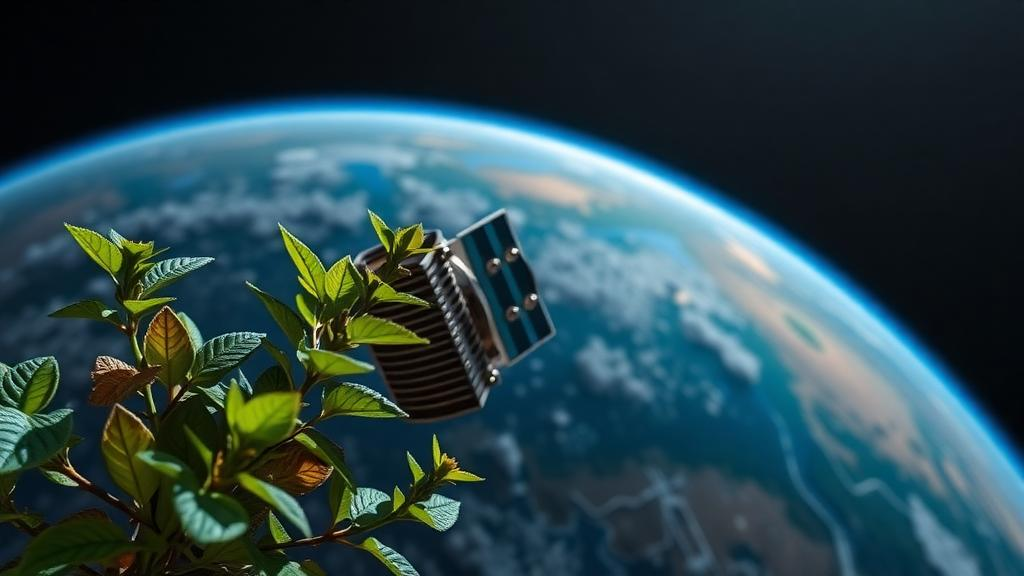
In the early hours of 15 September 2026, the European Space Agency is scheduled to launch a satellite designed to do something no spacecraft has ever done before: watch the world’s plants photosynthesize in real time. The mission, known as FLEX, short for FLuorescence EXplorer, is the eighth of ESA’s Earth Explorer missions, a program dedicated to cutting-edge research satellites that address fundamental questions about the Earth system. Rather than photographing forests and fields in the familiar colors of visible light, FLEX will detect an almost imperceptible glow that plants themselves produce as a by-product of turning sunlight into chemical energy. For the first time, scientists will be able to map photosynthetic activity across the entire planet from orbit, opening what researchers at Forschungszentrum Jülich describe as a new era of plant research from space.
The signal at the heart of the mission is called solar-induced chlorophyll fluorescence, often abbreviated as SIF. When chlorophyll molecules in a leaf absorb sunlight, most of that energy drives photosynthesis, the process by which carbon dioxide and water are converted into sugars and oxygen. A small fraction of the absorbed energy, however, is re-emitted by the chlorophyll as light at slightly longer, redder and far-red wavelengths than the incoming sunshine. This faint re-emission is fluorescence, and it acts as a kind of natural diagnostic of the photosynthetic machinery. When a plant is thriving, its fluorescence signature follows a characteristic pattern; when it is stressed by drought, heat or other environmental pressures, the balance between photosynthesis, heat dissipation and fluorescence shifts in measurable ways.
What makes this signal so valuable is that it reveals stress long before any visible symptom appears. A field of crops may look green and healthy to the eye or to a conventional satellite camera while its photosynthetic performance is already declining under water shortage or extreme temperatures. Because fluorescence is directly tied to the biochemistry of photosynthesis rather than to the structure or color of the vegetation, it offers a window into plant function rather than merely plant appearance. FLEX will use this link to determine how active plants are across the globe and whether they are experiencing drought, heat or other forms of environmental stress, providing the first-ever global maps of photosynthetic activity.
Those maps are expected to transform how scientists understand the role of vegetation in the global carbon and water cycles. Forests, grasslands and agricultural land absorb enormous quantities of carbon dioxide each year, but the exact magnitude of that uptake varies with weather, season and climate stress, and current estimates rely heavily on models and sparse ground measurements. A direct, space-based measurement of photosynthesis will provide an independent constraint on those estimates. According to Prof. Uwe Rascher, head of the Institute of Bio- and Geosciences – Plant Sciences at Forschungszentrum Jülich, FLEX will for the first time give researchers a direct insight into the photosynthesis of vegetation on a global scale, opening up entirely new possibilities for understanding the effects of climate change on plants and for significantly improving models of the carbon and water cycles.
Forschungszentrum Jülich has been deeply involved in the mission since ESA selected FLEX as an Earth Explorer in 2015. The center’s long-standing expertise in photosynthesis research and in measuring plants under natural conditions has placed it at the center of several key tasks. Prof. Rascher serves on the FLEX Mission Advisory Group, helping to guide the scientific development of the mission. Researchers at the Jülich Institute of Bio- and Geosciences – Plant Sciences are also developing highly specialized sensor systems for validation measurements taken on the ground and from the air, instruments that will be essential for checking that what the satellite sees from hundreds of kilometers above the Earth matches what is actually happening in fields and forests below.
That validation work will become the immediate priority once the satellite reaches orbit. In a series of international measurement campaigns, the Jülich researchers will use their airborne and ground-based instruments to verify the FLEX data and compare them with independent reference measurements. Validation of this kind is crucial to ensuring the quality and scientific value of the satellite data, because even the most sophisticated space instrument requires careful calibration against reality on the ground. The campaigns will bring together teams from across Europe, combining tower-based flux measurements, aircraft surveys and detailed leaf-level experiments to build the confidence needed before the data are released to the wider scientific community.
The launch also marks the beginning of a second, equally important phase of work: turning raw satellite data into knowledge. All FLEX data will be freely available, and the German FLEX project office, based at Forschungszentrum Jülich and commissioned by the German Space Agency at DLR, is charged with building a German user community around the mission. The office supports researchers and users in working with the data, develops usage concepts, and connects the community with national and international partners. Dr. Juliane Bendig, who heads the project office, emphasizes that realizing the mission’s scientific potential quickly will require a well-connected community applying the data to a wide range of research questions, with the office’s aim being to support researchers in developing new applications and to highlight the value of the FLEX data for science and society.
The range of potential applications is broad. In climate research, global fluorescence maps will sharpen understanding of how much carbon the biosphere absorbs and how that absorption changes during heat waves and droughts. In agriculture, early detection of plant stress could help farmers respond to water shortages before yields are damaged, supporting the development of climate-resilient farming systems. In environmental monitoring, the data could inform the protection of natural ecosystems and contribute to early warning of conditions that threaten forests and grasslands. German Federal Research Minister Dorothee Bär noted that the summer of 2026 has shown how important such data are in helping to mitigate crop losses and the risk of wildfires, and described FLEX as a crucial step towards detecting plant stress at an early stage.
Political and scientific leaders in Germany have framed the mission as an example of what coordinated European research can achieve. Prof. Dr. Astrid Lambrecht, Chair of the Board of Directors of Forschungszentrum Jülich, highlighted that the center is bringing its long-standing expertise in plant research to an important European initiative, combining scientific excellence, high-performance measurement technologies and openly accessible research data to deepen understanding of the impacts of climate and environmental change. NRW Science Minister Ina Brandes pointed out that a global photosynthesis map will help make agriculture more resilient and sustainable, contributing to food security for a growing global population. The mission brings together space agencies and research institutions from numerous European countries, and its supporters argue that pooling Europe’s own scientific and technological capabilities in Earth observation also strengthens the continent’s technological sovereignty.
For the researchers who have spent more than a decade preparing for this moment, the launch on 15 September at 03:21 CEST is both an ending and a beginning. Years of laboratory work, aircraft campaigns and instrument development will finally be tested against the ultimate challenge of measuring a faint fluorescent glow from orbit. At the same time, the real work of the scientific community is only just beginning: evaluating the freely available data, validating them against ground truth, and weaving them into climate models, agricultural practice and environmental policy. If FLEX delivers on its promise, scientists will for the first time be able to watch the planet breathe at the level of photosynthesis, tracking in near real time how the world’s vegetation responds as the climate continues to change.
Subject of Research: Satellite-based observation of solar-induced chlorophyll fluorescence to monitor global plant photosynthesis and vegetation stress
Article Title: Observing photosynthesis from space: Jülich supports European satellite mission
Article References: Observing photosynthesis from space: Jülich supports European satellite mission. (n.d.). Original publication
Image Credits: AI Generated
DOI: Not provided
Keywords: FLEX, ESA, photosynthesis, chlorophyll fluorescence, remote sensing, Forschungszentrum Jülich, climate change, agriculture, Earth observation, plant stress, carbon cycle, food security
News Source: Alan Morgan. (October 5, 2026). New European satellite to watch plants photosynthesize from orbit. Scienmag.