Credit: Ana Davidson
Right now, a prairie dog in Colorado is busy increasing soil carbon retention, increasing water infiltration, and clipping vegetation that will help maintain local grasslands and provide nutritious forage for large herbivores like cattle and bison. And, somewhere in Mexico, a pollinating bat is ensuring agave plants make good tequila.
Mammals across the globe provide natural goods and services that we all depend on, but one quarter of the world's mammals currently are threatened by human activities, according to the International Union for the Conservation of Nature, or IUCN. Their functional traits (such as the ability to fly, swim, or dig) and the consequent ecological roles they play in ecosystems is just one lens through which to view mammalian diversity, but it isn't the primary way most conservation efforts traditionally are prioritized. Most efforts look at the total number of species in an area and their vulnerability to determine conservation priorities, but that means biologically unique species — think about the platypus – may be underrepresented.
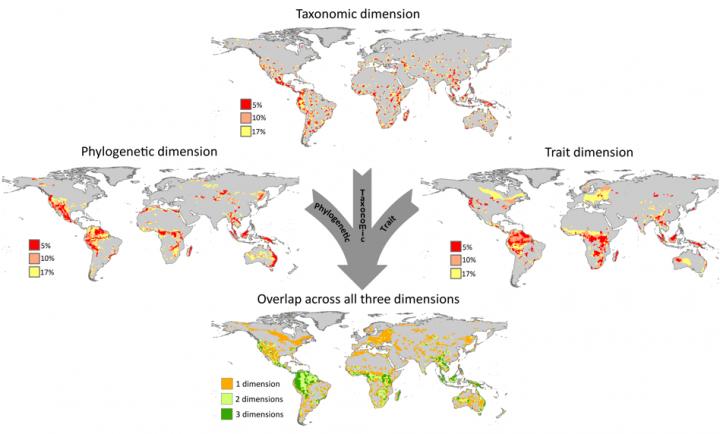
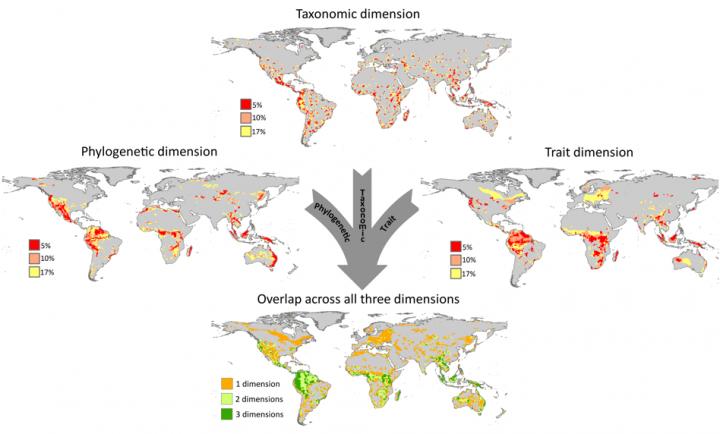
New research by Ana D. Davidson, a conservation scientist with the Colorado National Heritage Program within the Warner College of Natural Resources at Colorado State University, underscores the viewing of global conservation priority areas through three lenses. They are: 1. the number of species (taxonomic); 2. functional diversity (traits); and 3. evolutionary history (phylogenetic). Viewed through these lenses, conservation efforts can more effectively help safeguard mammalian diversity.
Davidson uses her hands to emphasize the importance of looking across these multiple dimensions of biodiversity to protect the remarkable diversity of mammals that range across eight orders of magnitude in body size. She pinches two fingers nearly together to demonstrate the size of a white-toothed pygmy shrew — the smallest mammal in the world weighing less than 2 grams. She talks about protection needed for the tiniest bumblebee bat (weighing just 2 grams and only a little over an inch long) to the biggest blue whale (the largest animal on Earth, upwards of 200 tons and up to 100 feet long). She pulls up a website dedicated to some of the planet's most evolutionary unique mammals that are on the edge of extinction, and scrolls through saying, "ooh, look, see, the aye-aye is a good example." She's rooting for all mammals to have the best shot at persisting in a human-dominated world. She's hopeful her research can help.
"Protecting the different dimensions of biodiversity will help ensure the evolutionary potential of species to adapt in a rapidly changing world, and safeguard nature's contribution on which we all depend," she said.
This new research finds limited overlap in priority regions across the three dimensions, as well as with current protected areas, indicating that conservation planning should consider multiple dimensions of biodiversity and safeguard those core areas where they do overlap to maximize biodiversity conservation.
In an important step toward ambitious goals, this work provides the first biological map of priority areas that capture all three dimensions of mammalian biodiversity. This complementarity-based prioritization provides a conservation solution that can be incorporated in future planning efforts aimed to help protect species, their evolutionary potential to adapt in a rapidly changing world, and the ecosystem services they provide (think pollinating bats and tequila!). This work also helps inform the 2020 goal set by the 10th United Nations Convention of Biodiversity — to protect 17 percent of the Earth's land surface.
Proceedings of the National Academy of Sciences, or PNAS, has published "Global priorities for conservation across multiple dimensions of mammalian diversity," with Davidson as senior author and her former student, Fernanda T. Brum, as lead author. Brum conducted this work as part of her doctoral dissertation while on a Brazilian government doctoral scholarship, studying with Ana Davidson and Catherine Graham at Stony Brook University in New York. There are six other contributing authors, and the research was funded by the National Science Foundation's Dimensions of Biodiversity program.
"By unevenly protecting the dimensions," said Brum, "we could be losing branches of the mammalian tree of life and compromise the provision of ecosystem service."
###
Media Contact
Anne Manning
[email protected]
970-491-7099
@ColoStateNews
Original Source
http://source.colostate.edu/new-research-can-change-conservation-planning-benefit-vulnerable-mammals/ http://dx.doi.org/10.1073/pnas.1706461114
############
Story Source: Materials provided by Scienmag