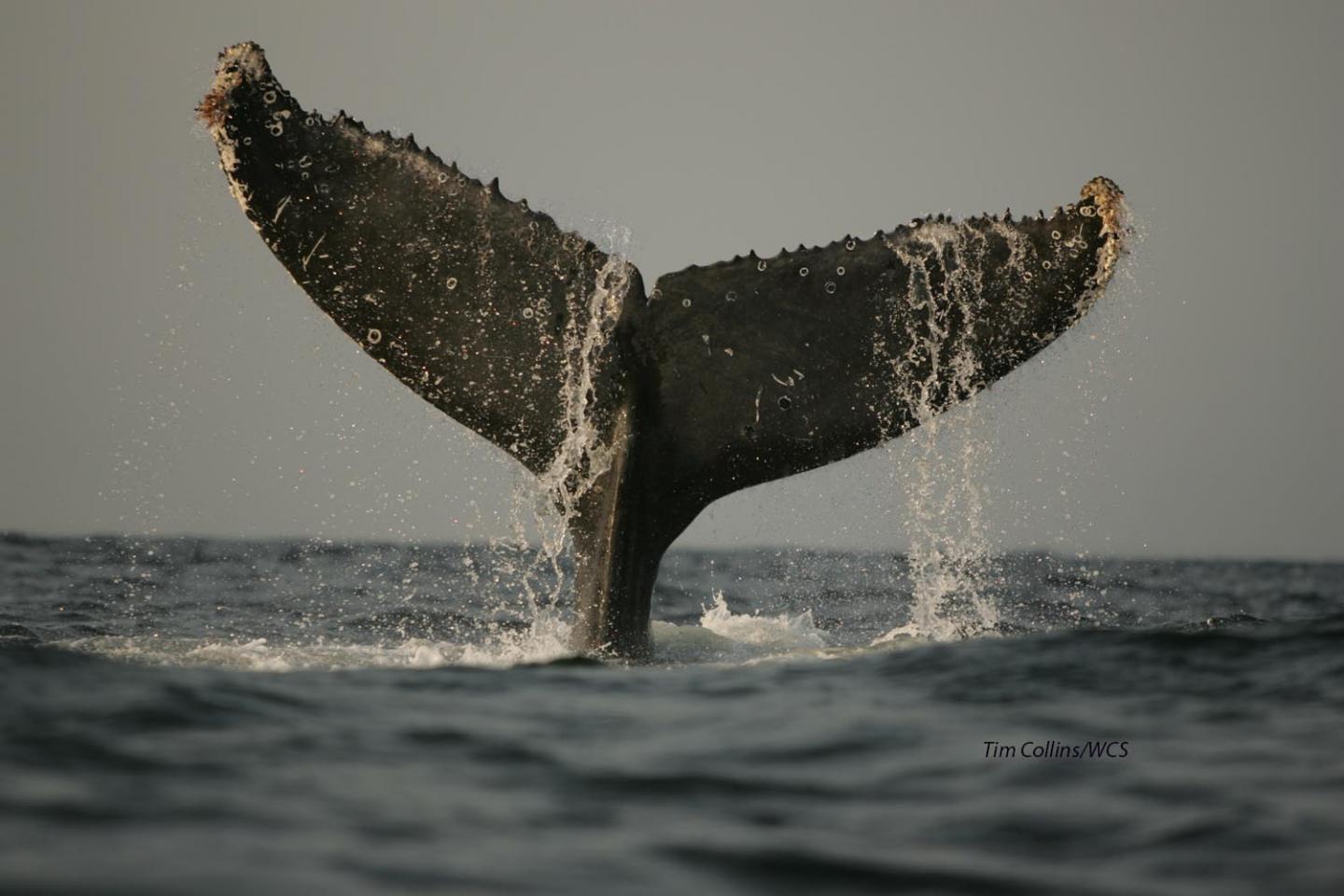
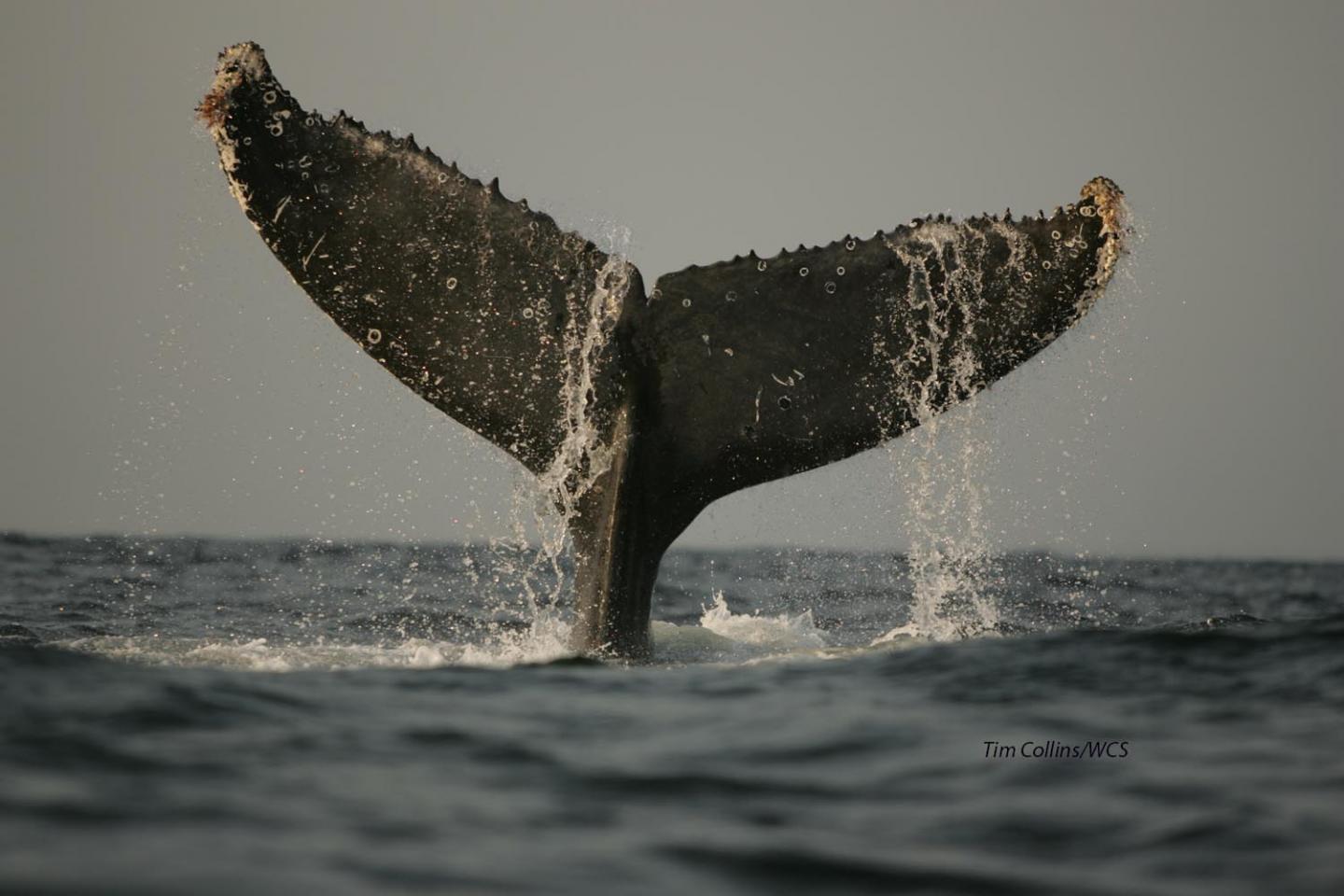
Credit: Tim Collins/WCS
Scientists conducting the first circum-global assessment of mitochondrial DNA variation in the Southern Hemisphere's humpback whales (Megaptera novaeangliae) have found that whales faithfully returning to calving grounds year after year play a major role in how populations form, according to WCS (Wildlife Conservation Society), the American Museum of Natural History, and a number of other contributing organizations.
The research results build on previous regional studies of genetic diversity and will help scientists to better understand how humpback whale populations evolve over time and how to best advise international management authorities.
The paper titled "First Circumpolar Assessment of Southern Hemisphere Humpback Whale Mitochondrial Genetic Variation at Multiple Scales and Implications for Management" now appears in the online version of Endangered Species Research.
"Exploring the relationships of humpback whales around the Southern Hemisphere has been a massive undertaking requiring years of work and collaboration by experts from more than a dozen countries," said Dr. Howard Rosenbaum, Director of WCS's Ocean Giants Program and lead author on the study. "Our findings give us insights into how fidelity to breeding and feeding destinations persist over many generations, resulting in differences between whale populations, and why some populations are more genetically differentiated from the rest. From these efforts, we are in better positions to inform actions and policies that will help protect Southern Hemisphere humpback whales across their range, as well as in the Arabian Sea."
In the largest study of its kind to date, researchers used mitochondrial DNA microsatellites from skin samples gathered from more than 3,000 individual humpback whales across the Southern Hemisphere and the Arabian Sea to examine how whale populations are related to one another, a question that is difficult to answer with direct observations of whales in their oceanic environment. Overall, the study's data from mitochondrial DNA — different from nuclear DNA in that it helps scientists trace maternal lineages — reveal that population structure in humpback whales is largely driven by female whales that return annually to the same breeding grounds and by the early experience of calves that accompany their mothers on their first round-trip migration to the feeding grounds. The persistence of return to these migratory destinations over generations, is known as 'maternally directed site fidelity'.
The occasional genetic interchange between populations also seemed to correlate with feeding grounds with high densities of krill, places where whales from different populations are likely to move vast distances and come into contact with other populations. The study also identified specific populations — those inhabiting the eastern South Pacific off of Colombia and a non-migratory population in the Arabian Sea–as more genetically distinct and isolated from other nearby populations and perhaps in need of additional management and conservation consideration.
"Our increased understanding of how whale populations are structured can help governments and inter-governmental organizations like the International Whaling Commission improve management decisions in the future," said Dr. C. Scott Baker of Oregon State University's Marine Mammal Institute and a member of the South Pacific Whale Research Consortium that contributed to the study.
The humpback whale reaches a body length of 50 feet and, as a largely coastal species, is popular with whale watch operations around the world. Before receiving international protection in 1966, humpback whales were targeted by commercial whaling vessels that nearly drove the species into extinction. This included more than 45,000 humpback whales taken illegally by the Soviet Union after World War II. Current threats to humpback whales include ship strikes, underwater noise, pollution, and entanglement in fishing gear.
These threats are particularly pertinent to humpback whales in the Arabian Sea, a genetically isolated population numbering fewer than 100 animals and currently listed on the IUCN's Red List of Threatened Species as "Endangered." WCS's research is done in collaboration with a number of regional and local partners in the Arabian Sea working on advocacy and conservation, notably the Environment Society of Oman, among others.
###
The authors of the study are: Howard C. Rosenbaum of WCS and AMNH (American Museum of Natural History); Francine Kershaw of Columbia University and the Natural Resources Defense Council; Martín Mendez of WCS; Cristina Pomilla of AMNH and the Wellcome Trust Sanger Institute, United Kingdom; Matthew S. Leslie of AMNH and the Smithsonian Institution; Ken P. Findlay of the Cape Peninsula University of Technology, South Africa; Peter B. Best of the University of Pretoria, South Africa; Timothy Collins of WCS; Michel Vely of Association Megaptera, France; Marcia H. Engel of Projeto Baleia Jubarte/Instituto Baleia Jubarte, Brazil; Robert Baldwin of the Five Oceans Environmental Services LLC, Sultanate of Oman; Gianna Minton of Megaptera Marine Conservation, the Netherlands; Michael Meÿer of Oceans and Coasts, Department of Environmental Affairs, South Africa; Lilian Flórez-González of Fundación Yubarta, Colombia; M. Michael Poole of the South Pacific Whale Research Consortium, Cook Islands; Nan Hauser of the South Pacific Whale Research Consortium and Cook Islands Whale Research, Cook Islands; Claire Garrigue of the South Pacific Whale Research Consortium (Cook Islands) and Opération Cétacés (New Caledonia); Muriel Brasseur of Edith Cowan University, Australia; John Bannister of the Western Australian Museum; Megan Anderson of Southern Cross University, Australia; Carlos Olavarría of the University of Auckland (New Zealand) and Centro de Estudios Avanzados en Zonas Aridas (Chile); and C. Scott Baker of the South Pacific Whale Research Consortium (Cook Islands) and Oregon State University.
Media Contact
John Delaney
[email protected]
718-220-3275
@TheWCS
http://www.wcs.org
############
Story Source: Materials provided by Scienmag