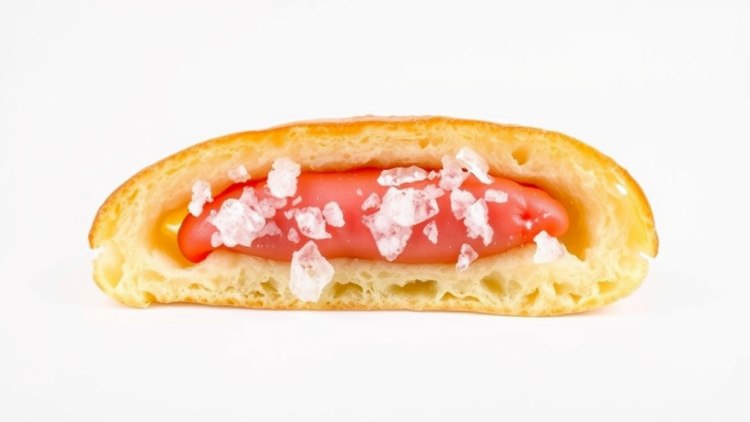
Salt is the quiet engine of the global diet. It does far more than make food taste salty; it suppresses bitterness, amplifies sweetness and umami, and shapes the texture and shelf life of everything from bread to processed meat. It is also, by consensus of public health authorities worldwide, consumed in amounts that raise blood pressure and contribute to cardiovascular disease on a mass scale. Reducing sodium in food without ruining the eating experience has therefore become one of the most persistent challenges in food science, and a new review published in npj Science of Food argues that the solution may lie not in the salt itself but in the architecture of the food that carries it.
The review, titled “Enhancing saltiness perception through food structure design: multi-scale mechanisms and strategies,” brings together findings from sensory physiology, food physics, materials science and computational modeling to map how the microscopic and macroscopic organization of food controls the way sodium reaches our taste receptors. The central insight is deceptively simple: saltiness is not determined solely by the total amount of sodium in a product, but by how efficiently that sodium is delivered to taste receptors on the tongue during chewing. Food structure, from the molecular arrangement of proteins and polysaccharides up to the visible organization of emulsions, gels, foams and porous solids, acts as the gatekeeper of that delivery.
At the finest scale, the authors examine the chemistry of sodium ions and their interaction with the saliva and mucus layer that bathes the tongue. Before a sodium ion can activate the epithelial sodium channels responsible for salt taste, it must diffuse through a hydrated matrix, be released from whatever food component binds it, and reach the receptor surface at a sufficiently high local concentration. Binding interactions with proteins such as caseins, with charged polysaccharides, or with lipids can slow that release, while free, unbound sodium in the liquid phase of a food reaches receptors almost immediately. This means two products with identical sodium content can produce markedly different saltiness ratings depending on how strongly the matrix holds on to its ions.
The review then scales up to the mesoscopic level of droplets, particles and networks. Here, the concept of localized salt pockets becomes crucial. Studies summarized in the review show that concentrating salt into heterogeneously distributed compartments—surface coatings, layered inclusions, or dissolved phases within oil-in-water emulsions—can produce bursts of intense saltiness during chewing even when the average sodium concentration is significantly reduced. Human sensory panels evaluating such structurally designed products frequently report equivalent or near-equivalent saltiness compared with conventionally salted controls, because the tongue responds to transient peaks in sodium concentration rather than to a diluted but uniform level. The physics of this strategy relies on controlled phase separation and on engineering which phase of a multiphase food carries the salt.
Moisture and water activity emerge as another powerful lever. Sodium ions migrate with water, and foods with higher water content or with water deliberately redistributed toward the surface release salt more readily into saliva during the first seconds of mastication, when salt perception is at its sharpest. Conversely, dry or tightly bound matrices such as crackers hold sodium in a form that is released slowly and perceived weakly, prompting manufacturers to compensate with more salt. By re-engineering moisture distribution—through humectants, through modified cooking and drying protocols, or through laminated structures that concentrate brine in specific layers—designers can increase apparent saltiness while cutting total sodium.
The review also devotes significant attention to mechanical breakdown behavior, the way a food fractures, melts or erodes in the mouth. Time-resolved sensory techniques such as temporal dominance of sensations show that the perceived intensity of saltiness depends on the rate at new sodium-laden surfaces are exposed during chewing. Soft gels that dissolve quickly can deliver their sodium payload in a brief, high-intensity pulse, whereas brittle structures that shatter into fine particles create many fresh surfaces at once, releasing salt rapidly and boosting the taste signal. Porous aerated structures, common in breads and snacks, provide internal surfaces that saliva can penetrate, effectively pre-dissolving salt before it reaches the receptor field. Matching food breakdown kinetics to the temporal sensitivity of human taste is presented as a design principle in its own right.
Beyond the tongue itself, the authors highlight multisensory and cognitive mechanisms that modulate saltiness. Aroma compounds can enhance perceived saltiness through cross-modal interaction, a phenomenon exploited by adding savory volatiles that trick the brain into expecting more sodium than is physically present. Texture cues also matter: crispness, juiciness and perceived moistness are subconsciously associated with saltiness, and visual expectations of a well-seasoned product can bias ratings before the first bite. Sound contributes as well, with louder, crunchier mastication sounds reported to increase intensity judgments. These psychological pathways offer sodium reduction routes that involve no reformulation of ionic content at all, only a reshaping of the context in which taste is constructed.
Turning mechanisms into strategies, the review organizes practical approaches into families. Surface salting and coatings concentrate sodium where it matters most, at the interface with saliva. Emulsion and gel engineering shifts salt into the continuous aqueous phase or into dispersed droplets that rupture during chewing. Encapsulation technologies, including liposomes and hydrogel beads, can protect sodium from premature interactions and release it on demand under mechanical shear. Porosity engineering uses aeration and freeze-drying to multiply surface area. Substitution strategies, replacing part of the sodium chloride with potassium chloride or other salts, are made more palatable when combined with structural delivery, because bitterness from potassium can be masked by optimized release timing and aroma pairing. The authors stress that no single tactic suffices; the most effective sodium reduction combines several structural approaches tuned to a specific product matrix.
The review does not shy away from the obstacles ahead. Sensory results from model systems do not always translate to complex real foods, where heat treatment, freezing, storage and ingredient interactions can reorganize structure over time. Manufacturing scale-up, cost, labeling and consumer acceptance all impose constraints, and regulatory ambiguity around novel salt substitutes complicates reformulation. Measuring sodium release kinetics in realistic chewing conditions requires sophisticated in vitro and in vivo methods, from dynamic saliva simulation to real-time monitoring in human subjects, and the field still lacks standardized protocols for comparing across studies. Standardization, the authors suggest, would accelerate progress by making multi-scale data comparable across laboratories.
Looking forward, the authors identify computational structure design as an emerging frontier. Machine learning models trained on compositional, structural and temporal sensory datasets could one day predict saltiness trajectories for new formulations before any panel is convened, shortening development cycles for reduced-sodium products. Coupled with high-resolution imaging of food microstructure and physics-based simulations of salivary release, such tools would turn sodium reduction from an empirical craft into a quantitative engineering discipline. The public health stakes are considerable: even a modest population-wide reduction in sodium intake is projected to prevent large numbers of hypertension-related deaths annually. If the tongue can be satisfied by smarter structure rather than more salt, the review concludes, the food industry gains a path to healthier products that consumers actually want to eat—an outcome in which physics, physiology and flavor converge on the same side.
Subject of Research: Food structure design to enhance saltiness perception for sodium reduction
Article Title: Enhancing saltiness perception through food structure design: multi-scale mechanisms and strategies
Article References: Meng, W., & Miao, S. (2026). Enhancing saltiness perception through food structure design: multi-scale mechanisms and strategies. npj Science of Food. https://doi.org/10.1038/s41538-026-01123-9
Image Credits: AI Generated
DOI: 10.1038/s41538-026-01123-9
Keywords: salt reduction, saltiness perception, food structure, sodium, taste receptors, food science, sensory science, emulsions, food texture, food microstructure, public health, npj Science of Food
Cite Scienmag News
APA MLA Chicago
Daisy Hatcher. (September 22, 2026). Scientists Reveal How Food Structure Can Fool the Tongue Into Tasting More Salt. Scienmag. https://scienmag.com/scientists-reveal-how-food-structure-can-fool-the-tongue-into-tasting-more-salt/
Daisy Hatcher. “Scientists Reveal How Food Structure Can Fool the Tongue Into Tasting More Salt.” Scienmag, 22 September 2026, https://scienmag.com/scientists-reveal-how-food-structure-can-fool-the-tongue-into-tasting-more-salt/. Accessed 22 September 2026.
Daisy Hatcher. “Scientists Reveal How Food Structure Can Fool the Tongue Into Tasting More Salt.” Scienmag. September 22, 2026. https://scienmag.com/scientists-reveal-how-food-structure-can-fool-the-tongue-into-tasting-more-salt/
Copy citation Download RIS
Tags: computational modeling of food tasteemulsionsfood microstructurefood sciencefood structurefood structure and taste receptor interactionfood texturefood texture engineeringimpact of food architecture on salt tasteinfluence of food microstructure on flavor releasematerials science in food flavor modulationmulti-scale mechanisms of saltiness perceptionnpj Science of FoodPublic healthreducing dietary sodium via food designrole of food physics in flavor perceptionsalt perception enhancement through food structuresalt reductionsaltiness perceptionsensory physiology of salt detectionsensory sciencesodiumstrategies for low-sodium food developmenttaste receptors