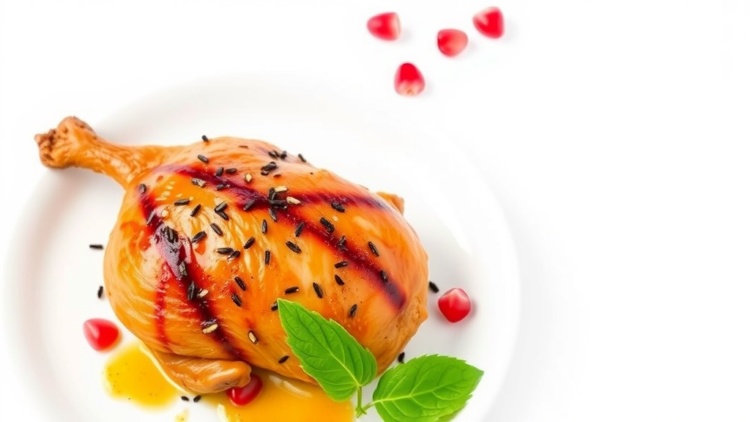
A fruit peel most people throw away may soon help keep one of Korea’s best-loved chicken dishes fresh for longer. In a study published in Food Science of Animal Resources, researchers at Kangwon National University found that adding a small amount of pomegranate peel extract to soy sauce-marinated dakgalbi slowed microbial growth, curbed protein breakdown, and improved water retention during more than two weeks of refrigerated storage. The findings suggest that this agricultural byproduct, long valued in traditional medicine and increasingly studied as a food ingredient, could serve as a clean-label preservative for the rapidly expanding ready-to-cook meal market.
Dakgalbi, a spicy stir-fried chicken dish that originated in Chuncheon, occupies a special place in Korean cuisine. A consumer survey cited by the authors found that Chuncheon dakgalbi accounted for 14.2 percent of preferred Korean-style chicken dishes for dining out. Beyond restaurants, the dish has strong potential in the home meal replacement sector, particularly in ready-to-cook formats that consumers can finish at home with minimal effort. The global home meal replacement market was valued at 564.5 billion US dollars in 2022 and is projected to reach 839.7 billion dollars by 2028, while the ready-to-cook segment is expected to grow at a compound annual rate of 6.83 percent between 2019 and 2025. Yet dakgalbi suffers from a persistent commercial weakness: a short shelf life driven by high initial microbial loads from raw chicken, vegetables, and sauce ingredients.
The research team tackled this problem using breast meat from Woorimatdag No. 1, a three-way crossbreed developed to overcome the slow growth and unstable supply of conventional Korean native chickens while retaining their distinctive flavor. The meat was diced, marinated in a soy sauce-based sauce at a one-to-four sauce-to-meat ratio, and divided into three treatments: an untreated control, and formulations containing either 0.14 percent or 0.18 percent pomegranate peel extract. The extract was prepared by washing and surface-sterilizing fresh pomegranates, separating the peels, grinding and freeze-drying them, and performing an aqueous extraction at a one-to-fifty weight-to-volume ratio for four hours at 20 degrees Celsius before a second lyophilization step yielded a dry powder.
Chemical analysis confirmed why pomegranate peel is such a promising candidate. The water-soluble extract contained 179.16 milligrams of gallic acid equivalents per gram of dry matter, a total phenolic content consistent with values reported in earlier literature. Pomegranate peel is particularly rich in hydrolyzable tannins, especially punicalagin and punicalin, along with ellagic acid and gallic acid, compounds recognized as the principal bioactive constituents of the peel. Antioxidant capacity, measured by three complementary assays, reached 2735.67 micromoles of Trolox equivalents per gram in the ABTS radical-scavenging test, 2285.85 micromoles per gram in the ferric reducing antioxidant power assay, and 1063.82 micromoles per gram in the oxygen radical absorbance capacity test. These phenolics are highly redox-active and can inhibit oxidative chain reactions in meat systems through radical scavenging, reducing power, and metal chelation.
The extract also displayed potent antimicrobial activity. In a paper disc diffusion assay against four major foodborne pathogens, pomegranate peel extract at concentrations ranging from 1.25 to 10 milligrams per disc generated measurable inhibition zones against all tested strains, with effects increasing dose-dependently. Salmonella Enteritidis proved the most sensitive organism, while Listeria monocytogenes was relatively less susceptible, a difference the authors attribute to species-specific variations in cell envelope structure, permeability, and stress adaptation. Even at the lowest dose of 1.25 milligrams per disc, inhibition zones exceeded 10 millimeters. The antimicrobial action is believed to involve disruption of the bacterial cell envelope, interference with membrane-associated proteins and enzymes, restriction of essential metal ions, and inhibition of biofilm formation.
When the fortified dakgalbi was vacuum-packaged and stored at 4 degrees Celsius for 16 days, the microbial results told a clear story. Total aerobic bacterial counts rose significantly in all treatments, but from day 12 onward the control group showed markedly higher counts than either extract-treated group. By day 16, counts stood at 6.27 log colony-forming units per gram in the control compared with 5.96 and 5.89 in the 0.14 percent and 0.18 percent treatments respectively, all remaining below the Korean Ministry of Food and Drug Safety limit of 6.70 log CFU per gram, although the control was approaching the threshold. Coliform counts told a similar tale, rising sharply by day 16 with significantly greater levels in the control than in the extract-treated samples. No Escherichia coli was detected in any treatment throughout storage.
Chemical spoilage indicators reinforced the microbiological picture. Total volatile basic nitrogen, a marker of protein degradation by microbial and endogenous enzymes, increased in all groups but was significantly lower in the treated samples by the end of storage, reaching 32.22 milligrams percent in the control compared with 27.46 and 28.66 milligrams percent in the two extract groups. Because soy sauce itself elevates baseline nitrogenous compounds, the authors caution that absolute values should be interpreted alongside the formulation and other spoilage indicators. Lipid oxidation, measured by thiobarbituric acid reactive substances, rose with storage time but did not differ significantly among treatments, indicating that under these conditions the extract did not effectively retard rancidity in the soy sauce-marinated breast meat product. Water-holding capacity, however, was better preserved: by day 16, the treated samples retained more moisture than the control, whose value had fallen to 46.10 percent, with the highest retention of 51.46 percent observed in the 0.14 percent group, a finding the authors link to better preservation of muscle protein functionality.
Sensory evaluation by a trained 15-member panel added an important consumer dimension. Appearance scores for the extract-containing samples declined after day 8, reflecting the darker color and reduced lightness and yellowness imparted by the dried peel powder. Flavor and off-flavor scores in the control deteriorated significantly by day 12, whereas the treated groups maintained these attributes without significant change, and overall acceptability was sustained through day 12 in all formulations. Notably, the proximate composition of the final products, containing roughly 20.20 to 20.73 percent crude protein and only 0.83 to 0.91 percent crude fat, was unaffected by extract supplementation, confirming that the addition improved functional quality without altering basic nutritional value. The authors concluded that the lower 0.14 percent addition level appeared sufficient, making it a practical choice for manufacturers seeking to balance efficacy against color penalties.
The study carries broader significance for the food industry’s search for natural alternatives to synthetic preservatives. Concerns over synthetic antioxidants have intensified demand for plant-derived solutions, and pomegranate peel, a waste stream of juice processing, has previously outperformed butylated hydroxytoluene in chicken patties and ascorbic acid in refrigerated sausages, and has shown potential as a nitrite substitute in dry-fermented products. Its application to Korean marinated chicken dishes, however, had remained largely unexplored. By demonstrating that the extract preserved the quality of dakgalbi primarily through suppressing microbial proliferation and proteolysis, and by validating Woorimatdag No. 1 breast meat as a suitable raw material, the researchers have opened a path toward longer-lasting, clean-label ready-to-cook chicken products. The authors note that further work is warranted to characterize shifts in the microbial community, standardize active compound levels, and confirm performance across wider processing conditions, but the message for an industry racing to meet demand for convenient, minimally preserved foods is clear: the answer may lie in the peel.
Subject of Research: Use of pomegranate peel extract as a natural preservative to improve the quality and refrigerated storage stability of marinated chicken dakgalbi
Article Title: Effect of pomegranate (Punica granatum L.) peel extract on the quality and storage stability of dakgalbi prepared from the breast meat of Korean native chicken
Article References: Jeong, D., Sujiwo, J., Jung, Y., Kim, D., Lee, H.-J., Oh, S., Lee, S., Choo, H.-J., & Jang, A. (2026). Effect of pomegranate (Punica granatum L.) peel extract on the quality and storage stability of dakgalbi prepared from the breast meat of Korean native chicken. Food Science of Animal Resources, 46(1), Article 95. https://doi.org/10.1007/s44463-026-00080-x
Image Credits: AI Generated
DOI: 10.1007/s44463-026-00080-x
Keywords: pomegranate peel extract, dakgalbi, Korean native chicken, Woorimatdag, natural preservatives, antimicrobial activity, antioxidant capacity, shelf life, meat quality, food storage stability, ready-to-cook meals, phenolic compounds
Cite Scienmag News
APA MLA Chicago
Alan Morgan. (September 12, 2026). Pomegranate Peel Extract Extends Shelf Life of Marinated Korean Native Chicken. Scienmag. https://scienmag.com/pomegranate-peel-extract-extends-shelf-life-of-marinated-korean-native-chicken/
Alan Morgan. “Pomegranate Peel Extract Extends Shelf Life of Marinated Korean Native Chicken.” Scienmag, 12 September 2026, https://scienmag.com/pomegranate-peel-extract-extends-shelf-life-of-marinated-korean-native-chicken/. Accessed 12 September 2026.
Alan Morgan. “Pomegranate Peel Extract Extends Shelf Life of Marinated Korean Native Chicken.” Scienmag. September 12, 2026. https://scienmag.com/pomegranate-peel-extract-extends-shelf-life-of-marinated-korean-native-chicken/
Copy citation Download RIS
Tags: antimicrobial activityantioxidant capacityapplication of natural antioxidants in Korean cuisineclean-label food additivesdakgalbifood storage stabilitygrowth of home meal replacement marketimpact of fruit peel extracts on food safetyinnovative food preservation techniquesKorean native chickenMeat Qualitymicrobial growth inhibition in ready-to-cook mealsnatural preservativesPhenolic compoundsPomegranate peel extractPomegranate peel extract as natural food preservativeprotein breakdown prevention in meat productsready-to-cook mealsshelf lifeshelf life extension of marinated chickentraditional Korean chicken dish preservationuse of agricultural byproducts in food industrywater retention in marinated poultryWoorimatdag