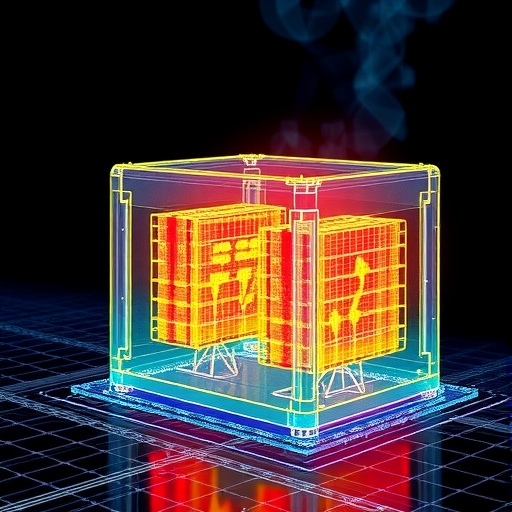
Buildings could soon get a powerful new tool for cutting heating and cooling demand: an artificial-intelligence system that learns the physics of latent heat thermal energy storage and rapidly searches thousands of possible designs. Researchers from Hanbat National University in South Korea have developed a hybrid physics-informed neural network, or PINN, capable of optimizing these systems while avoiding the enormous computational cost normally associated with detailed simulations.
The breakthrough targets one of the most persistent challenges in building decarbonization. Heating and cooling account for a substantial share of global building energy consumption, and demand is expected to grow as temperatures rise and air-conditioning becomes more widespread. Thermal energy storage can help shift energy use away from peak periods, but conventional storage systems often struggle to deliver heat or cold efficiently at the right time. Latent heat thermal energy storage, known as LHTES, offers a particularly attractive solution because it stores energy through a material’s phase change rather than simply raising its temperature.
In an LHTES system, a phase change material absorbs large quantities of heat as it melts and releases that energy as it solidifies. Wax-based materials are commonly used because they can store considerable amounts of thermal energy while maintaining an almost constant temperature during the phase transition. This behavior allows an LHTES unit to function like a rechargeable battery for heat, supplying thermal energy steadily instead of producing the fluctuating temperatures associated with many conventional systems. Previous studies have indicated that effective latent heat storage could reduce building heating and cooling energy consumption by as much as 45 percent.
The problem is that designing an efficient LHTES device requires engineers to balance several competing factors. The geometry of the pipes, the flow rate of the heat-transfer fluid, the size of the storage unit, the melting behavior of the phase change material and the pumping energy required by the system all influence performance. Heat transfer and fluid flow are tightly coupled, making the underlying physics difficult to reproduce with simple calculations. Laboratory experiments can provide reliable measurements, but they are usually limited to a small number of configurations. Computational fluid dynamics, or CFD, can simulate the detailed behavior, yet each simulation may require significant processing time, making it impractical to evaluate tens of thousands of potential designs.
To address this bottleneck, the Korean research team first built a laboratory-scale LHTES system and developed a corresponding high-fidelity CFD model. Experimental measurements were used to validate the numerical simulations, and the results showed strong agreement with only minor deviations. Once the model had been established as a reliable representation of the physical system, the researchers used it to generate 15 high-fidelity simulation cases. This dataset was sparse by conventional machine-learning standards, but the researchers designed their neural network to learn from physical laws rather than relying only on large volumes of examples.
The PINN framework incorporates the governing equations of the storage system directly into its training process. Instead of merely matching input-output data, the model is penalized when its predictions violate principles such as energy conservation. In this study, the network used a zero-dimensional physical model to represent the overall thermal behavior of the system. It also learned case-specific effective heat-transfer coefficients, which summarize the complex thermal interactions occurring inside the storage device. By learning these coefficients while enforcing the governing physics, the model could reproduce the behavior of the CFD simulations without needing to resolve every local flow and temperature detail.
The researchers added another important component: a response surface model, or RSM, to represent the influence of geometry and operating conditions. An RSM is a mathematical approximation that maps design variables to system behavior, allowing predictions to be made for configurations that were not explicitly included in the training dataset. In the new framework, the PINN and RSM work together as a rapid digital twin of the LHTES unit. The PINN captures the system’s physical rules, while the response surface model estimates how changes in pipe shape and flow conditions affect heat transfer. This combination allows the digital twin to examine previously unseen designs at a fraction of the cost of running new CFD simulations.
The digital twin was then linked to the Non-dominated Sorting Genetic Algorithm II, widely known as NSGA-II, a computational method designed for multi-objective optimization. Rather than searching for a single design judged by one performance measure, NSGA-II identifies a range of solutions that represent different compromises between competing goals. The researchers sought to maximize total discharged heat and average discharge power while minimizing pumping power. A design that releases heat very quickly may require stronger fluid circulation, for example, while a design that minimizes pumping energy may deliver heat more slowly. The algorithm reveals the trade-offs so engineers can select a configuration suited to a particular application.
In numerical testing, the PINN reproduced the CFD-predicted system behavior with excellent accuracy and enabled autonomous exploration of a large design space. The optimized configuration performed similarly to the strongest baseline design in terms of thermal output, but it required substantially less pumping power. The analysis also indicated that flatter pipes could provide more favorable performance, a finding that may help guide future physical prototypes. Because the system can evaluate many candidate designs rapidly, researchers can focus laboratory testing on the most promising options rather than repeatedly analyzing inefficient configurations.
The implications extend beyond building heating and cooling. The same physics-informed design strategy could be adapted for thermal management in electric-vehicle batteries, where temperature uniformity is essential for safety and battery life. It could also support cooling systems for data centers, temperature-controlled cold-chain logistics and solar thermal installations. Earlier research has suggested that intelligent control of latent heat storage could reduce electricity costs by more than 70 percent in suitable applications. By transforming LHTES design from a slow comparison of isolated cases into an automated search across a broad design space, the Hanbat National University team has demonstrated how artificial intelligence can accelerate the development of lower-energy thermal systems. The approach does not replace physical understanding; instead, it embeds that understanding into machine learning, creating a practical route toward faster, more efficient and more sustainable energy-storage technologies.
Subject of Research: Computational simulation/modeling
Article Title: Physics-informed neural networks for multi-objective design optimization of latent heat thermal energy storage systems
News Publication Date: 30 July 2026
Web References: https://doi.org/10.1016/j.est.2026.122514
References: 10.1016/j.est.2026.122514
Image Credits: Assistant Professor Joo Hyun Moon, Hanbat National University
Keywords
Latent heat thermal energy storage, phase change materials, physics-informed neural networks, artificial intelligence, thermal energy storage, building decarbonization, computational fluid dynamics, digital twins, NSGA-II, multi-objective optimization, heat transfer, energy efficiency
Tags: AI-based simulation of latent heat storageAI-driven design of thermal energy systemscomputational methods for energy system optimizationenergy efficiency in heating and coolingHanbat University thermal energy researchhybrid neural networks for building decarbonizationlatent heat thermal energy storage systemsphase change material energy storagephysics-informed AI for thermal energy storage optimizationrenewable energy integration in buildingssustainable building technology innovationsthermal energy storage material research