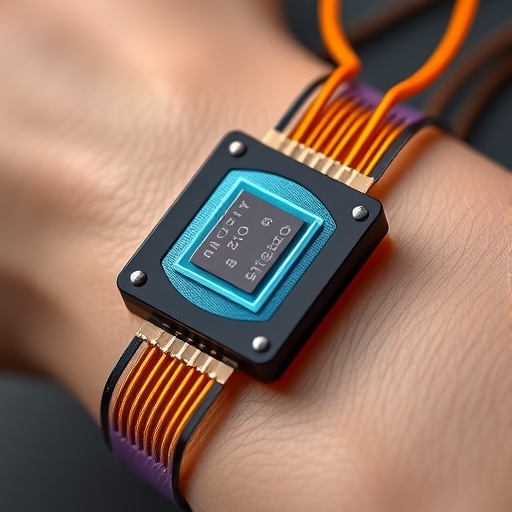
Wearable electronics are moving beyond passive health tracking. The next generation of devices is expected to sense physiological changes, interpret them, remember important signals, and respond immediately—all while stretching and moving with the human body. Researchers at Pusan National University in South Korea have now developed a soft transistor that can switch between digital logic and analog memory-like behavior, potentially allowing a single wearable component to perform tasks that normally require several separate electronic devices.
The technology is based on a stretchable organic electrochemical transistor, or OECT, a class of device that controls electrical current through the movement of ions. Unlike conventional silicon transistors, which primarily rely on electrons moving through rigid semiconductor channels, OECTs use an electrolyte to modulate the conductivity of an organic material. This ionic operation makes them particularly attractive for bioelectronics because they can interact with the chemical and electrical signals found in living tissue. The new device was designed to be both mechanically compliant and functionally adaptable.
In the study, led by Assistant Professor Hyunseok Shim, the researchers modified the conducting polymer PEDOT:PSS with two additives. These chemical adjustments improved the material’s electrical conductivity while also helping it withstand repeated stretching. The result was a transistor capable of maintaining its electronic performance even as it was deformed, an essential property for devices attached to skin, embedded in soft robotics, or integrated with moving organs. Conventional electronic components often lose efficiency or fail when subjected to continuous bending and stretching, but the modified polymer was engineered to reduce that vulnerability.
The most unusual feature of the transistor is that its function can be changed without replacing the device or redesigning the surrounding circuit. The researchers achieved this by varying the concentration of sodium chloride in the electrolyte surrounding the transistor. At higher salt concentrations, ions move in a way that enables fast and clearly defined switching between ON and OFF states. This behavior allows the device to operate as a digital logic element, carrying out basic computational operations. In practical terms, several such transistors could be connected to process sensor signals directly on a wearable patch.
At lower salt concentrations, however, the same transistor exhibits a slower, continuous response rather than a simple binary switch. Its electrical conductance changes gradually and retains a memory of previous stimulation, producing behavior comparable to an artificial synapse. Biological synapses adjust the strength of connections between neurons based on patterns of activity, and this type of analog response is central to neuromorphic computing. By reproducing a similar form of conductance modulation, the transistor could help wearable systems recognize changing biological patterns without sending every piece of raw data to an external processor.
The device also provides a visual indication of its internal operating state. As the transistor changes modes, the conducting polymer shifts in color from light blue to dark blue. This electrochromic behavior means that the device’s condition can be read by sight, without requiring a separate diagnostic circuit or wireless connection. A visible color change could be valuable in medical settings, where caregivers or users may need to determine quickly whether a soft electronic system is active, storing information, or operating in a different computational mode.
To demonstrate the concept, the researchers incorporated the technology into a wearable patch designed to monitor inflammatory edema and skin temperature. The patch was linked to a compression band that could tighten or loosen in response to changes detected by the sensors. Such a system could potentially help regulate pressure around swollen tissue, reducing the risk of excessive compression and associated tissue damage. Although the demonstration represents an early proof of concept, it illustrates how sensing, computation, memory, and actuation might be combined in a compact and flexible platform rather than distributed across multiple rigid components.
This integration could address one of the central limitations of current wearable electronics. Most commercial systems rely on separate sensors, processors, memory units, batteries, and communication modules. Combining these parts increases bulk, power consumption, and manufacturing complexity. An adaptive OECT could perform some signal-processing and memory functions at the point where biological data are collected, reducing the need to transmit all information to a distant processor. Lower data traffic could also help reduce energy use, an important advantage for devices intended to operate continuously on the body.
The researchers envision applications in electronic skin, wearable health monitors, soft robots, adaptive prosthetic systems, and implantable bioelectronics. In the longer term, networks of these transistors could form low-power neuromorphic systems capable of learning from physiological signals and responding to changing conditions. Dynamic compression bandages might adjust automatically as swelling changes, while electronic skins could detect injury and adapt their response in real time. The color-changing operation would add an immediate visual layer of feedback. The work, reported in ACS Nano under the title “Fully Stretchable Ionically Tunable Organic Electrochemical Transistors for Wearable Adaptive Logic Bioelectronics,” points toward a future in which wearable devices are not merely flexible, but capable of changing how they compute according to their environment.
Subject of Research: Experimental study of fully stretchable, ionically tunable organic electrochemical transistors for adaptive wearable bioelectronics.
Article Title: Fully Stretchable Ionically Tunable Organic Electrochemical Transistors for Wearable Adaptive Logic Bioelectronics.
News Publication Date: 24 June 2026.
Web References: https://doi.org/10.1021/acsnano.6c05309
References: ACS Nano, DOI: 10.1021/acsnano.6c05309.
Image Credits: Assistant Professor Hyunseok Shim, Pusan National University.
Keywords
Wearable devices, soft electronics, organic electrochemical transistors, stretchable electronics, adaptive logic, artificial synapses, neuromorphic bioelectronics, biomedical engineering, electronic skin, medical technology, sensors, soft robotics.
Tags: bioelectronic devicesflexible electronic componentsionic electrochemical transistorsmultifunctional wearable sensorsorganic electrochemical transistor developmentorganic memory transistorsPusan National University researchsoft transistors for human movementstretchable bioelectronicsstretchable organic transistorswearable electronicswearable health monitoring technology