• HOME
  • NEWS
  • EXPLORE
    • CAREER
      • Companies
      • Jobs
    • EVENTS
    • iGEM
      • News
      • Team
    • PHOTOS
    • VIDEO
    • WIKI
  • BLOG
  • COMMUNITY
    • FACEBOOK
    • INSTAGRAM
    • TWITTER
Thursday, July 30, 2026
BIOENGINEER.ORG
No Result
View All Result
  • Login
  • HOME
  • NEWS
  • EXPLORE
    • CAREER
      • Companies
      • Jobs
        • Lecturer
        • PhD Studentship
        • Postdoc
        • Research Assistant
    • EVENTS
    • iGEM
      • News
      • Team
    • PHOTOS
    • VIDEO
    • WIKI
  • BLOG
  • COMMUNITY
    • FACEBOOK
    • INSTAGRAM
    • TWITTER
  • HOME
  • NEWS
  • EXPLORE
    • CAREER
      • Companies
      • Jobs
        • Lecturer
        • PhD Studentship
        • Postdoc
        • Research Assistant
    • EVENTS
    • iGEM
      • News
      • Team
    • PHOTOS
    • VIDEO
    • WIKI
  • BLOG
  • COMMUNITY
    • FACEBOOK
    • INSTAGRAM
    • TWITTER
No Result
View All Result
Bioengineer.org
No Result
View All Result
Home NEWS Science News Cancer

Nanosecond proton FLASH radiotherapy reduces normal cell damage

Bioengineer by Bioengineer
July 30, 2026
in Cancer
Reading Time: 2 mins read
0
Share on FacebookShare on TwitterShare on LinkedinShare on RedditShare on Telegram
Nanosecond proton FLASH radiotherapy reduces normal cell damage
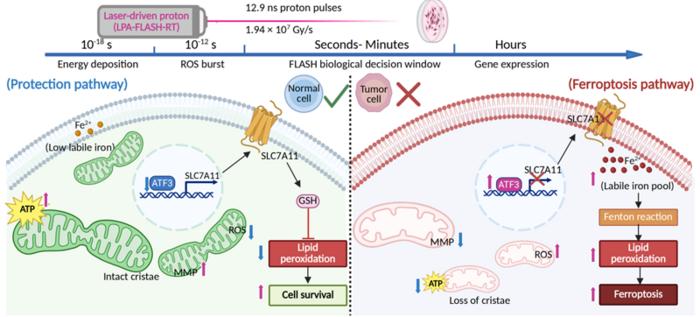
Nanosecond Proton FLASH Radiotherapy Reduces Normal Cell Damage image: Schematic of Normal Tissue Sparing in Laser-Proton FLASH-RT

view more 

Credit: SHAO Changsheng

A research team led by Prof. HUANG Qing from the Hefei Institutes of Physical Science of the Chinese Academy of Sciences, in collaboration with the Shanghai Institute of Optics and Fine Mechanics and Shandong University, has found that nanosecond laser-driven proton FLASH radiotherapy can maintain its cancer-killing effect while reducing damage to normal cells.

The study, published in iMed, shows that this new irradiation method protects normal bronchial epithelial cells by preserving mitochondrial function and reducing ferroptosis, an iron-dependent form of cell death.

Radiotherapy is widely used to treat cancer, but radiation can also harm surrounding healthy tissues. FLASH radiotherapy, which delivers radiation at an ultra-high dose rate, has attracted attention because it may reduce normal tissue damage without weakening tumor control.

In this study, the researchers used a laser-driven proton platform to deliver radiation pulses lasting about 12.9 nanoseconds. They compared the effects of this approach with conventional proton irradiation on lung cancer A549 cells and normal bronchial epithelial BEAS-2B cells.

The results showed that both treatments effectively killed cancer cells. However, compared with conventional irradiation, nanosecond FLASH irradiation caused much less damage to normal cells. Further analysis found that FLASH irradiation helped maintain mitochondrial structure and function while reducing ferroptosis.

The researchers also found that conventional irradiation triggered the stress-related protein ATF3 in normal cells, weakening antioxidant defenses and increasing oxidative damage. The extremely short FLASH pulse appeared to limit this stress response, helping normal cells better withstand radiation exposure.

The findings suggest that the way radiation energy is delivered, not only the total dose, plays an important role in determining cellular responses. This work may contribute to the development of safer and more precise radiotherapy approaches.

DOI

10.70322/iMed.2026.10006

Article Title

Nanosecond Laser-Driven Proton FLASH Spares Normal Tissue Cells by Sustaining Mitochondrial Homeostasis and Attenuating Ferroptosis

Article Publication Date

13-Jul-2026

Media Contact

Weiwei Zhao

Hefei Institutes of Physical Science, Chinese Academy of Sciences

[email protected]

Office: 86-551-655-91206

DOI 10.70322/iMed.2026.10006

DOI

10.70322/iMed.2026.10006

Article Title

Nanosecond Laser-Driven Proton FLASH Spares Normal Tissue Cells by Sustaining Mitochondrial Homeostasis and Attenuating Ferroptosis

Article Publication Date

13-Jul-2026

Tags
/Physical sciences
Share12Tweet7Share2ShareShareShare1

Related Posts

Age- and sex-dependent associations of metabolic syndrome with colorectal cancer in the UK Biobank

July 30, 2026

Kidney transplant despite poor initial conditions: New drug sustainably reduces immune response against donor organ

July 30, 2026

Clinical toxicity of ADCs and ICI–ADC combinations: mechanisms, patterns and management

July 30, 2026

Non-invasive biomarkers for early oral cancer detection through multiomics approach

July 30, 2026

POPULAR NEWS

  • Ferroptotic propagation: from single-cell execution to tissue-scale death programs

    29 shares
    Share 12 Tweet 7
  • Residential proximity to major roadways and prevalent diabetes in older adults: a cross-sectional study based on CLHLS

    29 shares
    Share 12 Tweet 7
  • Reusability report: Exploring the utility and extensibility of an integrated modelling framework for liquid electrolyte design

    29 shares
    Share 12 Tweet 7
  • Structure-alignment-driven cross-graph modeling for functional RNA design

    29 shares
    Share 12 Tweet 7

About

We bring you the latest biotechnology news from best research centers and universities around the world. Check our website.

Follow us

Recent News

Ferroptotic propagation: from single-cell execution to tissue-scale death programs

Residential proximity to major roadways and prevalent diabetes in older adults: a cross-sectional study based on CLHLS

Reusability report: Exploring the utility and extensibility of an integrated modelling framework for liquid electrolyte design

Subscribe to Blog via Email

Enter your email address to subscribe to this blog and receive notifications of new posts by email.

Join 85 other subscribers
  • Contact Us

Bioengineer.org © Copyright 2023 All Rights Reserved.

Welcome Back!

Login to your account below

Forgotten Password?

Retrieve your password

Please enter your username or email address to reset your password.

Log In
No Result
View All Result
  • Homepages
    • Home Page 1
    • Home Page 2
  • News
  • National
  • Business
  • Health
  • Lifestyle
  • Science

Bioengineer.org © Copyright 2023 All Rights Reserved.