
image:
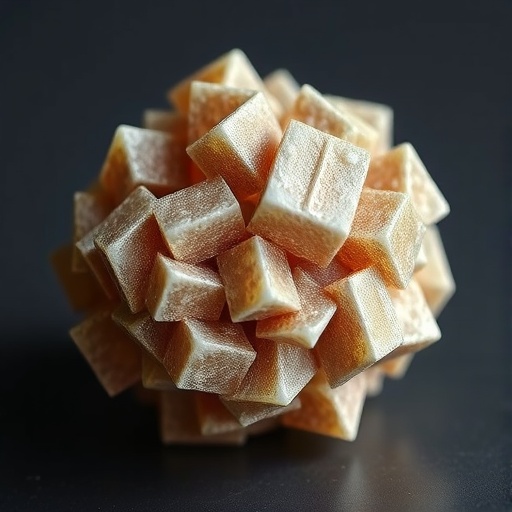
Iron-substituted calcium titanate (Fe-doped CaTiO3) contains oxygen vacancies and exhibits high oxygen-ion and electronic conductivity, helping accelerate carbon dioxide (CO2) splitting to carbon monoxide (CO) via chemical looping.
view more
Credit: Institute of Science Tokyo
To improve carbon recycling and reduce emissions, researchers at Science Tokyo developed iron-substituted calcium titanate (Fe-doped CaTiO3) as an environmentally friendly support material for chemical looping, a process that converts carbon dioxide (CO2) into carbon monoxide for fuel and chemical production. By substituting iron into CaTiO3, the material gained oxygen vacancies and improved ion and electron transport, accelerating CO2 conversion. Built from widely available, low-cost elements, the material could help enable scalable carbon recycling.
One promising approach is to convert carbon dioxide (CO2) into carbon monoxide (CO) or syngas, a mixture of CO and hydrogen (H2) used to produce fuels and industrial chemicals. One way to achieve this is through chemical looping, a process in which metal oxides repeatedly transfer oxygen between gases through oxidation–reduction reactions. In this cycle, CO2 is reduced by a metal oxide to CO. The oxidized material is then regenerated using reducing gases such as hydrogen or methane, allowing the cycle to continue.
For this process to work well on a large scale, oxygen-carrying materials should ideally be inexpensive, environmentally friendly, made from widely available elements, possess high oxygen-carrying capacity, and remain stable during repeated cycles. Iron oxide meets many of these requirements. However, repeated reactions can cause iron atoms to move, forming tiny pores that gradually weaken the material and reduce its performance.
To solve this problem, Professor Junichiro Otomo and doctoral student Takayuki Kosaka from the Department of Transdisciplinary Science and Engineering, School of Environment and Society, Institute of Science Tokyo (Science Tokyo), Japan, together with Mr. Arufa Shiota from Mitsubishi Electric Corporation, Japan, investigated calcium titanate (CaTiO3) as a support material for iron, where some of the titanium atoms were replaced with iron, creating iron-substituted (Fe-doped) CaTiO3.
The paper was made available online on April 20, 2026, and was published in Volume 538 of the Chemical Engineering Journal on June 15, 2026.
“We achieve efficient reduction of CO2 via chemical looping using iron-substituted CaTiO3. We expect this to contribute to carbon neutrality through carbon recycling,” says Otomo.
The researchers tested the material in a thermogravimetric analyzer and a tubular reactor designed to mimic the fluidized-bed conditions used in real chemical looping systems. In the experiment, hydrogen was used to reduce the iron oxide, after which CO2 was introduced to oxidize the material again, thereby producing CO. The performance of Fe-doped CaTiO3 was also compared with yttria-stabilized zirconia, an oxide-ion conductor, and α-alumina, an insulator. The researchers found that Fe-doped CaTiO3 achieved a faster CO2 reduction reaction compared to the other support materials while maintaining 100% selectivity toward CO using a tubular reactor designed to mimic the fluidized-bed conditions.
So why did it perform so well? Substituting titanium with iron increases the concentration of oxygen vacancies, or missing oxygen atoms in the crystal lattice. These vacancies create pathways that help oxide ions diffuse through the material more easily. Under reaction conditions, the material also exhibits additional charge carriers, including electrons and holes, which improve charge transport during redox reactions.
During the reaction, CO2 molecules split on the iron surface into CO and oxygen species. At the iron–support interface, oxygen vacancies help transport oxide ions through the material, while electrons facilitate charge transfer during the oxidation of iron. Under oxidation conditions where the reaction occurs, Fe-doped CaTiO3 showed high electronic conductivity (approximately 10-1.2 S cm-1) and oxide-ion conductivity (approximately 10-1.8 S cm-1) at 900 °C, the temperature at which chemical looping systems typically operate. The researchers suggest that the material’s combined ability to conduct both oxide ions and electrons contributes to the faster reaction rate.
These findings show that carefully designed support materials can improve the performance of chemical looping systems and make CO2 conversion more efficient. Importantly, Fe-doped CaTiO3 relies on abundant, low-cost elements rather than rare-earth or precious metals. The researchers expect this design to help inform the development of next-generation oxide materials and redox reactions, paving the way for scalable conversion of CO2 into useful products.
“The findings obtained in this study are expected to contribute broadly to the design of oxide materials and redox reactions for carbon recycling with renewable energy,” says Otomo.
***
About Institute of Science Tokyo (Science Tokyo)
Institute of Science Tokyo (Science Tokyo) was established on October 1, 2024, following the merger between Tokyo Medical and Dental University (TMDU) and Tokyo Institute of Technology (Tokyo Tech), with the mission of “Advancing science and human wellbeing to create value for and with society.”
Reference
DOI:
Journal
Chemical Engineering Journal
DOI
10.1016/j.cej.2026.176455
Method of Research
Experimental study
Subject of Research
Not applicable
Article Title
Cooperative enhancement of the metal oxide redox reaction in chemical looping CO2 splitting using a mixed ionic and electronic conductor
Article Publication Date
15-Jun-2026
COI Statement
The authors declare no competing financial interests.
Media Contact
Hiromi Nishimura
Institute of Science Tokyo
Journal
Chemical Engineering Journal
Funder
Japan Science and Technology Agency
DOI
10.1016/j.cej.2026.176455
Journal
Chemical Engineering Journal
DOI
10.1016/j.cej.2026.176455
Method of Research
Experimental study
Subject of Research
Not applicable
Article Title
Cooperative enhancement of the metal oxide redox reaction in chemical looping CO2 splitting using a mixed ionic and electronic conductor
Article Publication Date
15-Jun-2026
COI Statement
The authors declare no competing financial interests.
Tags
/Physical sciences/Chemistry
/Physical sciences/Physics/Energy
/Applied sciences and engineering/Environmental sciences
/Physical sciences/Materials science
/Physical sciences/Chemistry/Chemical engineering