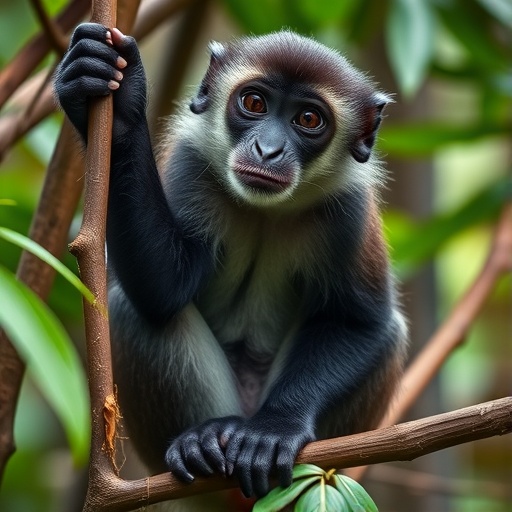
In the rainforests of the Democratic Republic of Congo (DRC), scientists have confirmed a previously unknown African monkey species, described as one of the rarest modern primatology discoveries. The new species, Colobus congoensis, is locally known as “Likweli,” and stands out for its mostly black body and vivid orange facial patches that create a distinctive mask-like appearance.
Researchers report that the animal had effectively “vanished” from the scientific record despite decades of exploration in Central Africa. The first clue came in 2008, when researchers captured a partially obscured photograph. A clearer sighting and image were obtained about a decade later, enabling deeper follow-up investigations.
The current study integrates genetic, anatomical, and acoustic analyses. Using these complementary lines of evidence, the team concluded that C. congoensis forms a distinct evolutionary lineage that diverged from its closest known relative 4 to 5 million years ago, indicating an unusually ancient split within the Colobus lineage.
Published in PLOS One, the research also supports a formal anatomical diagnosis. Comparative skull and pelage analyses were used alongside museum datasets, helping distinguish C. congoensis from other African colobus monkeys. The investigators further identified traits involving cranial and dental features consistent with species-level separation.
Acoustics provided an additional diagnostic layer. The monkey’s deep, resonant roaring calls resemble those of related Colobus species, but the acoustic structure differs, supporting the idea that the species is evolutionarily and biologically distinct.
Fieldwork combined with local knowledge to estimate distribution and behavior. Across 2018 to 2022, the team recorded 114 sightings within an estimated range of about 1,700 square kilometers—an unusually restricted area for colobus monkeys. Local communities emphasized the animal’s elusiveness and referred to it using names tied to its behavior.
Despite its scientific debut, the researchers warn that the species may already face serious risk. Limited range, small population size, habitat loss, and hunting pressure are central concerns, and the team proposes an Endangered classification on the IUCN Red List, largely because key habitat overlaps with Lomami National Park.
The discovery was led by an international collaboration involving institutions including Florida Atlantic University, Lukuru Wildlife Research Foundation, Yale University, the City University of New York, and Lomami National Park partners. The work highlights how much undiscovered biodiversity remains in the Congo Basin and how quickly species can disappear before they are fully understood.
Subject of Research: Animals
Article Title: Likweli: A remarkable new species of Colobus monkey from the Lomami National Park, Democratic Republic of Congo
News Publication Date: 15-Jul-2026
Web References: https://journals.plos.org/plosone/article?id=10.1371/journal.pone.0349857
References: PLOS One (Article link above)
Image Credits: Daniel Rosengren
Keywords: Colobus congoensis; Likweli; DRC; primatology; species discovery; genetics; anatomy; bioacoustics; endangered species; Congo Basin; Lomami National Park
Tags: acoustic analysis in primate taxonomyAfrican monkey species discoveryancient divergence of primatesCongo rainforest biodiversityCongo rainforest conservationCongo rainforest primatologygenetic and anatomical primate studiesimpact of rainforest habitat lossnew Colobus species identificationprimate evolutionary lineageprimate species differentiationrare primate species documentation