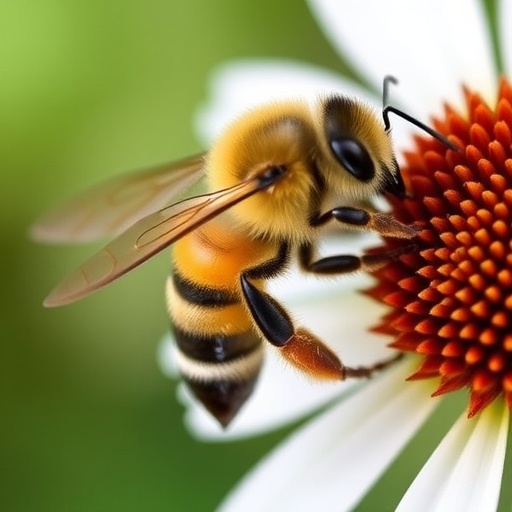
Honey bee larvae do not smell the way adult bees do, according to a new study that links the phenomenon to the species’ highly social lifestyle. Published in Proceedings of the National Academy of Sciences, the work suggests a temporary loss of olfactory function rather than a permanent evolutionary disappearance of smell-related machinery.
In honey bee colonies, reproduction is restricted to a limited number of individuals, while worker “nurse” bees provide intensive care to young in wax cells. Larvae are routinely fed through nurse-mediated droplets—honey, pollen, and royal jelly—distributed directly into their chambers. Because they do not need to locate food or assess environmental odors, larval life proceeds under dramatically different sensory demands than foraging adult stages.
Researchers focused on two receptor systems known to underlie odor detection. Olfactory receptor function depends on ORCO, a coreceptor essential for olfactory receptors (ORs). Related ionotropic receptor pathways require coreceptors such as IR25a, which supports proper ionotropic receptor (IR) function and is implicated in taste.
Comparing gene activity between life stages, the team found that expression of ORCO in both antennae and brain was reduced in larvae relative to adults. When tested in behavioral assays, larvae failed to respond when food droplets were presented nearby, showing no movement toward potential sources. They also did not avoid acetic acid, a repellent cue, nor did they show preference for a queen-associated pheromone—responses that adult bees would rapidly exhibit.
Interestingly, the pattern was not uniform across chemosensation. Several IR genes showed higher expression in larvae than in other receptor classes, including IR25a. The researchers conclude that larvae may rely more on gustatory or other non-olfactory pathways, effectively “tasting” food rather than smelling it.
The study frames this as social evolution in action. If smell is temporarily unnecessary during brood care, selection may favor suppressing odor-related gene expression during larval development. The authors emphasize that this is not gene loss: adults must retain olfactory capability, so the system instead downregulates ORCO during development.
To document the mechanism, the researchers interpret the results as a developmentally regulated loss-of-function driven by low expression, echoing evolutionary “regressive” patterns seen elsewhere—though here the effect is reversible across the life cycle. The findings underscore how colony structure can reshape even the molecular wiring of sensory behavior.
Subject of Research: Animals
Article Title: Social evolution and diminished olfactory function in larval honey bees
News Publication Date: 14-Jul-2026
Web References: http://dx.doi.org/10.1073/pnas.2615678123
References: Proceedings of the National Academy of Sciences; DOI: 10.1073/pnas.2615678123
Image Credits: Photo by L. Brian Stauffer
Keywords: honey bees; larval development; olfaction; ORCO; IR25a; social evolution; gene expression; chemosensory receptors; pheromones
Tags: behavioral response differences between bee life stagesdevelopmental regulation of olfactory receptors in beesHoney bee olfactory developmentimpact of social lifestyle on bee sensory systemsimplications for honey bee communication andlarval sensory requirements and odor detectionlarval versus adult smell perceptionolfactory receptor gene expression in honey beesolfactory system plasticity in social insectsrole of ORCO and IR25a in bee olfactionsensory shift during honey bee developmentsocial behavior and sensory adaptation in bees