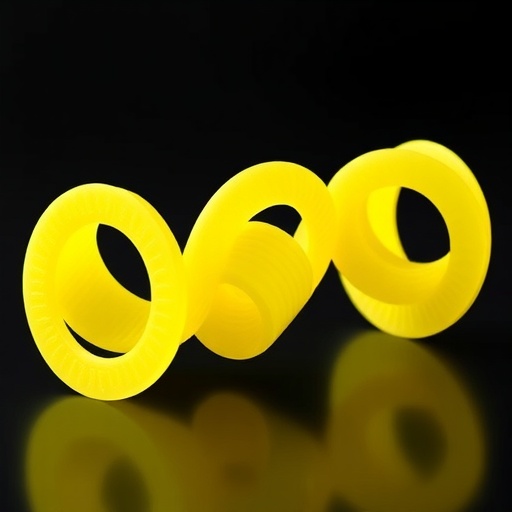
In a groundbreaking development from EPFL’s Soft Materials Laboratory, researchers have unveiled a novel class of rubber-like materials known as double network granular elastomers (DNGEs). These materials, consisting of microscopic elastomer particles embedded within a softer elastomer matrix, were initially engineered as innovative inks for 3D printing flexible devices. Their unique dual-network architecture allows unprecedented control over mechanical properties, overcoming longstanding challenges in soft material fabrication.
The latest study published in Science Advances reveals that beyond facilitating advanced 3D printing, DNGEs exhibit a remarkable combination of toughness and fatigue resistance—a rare feat in elastomers. Typically, materials that resist fractures tend to accumulate damage under cyclic stress, leading to shorter lifespans, while those that endure repetitive strain often sacrifice ultimate strength. DNGEs defy this trade-off through their specialized microstructure.
The secret lies in the interplay between their two constituent networks. One network is composed of rigid granular elastomer particles, while the second is a softer, more compliant elastomer. When subjected to mechanical stress, these networks share and redistribute strain, preventing concentration of damage in any single region. This strain-sharing mechanism enhances overall material robustness, allowing DNGEs to absorb and dissipate energy repeatedly without irreversible bond breakage.
Experimental evaluations demonstrated fracture toughness values up to 15 times greater than comparable elastomers, with fatigue resistance improvements reaching threefold. Crucially, the granular structure alters crack propagation pathways. Instead of a direct fracture line, cracks navigate a tortuous route through the softer matrix regions, significantly slowing crack growth and delaying failure.
At the molecular level, the softer elastomer regions accommodate strain by enabling polymer chains to slide and rearrange, dissipating energy through reversible mechanisms rather than permanent damage. This dynamic energy absorption is key to the materials’ durability under repeated mechanical loading.
The implications of this research are profound for the design of longer-lasting flexible materials in emerging technologies such as soft robotics, wearable electronics, and biomedical devices. Components in these fields are often exposed to continual deformation and loading cycles, demanding materials that withstand both sudden shocks and chronic fatigue.
Looking forward, the EPFL team is working toward enhancing sustainability by incorporating biodegradable and recycled elastomers into their double network design. This approach aims to maintain the high-performance mechanical characteristics of DNGEs while reducing environmental impact. By broadening material choices and preserving processability, they hope to democratize access to these advanced elastomer inks, making them widely available to labs equipped with standard commercial 3D printers.
This innovative research not only redefines what’s possible in elastomer toughness and fatigue resistance but also offers a scalable, adaptable platform for next-generation soft materials with vast applications.
Subject of Research: Double network granular elastomers for advanced 3D printing and enhanced mechanical durability
Article Title: Fatigue-resistant and tough double network granular elastomers
News Publication Date: 10-Jul-2026
Web References: https://doi.org/10.1126/sciadv.aec3482
Image Credits: 2026 SMaL EPFL CC BY Sa
Keywords
Materials science, elastomers, 3D printing, fatigue resistance, fracture toughness, soft robotics, sustainable materials
Tags: 3D printing flexible devicesdouble network granular elastomersElastic polymerelastomer fracture toughnesshigh-strength soft materialsinnovative elastomer inksmicrostructural control of mechanical propertiesmicrostructure of elastomersrubber-like materialssoft material fabrication advancementsstrain-sharing mechanisms in polymerstough and fatigue-resistant elastomers