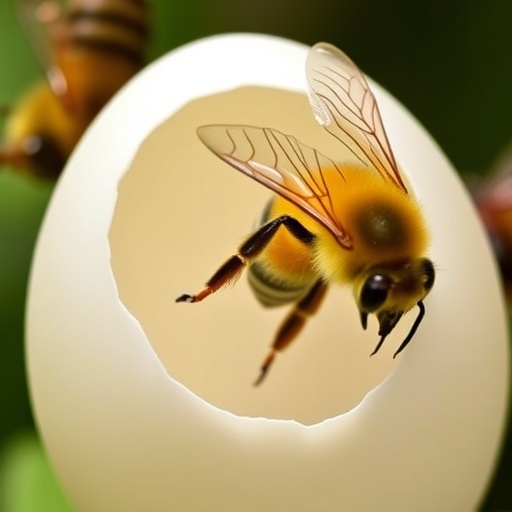
In the intricate world of honeybee colonies, the queen bee plays a pivotal role not only as the mother of the hive but also as a central figure in its survival against environmental challenges, including pesticide exposure. Recent groundbreaking research has revealed that queen bees employ a unique biological mechanism to cope with chronic pesticide contamination—a process known as maternal offloading, where the queen transfers toxic chemicals directly into her eggs. This discovery, published in the prestigious journal Current Biology, represents a major advance in our understanding of how pesticides permeate and persist within a colony’s ecosystem, ultimately affecting bee health and colony sustainability.
Honeybees, responsible for pollinating approximately one-third of global food crops, are vital for food security and agricultural productivity. Worker bees have long been recognized as the frontline defenders, acting as biological filters that remove contaminants from food and pollen before it reaches the queen. However, the capacity of worker bees to protect the queen has a threshold, and when this filtration system becomes overwhelmed, the queen’s own survival strategies come into play. The research, led by scientists at the University of California, Davis (UC Davis), has uncovered that under chronic pesticide stress, the queen bee sequesters harmful substances by depositing them into her eggs. This strategy, while protective for the queen in the short term, raises concerns about the long-term consequences on progeny viability and colony health.
Previous toxicological studies predominantly focused on worker bees, neglecting the queen’s direct exposure and response to contaminants. This study took a novel route by investigating where pesticides accumulate within the hive and their transmission routes, emphasizing the queen’s role and her ovaries as reservoirs of chemical burden. The experimental design cleverly simulated real hive conditions by using “nanocolonies”—small plastic containers that housed one queen and sixty worker bees, allowing meticulous control and observation of pesticide exposure dynamics.
Within these nanocolonies, researchers introduced pollen and food contaminated with methyl parathion, a pesticide labeled with a low-level radioactive marker for precise tracking. Initial observations showed worker bees filtering out about 95% of the pesticide on the first day, depositing much of it into the honeycomb rather than passing it along. Yet, by the tenth day, this filtration efficiency dropped significantly to 86%, which allowed increased pesticide accumulation in the queen. This gradual decline illustrates a critical limit in social buffering capacity within the colony, beyond which the queen experiences heightened toxic exposure.
Utilizing advanced biological accelerator mass spectrometry (BioAMS) at Lawrence Livermore National Laboratory (LLNL), researchers were able to detect and quantify minuscule amounts of pesticides within different hive compartments, including the queen’s eggs. This technology’s sensitivity permitted the measurement of pesticide concentrations at atomic levels, providing an unprecedented window into how contaminants traverse the colony. Notably, the concentrations of methyl parathion used were environmentally relevant and sublethal, reflecting real-world exposure scenarios rather than laboratory extremes.
The queen’s remarkable ability to lay between 1,500 and 2,000 eggs daily underscores the significance of maternal offloading. By diverting pesticides into her eggs, she manages to rid herself of toxic compounds, thereby sustaining her own health and that of the colony. Yet, this defense mechanism may come at the cost of embryo development, as high pesticide loads in eggs could impair proper maturation or viability. The researchers caution that such chemical burdens may contribute to a subtle, slow-moving decline in colony health—a phenomenon that could eventually precipitate colony collapse.
This new perspective challenges previous assumptions that queens are fully shielded by worker bee care, highlighting a vulnerability that had been overlooked. The implications extend beyond apiculture, influencing agricultural pest management and pollinator conservation strategies. Beekeepers and growers might need to reassess pesticide application timings and integrate practices that mitigate chemical accumulation within colonies. Moreover, understanding how different pesticides vary in their capacity to induce maternal offloading remains an important area for future research.
Collaborative efforts between the USDA Agricultural Research Service and LLNL enabled this multidimensional investigation combining expertise in honeybee biology, environmental toxicology, and sophisticated isotopic tracing techniques. The synergy between institutions exemplifies the interdisciplinary approach needed to unravel complex ecological challenges. The use of nanocolonies as experimental models offers a scalable and replicable framework for exploring other contaminants’ effects on social insects.
The study also highlights critical knowledge gaps regarding the longevity of pesticide residues within queens and their progeny, and the potential generational impacts on colony dynamics. As queens are the sole reproductive individuals maintaining hive populations, their compromised health directly translates into reduced worker numbers and impaired colony productivity. These findings underscore the urgent need for more comprehensive assessments of pesticide effects encompassing all hive members, especially reproductive castes.
The broader ecological ramifications are profound. Declining bee populations threaten biodiversity and agricultural yields, making it imperative to understand every facet of stressors involved. This research provides a vital piece of the puzzle by illuminating how pesticide exposure subtly operates at the molecular and reproductive levels within the hive, potentially leading to colony weakening over time despite apparent external vitality.
By unveiling the queen’s hidden biochemical strategy of maternal offloading, this study bridges gaps in knowledge and sets the stage for deeper investigations into pesticide-pollinator interactions. It serves as a call to action for the scientific community, policymakers, and agricultural stakeholders to prioritize safeguarding the reproductive health of bees to ensure their continued role as indispensable agents of pollination.
Subject of Research: Animals
Article Title: Queen Bees Offload Pesticide Burden to Eggs When Social Buffering is Overwhelmed
News Publication Date: 2-Jul-2026
Web References: http://dx.doi.org/10.1016/j.cub.2026.06.022
Image Credits: Sascha Nicklisch/UC Davis
Keywords: honeybee queen, pesticide exposure, maternal offloading, colony health, methyl parathion, pesticide filtration, worker bees, environmental toxicology, pollination, colony collapse, biological accelerator mass spectrometry, nanocolonies
Tags: agricultural pollinator pesticide riskschronic pesticide stress in beeseffects of pesticides on bee healthhoneybee colony survival strategieshoneybee protection mechanismshoneybee queen pesticide exposurematernal offloading in beespesticide bioaccumulation in insectspesticide contamination in bee coloniespesticide transfer to honeybee eggspollinator pesticide impact researchUC Davis honeybee study