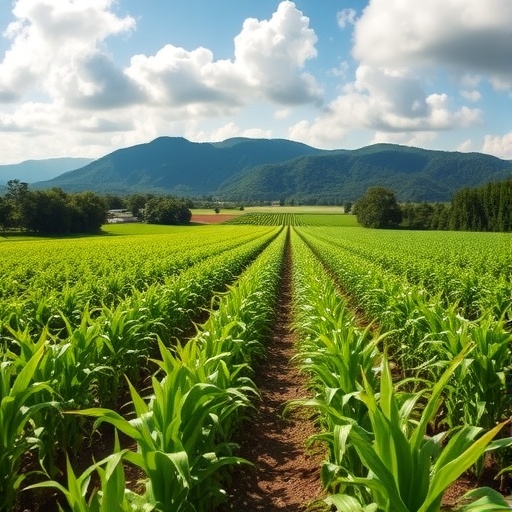
In recent years, Brazil has solidified its position as a global agricultural powerhouse, notably in corn production. With the dynamic shift towards sustainable agriculture and climate change mitigation, understanding the environmental impact of land-use changes and soil management practices becomes paramount. A transformative new study sheds light on the nuanced relationships between second-crop corn cultivation, land-use transitions, and soil carbon dynamics in Brazil, revealing critical insights into the net carbon dioxide (CO₂) balance associated with these systems.
Corn, especially when planted as a second crop following soybeans or other staples, plays an increasingly significant role in Brazil’s agricultural calendar. The practice of double cropping aims to maximize land productivity and meet rising global demands. However, concerns have grown over the environmental repercussions, particularly regarding greenhouse gas emissions from soil and alterations in carbon sequestration capabilities due to land conversion. The study in focus meticulously investigates how shifting land-use patterns and tailored soil management approaches influence the net CO₂ fluxes in Brazilian second-crop corn systems.
Integrative research methodologies, combining field measurements, remote sensing data, and sophisticated carbon modeling, were employed to analyze multiple farming scenarios across diverse Brazilian agroecological zones. This comprehensive approach enabled the authors to capture the complex interactions between land preparation, crop phenology, soil respiration, and overall carbon budgeting. By distinguishing between cropland and native vegetation, as well as between different tillage and fertilization regimes, the study unveils the subtleties in carbon emissions and sequestration associated with second-crop corn production.
One of the standout conclusions is that land-use change—especially the conversion of native ecosystems or pastureland to croplands for double cropping—can induce a significantly positive CO₂ balance, reflecting a net release of carbon into the atmosphere. This is particularly true when conventional tillage methods are applied, which disrupt soil structure and accelerate organic matter decomposition. The findings underscore the critical importance of conserving existing native vegetation patches and adopting sustainable land conversion practices to curb carbon losses.
Conversely, the research highlights the potential of no-till or reduced-tillage systems in mitigating CO₂ emissions from soil when integrated with second-crop corn cultivation. Reduced soil disturbance preserves soil organic carbon stocks and promotes the accumulation of residues on the surface, thus enhancing carbon sequestration. The temporal patterns of soil respiration under different managements were closely monitored, revealing that the adoption of conservation tillage can offset much of the carbon emissions typically linked to intensive agricultural practices.
Fertilizer application rates and types emerged as another pivotal factor controlling the net carbon balance. Excessive nitrogen input, particularly from synthetic fertilizers, was linked to increased CO₂ emissions due to enhanced microbial activity leading to accelerated decomposition of soil organic matter. The study emphasizes the adoption of precision nutrient management to optimize fertilizer use, minimize emissions, and sustain crop yield without compromising soil health.
Significantly, the investigation reveals that the timing and duration of second-crop corn cycles influence the overall carbon footprint. Shorter crop cycles with rapid biomass turnover might reduce soil carbon input, while longer-growing second crops can enhance carbon fixation through photosynthesis. This temporal dimension adds complexity to estimating net CO₂ balances and necessitates a location-specific understanding of crop calendars in relation to climatic conditions.
Intercropping and crop rotations are also discussed as strategies that can alter carbon dynamics positively. Integrating legumes or cover crops within the second-crop farming system was found to improve soil nitrogen levels naturally and increase organic matter inputs, thereby decreasing reliance on synthetic fertilizers and reducing net CO₂ emissions. These agroecological practices encourage biodiversity and promote a healthier soil microenvironment that boosts long-term soil carbon storage.
Moreover, the research draws attention to the policy implications of their findings. With Brazil’s agriculture sector often under scrutiny for its environmental sustainability, particularly regarding deforestation linked to agricultural expansion, the insights provided offer critical guidance. Policymakers are urged to incentivize sustainable soil management and limit land clearing, enabling Brazil’s agricultural growth to align more closely with national and international climate goals.
From a global perspective, the study sets a benchmark for quantifying agricultural carbon footprints in tropical regions where data have traditionally been sparse. The tropical soils and climate variability introduce unique challenges in managing carbon pools, making Brazil an essential case study for climate-smart agricultural interventions. The tools and methodologies refined here can be adapted for similar tropical commodity systems elsewhere, fostering global efforts in sustainable intensification.
The authors advocate for integrating local farmers’ knowledge and practices into scientific frameworks to refine these carbon balance models further. Adoption rates of conservation agriculture and precision nutrient management will largely depend on socio-economic factors, infrastructure, and access to technology. Addressing these human dimensions is critical to scaling sustainable second-crop corn systems ready to both feed populations and protect the environment.
Looking ahead, this research opens pathways for further investigations into the long-term impacts of continued intensification of agriculture in Brazil. Longitudinal studies tracking carbon stocks beyond the immediate crop cycles and encompassing soil microbiome changes are necessary to develop resilient farming systems. Moreover, coupling carbon balance assessments with non-CO₂ greenhouse gases such as methane and nitrous oxide would provide a more comprehensive view of agricultural emissions.
The intersection of crop productivity, soil health, and climate mitigation stands as a central theme of sustainable agriculture, and this study significantly advances that discourse. By teasing apart the elements that drive the net carbon dioxide balance in Brazil’s second-crop corn fields, it offers actionable knowledge pivotal for the future trajectory of agriculture in one of the world’s most vital farming nations.
In summary, the research conducted by Garofalo and colleagues represents a major step forward towards understanding the climatic implications of second-crop corn production in Brazil. It intricately reveals how land-use change, soil management, and nitrogen application collectively shape the net CO₂ balance. With an ever-growing global demand for food coupled with mounting environmental pressures, studies like this form the knowledge backbone required to align agricultural development with a sustainable and climate-resilient future.
Subject of Research: Land-use change, soil management, and their impact on the net CO₂ balance of second-crop corn production in Brazil.
Article Title: Land-use change, soil management, and net CO₂ balance of second-crop corn in Brazil.
Article References:
Garofalo, D.F.T., Novaes, R.M.L., de Aguiar, D.A. et al. Land-use change, soil management, and net CO₂ balance of second-crop corn in Brazil. npj Sustain. Agric. 4, 47 (2026). https://doi.org/10.1038/s44264-026-00153-w
Image Credits: AI Generated
DOI: https://doi.org/10.1038/s44264-026-00153-w
Tags: agroecological zones and carbon fluxBrazil second-crop corn productioncarbon sequestration in Brazilian farmlandsclimate change mitigation in agricultureenvironmental impact of Brazilian corn farminggreenhouse gas emissions from double croppingimpact of second-crop corn on CO2 balanceland-use change and carbon emissionsremote sensing in agricultural land usesoil carbon dynamics in corn farmingsoil management practices for carbon reductionsustainable agriculture in Brazil