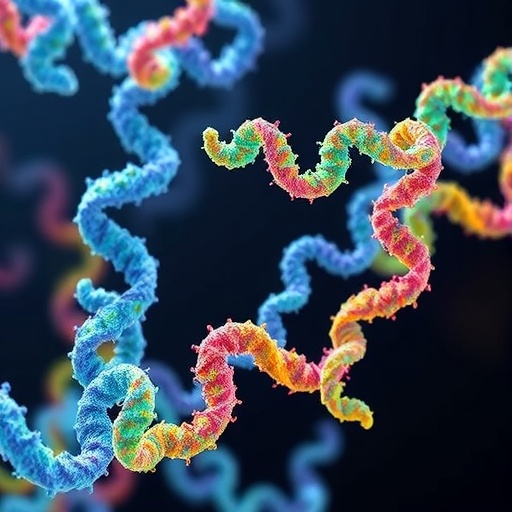
In the ever-expanding field of structural biology, a striking paradox continues to capture the imagination of researchers: how can proteins with highly conserved three-dimensional folds exhibit such diverse biochemical functionalities? This conundrum, often described as a structural enigma, challenges traditional paradigms that closely link protein structure to function. A groundbreaking study recently published in Nature Chemistry offers compelling insights into this mystery by delving into the energetic landscapes underlying conserved protein folds. The research, led by Wells, Lu, Sultanov, and colleagues, illuminates how subtle differences in energetic blueprints within homologous protein families underlie their divergent functions, paving the way for novel approaches in protein engineering and drug design.
Proteins, the molecular workhorses of life, owe their diverse functions to their complex three-dimensional structures, which arise from precise folding patterns. While structural biology has made remarkable progress in elucidating these folds, the relationship between fold conservation and functional diversity remains poorly understood. Typically, proteins sharing a fold tend to execute similar biochemical roles; however, exceptions proliferate across evolutionary timescales. This study addresses the fundamental question: how do proteins with conserved structural frameworks evolve to fulfill radically different biochemical tasks?
Focusing on a family of bacterial transcription factors alongside their distant structural relatives, the periplasmic binding proteins, the researchers employed a multifaceted approach combining hydrogen exchange mass spectrometry (HX-MS), bioinformatics, X-ray crystallography, and molecular dynamics simulations. These techniques enabled an unprecedented exploration of the proteins’ dynamic energetic landscapes — essentially the distribution of energy states that dictate folding stability, conformational flexibility, and ligand interactions. Intriguingly, both protein families bind the same sugars, yet the study revealed they possess distinct energetic architectures exquisitely tuned to their specialized functions.
Hydrogen exchange mass spectrometry, a sensitive method for probing protein dynamics, was pivotal in delineating differential folding stabilities and local flexibility patterns between the transcription factors and periplasmic binding proteins. HX-MS measures how rapidly backbone amide hydrogens swap with solvent hydrogens, serving as an indirect readout of structural stability. By comparing the exchange profiles, the team identified regions with altered energetic stabilities that correlate with functional adaptations, highlighting how conserved folds are reprogrammed energetically rather than structurally.
Complementing HX-MS, high-resolution X-ray crystallography provided snapshots of the proteins’ static conformations, while molecular dynamics simulations offered dynamic views into the ensembles of conformations accessible to these proteins. This integrative strategy revealed that although the overall protein folds appear strikingly similar, subtle differences in intra-protein interactions and conformational fluctuations give rise to dramatically different energetic blueprints. Such blueprints can be viewed as energetically encoded functional instructions embedded within the protein fold.
The bioinformatics component further enriched the narrative by demonstrating evolutionary conservation patterns that align with these energetic divergences. Sequence analyses revealed residue substitutions concentrated in energetically critical positions that modulate local stability and flexibility, thereby fine-tuning function without compromising the fold. This observation underscores the power of evolutionary pressures to sculpt protein function via energetic remodeling rather than wholesale structural changes.
To test the functional consequences of these energetic distinctions, the researchers embarked on a pioneering protein engineering effort. By rationally redesigning the energetic landscape of the transcription factor fold, they created synthetic variants with tunable ligand-induced transcriptional responses. This energy-driven engineering approach breaks new ground by manipulating the ensemble of energetic states rather than merely altering active site residues or binding pockets. Remarkably, the engineered proteins exhibited transcription behaviors matching theoretical predictions, validating the concept of energetic blueprints as a design principle.
This discovery carries profound implications beyond fundamental biochemistry. Efforts to engineer proteins for specific tasks or design effective drugs often confront the challenge of targeting proteins with conserved folds that perform diverse roles. By decoding energetic blueprints, scientists gain an alternative roadmap for tuning protein function that circumvents constraints imposed by rigid structural frameworks. This paradigm shift could accelerate the development of synthetic transcription factors, biosensors, and allosteric modulators with finely calibrated activities.
The study’s revelations also provide a fresh lens to view drug discovery for challenging targets such as transcription factors, which have historically been considered “undruggable” due to their lack of classical binding pockets. Understanding and manipulating the energetic landscape offers new potential to modulate function allosterically or via indirect mechanisms. This approach could unlock therapeutic opportunities for diseases linked to transcriptional dysregulation and expand the pharmacological toolkit.
Furthermore, the findings provoke deeper questions regarding protein evolution. The conservation of three-dimensional folds throughout billions of years of evolution suggests strong structural constraints, yet the ability to diversify function through energy landscape remodeling hints at high adaptability embedded within folds. This duality may represent an evolutionary strategy balancing stability and plasticity for efficient functional specialization.
While the current study focused on bacterial proteins, its principles likely extend broadly across protein families. Conserved folds in enzymes, receptors, and signaling proteins may harbor similarly hidden energetic blueprints that encode functionally relevant plasticity. Future investigations expanding these methods could reveal universal strategies by which nature exploits energetic landscapes to diversify biochemistry from a finite set of structural templates.
The methodological innovations themselves represent significant progress. The integration of high-resolution HX-MS, bioinformatics, crystallography, and simulation provides a powerful toolbox to dissect protein energetics at unparalleled resolution. This multidisciplinary framework can serve as a model for studying other complex protein systems and inspire new techniques for probing dynamic landscapes experimentally.
In summary, the work by Wells et al. elegantly bridges the longstanding gap between protein structure and function by highlighting the pivotal role of energetic blueprints encoded within conserved folds. Their findings not only explain how similar protein architectures achieve disparate biochemical behaviors but also establish an innovative paradigm for protein design rooted in energy landscape manipulation. This new understanding promises to reshape approaches to synthetic biology, drug discovery, and fundamental molecular science, marking an exciting milestone in the quest to decode life’s molecular machines.
The results underscore a conceptual shift: protein functionality is not solely a product of static structure but emerges dynamically from a complex, tunable energetic ensemble. Harnessing these energetic blueprints offers vast untapped potential to engineer proteins with bespoke functionalities tailored to myriad biomedical and biotechnological challenges. As the field advances, the interplay between evolution, structure, and energy landscapes will undoubtedly form a fertile frontier for transformative discoveries.
Subject of Research: The energetic landscapes and functional diversification of conserved protein folds, with a focus on bacterial transcription factors and periplasmic binding proteins.
Article Title: Distinct energetic blueprints diversify function of conserved protein folds.
Article References:
Wells, M.L., Lu, C., Sultanov, D. et al. Distinct energetic blueprints diversify function of conserved protein folds. Nat. Chem. (2026). https://doi.org/10.1038/s41557-026-02163-0
Image Credits: AI Generated
DOI: https://doi.org/10.1038/s41557-026-02163-0
Tags: bacterial transcription factors protein studybiochemical functionality of homologous proteinsconserved protein folds functional diversitydrug design targeting protein energeticsenergetic differences in conserved proteinsenergetic landscapes in protein familiesevolution of protein structure-function relationshipsmolecular mechanisms of protein function evolutionNature Chemistry protein researchprotein engineering based on energetic blueprintsprotein fold conservation and divergencestructural biology paradox protein function