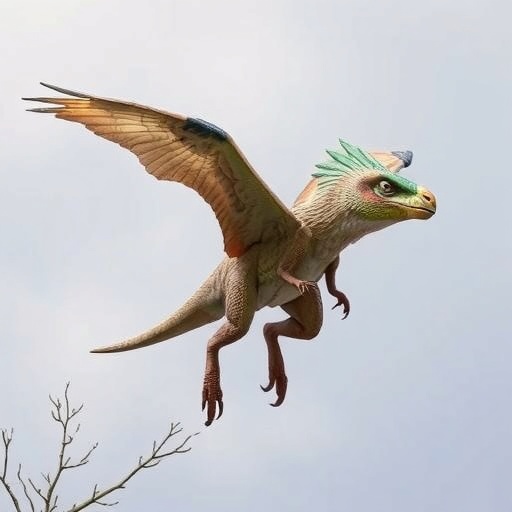
A remarkable discovery from northwestern China has shed new light on the predatory dynamics within prehistoric ecosystems that thrived approximately 120 million years ago. Found within a fossil bed rich with avian remains, this newly identified species of dinosaur, Jian changmaensis, offers compelling evidence of a non-avian theropod that may have preyed upon early birds, a predator long suspected but never previously confirmed in the Changma Basin. This breakthrough not only fills a significant gap in the paleontological record but also enhances our understanding of the evolutionary relationships between dinosaurs and the earliest birds.
The fossil bed, located in the Changma Basin of Gansu province, is renowned for an abundance of well-preserved bird fossils. Among these, numerous clusters of fragmented bird bones appear to have been regurgitated in pellet-like formations, reminiscent of the pellets produced by modern owls. For decades, researchers hypothesized that a larger carnivorous creature was responsible for these remnant clusters, but no direct fossil evidence of the predator had emerged—until now. The discovery of Jian changmaensis, a dromaeosaurid with distinctive morphological adaptations, provides the missing link to this ancient predatory behavior.
Jian changmaensis belongs to the clade Microraptorinae, a subgroup of dromaeosaurs characterized by their feathered limbs and gliding capabilities. Unlike many of its smaller relatives, Jian represents one of the largest microraptor specimens discovered to date, with a partial humerus bone measuring approximately four inches in length. Extrapolating from this fragment suggests that Jian had an estimated wingspan of nearly four feet, comparable to modern barn owls. This relatively large size among microraptors indicates it could have occupied a unique ecological niche as a top avian predator in its environment.
The morphology of Jian’s upper limb reveals important anatomical specializations. Its arm and shoulder bones point towards an adaptation for gliding locomotion rather than powered flight, supporting the hypothesis that microraptors utilized a four-winged gliding mechanism. This contrasts with the flight capabilities of extant birds, highlighting an evolutionary intermediate stage in the development of avian flight. The existence of long feathers on both forelimbs and hindlimbs would have provided Jian with enhanced aerodynamic control enabling it to maneuver through dense prehistoric forests as it hunted.
Significantly, Jian’s discovery suggests that non-avian theropods were not completely outcompeted by birds in this region during the Early Cretaceous, but rather continued to coexist and fill predator roles alongside emerging avian species. The specimen’s carnivorous nature and relative size differentiate it from the myriad smaller birds found alongside it, underscoring its potential as a key predator influencing avian population dynamics. This renewed understanding of predator-prey interactions deepens our comprehension of early bird ecology and the evolutionary pressures that shaped their survival.
The broader context of this find speaks to the intricate evolutionary tapestry connecting modern birds to their dinosaur ancestors. Birds, as the sole surviving lineage of theropod dinosaurs following the Cretaceous-Paleogene extinction event, have origins entwined with diverse dromaeosaurid species. The Velociraptor genus, for instance, has long captured public imagination due to its perceived ferocity, but microraptors like Jian provide valuable insight into the smaller, feathered relatives that likely exhibited complex behaviors including gliding predation strategies.
Further study of Jian changmaensis not only enhances knowledge about non-avian dinosaur diversity but also enriches scientific dialogue around the evolution of flight and predation strategies. The anatomical features observed in Jian highlight the gradational morphological innovations preceding the advent of fully powered flight, offering a snapshot into the evolutionary experimentation that ultimately gave rise to the avian lineage’s unparalleled success.
This discovery was realized through collaboration among international institutions, including the Field Museum in Chicago, the Carnegie Museum of Natural History, and several Chinese research entities. The specimen’s description, published in the Annals of Carnegie Museum, highlights an integrative approach combining detailed fossil excavation, comparative anatomy, and phylogenetic analysis. Such multidisciplinary methodologies are key in unraveling the complexities of ancient ecosystems and evolutionary history.
The findings also underscore the richness of the Xiagou Formation within the Changma Basin as a paleontological hotspot. The formation continues to yield exceptional fossils that illuminate diverse aspects of Cretaceous life. Jian changmaensis, as the sole non-avian theropod found among a vast assemblage of bird fossils in this region, exemplifies the intricate natural histories that fossil beds can uncover.
The name Jian changmaensis reflects both the mythological inspiration of the winged creature “Jian” from Chinese lore and acknowledges the geographic provenance of the fossil. This dual homage captures the scientific and cultural significance embedded within paleontological discoveries, combining modern investigative rigor with regional heritage appreciation.
Understanding Jian’s ecological role aids in reconstructing ancient food webs and predator-prey dynamics. The physical evidence of predation on birds represented by bone pellets gains new clarity with Jian as the likely agent. This knowledge provides perspectives on survival strategies, interspecies interactions, and environmental adaptation processes that shaped early Cretaceous terrestrial ecosystems.
Importantly, insights from Jian’s anatomy and presumed behavior contribute to broader evolutionary narratives regarding dinosaur-bird transition. As avian species evolved greater flight specialization, the persistence of gliding, predatory microraptors like Jian highlights evolutionary diversity and experimentation prior to the definitive avian flight adaptations seen today.
Ultimately, the discovery of Jian changmaensis enriches our comprehension of prehistoric biodiversity and evolutionary pathways. It serves as a poignant reminder of the complex lineage leading to modern birds, deepening scientific and public appreciation for the dynamic and often surprising outcomes of natural history.
Subject of Research: Non-avian theropod dinosaur and early bird predator from the Lower Cretaceous of the Changma Basin, China
Article Title: FIRST NON-AVIAN THEROPOD (DROMAEOSAURIDAE, MICRORAPTORINAE) FROM THE BIRD-BEARING LOWER CRETACEOUS XIAGOU FORMATION OF THE CHANGMA BASIN, GANSU PROVINCE, NORTHWESTERN CHINA
News Publication Date: 4-Jun-2026
Image Credits: Illustration by Lewis LaRosa, colorized by Jão Canola
Keywords: Jian changmaensis, microraptor, dromaeosaurid, Cretaceous, Changma Basin, fossil birds, dinosaur evolution, predator-prey dynamics, feathered dinosaur, gliding locomotion, Velociraptor relatives, paleontology
Tags: Changma Basin paleontologyCretaceous period ecosystemsdinosaur and bird evolutionary linkearly bird predator evidencefeathered dinosaur flight adaptationsfossilized bird bone pelletsfour-winged dinosaur glidingJian changmaensis fossilMicroraptorinae clade characteristicsnon-avian theropod hunting behaviorprehistoric predator-prey dynamicsvelociraptor relative discovery