For decades, aluminum oxide has been a material of intrigue and considerable promise within the scientific community, especially in the realm of catalysis and surface chemistry. The prevailing theoretical frameworks had long posited that the basal plane of aluminum oxide, particularly the α-Al2O3(0001) surface, would reveal a smooth, well-ordered array of aluminum atoms. This conjecture implied a highly reactive surface, ideally suited for catalyzing critical chemical reactions such as water splitting, a process central to hydrogen production and energy technologies. Yet, in a perplexing contradiction, experimental observations consistently demonstrated a significantly lower chemical reactivity than these models predicted.
In an illuminating advancement spearheaded by researchers at the Vienna University of Technology (TU Wien), this paradox has been methodically interrogated using pioneering techniques that transcend the limitations of conventional surface analysis. By integrating noncontact atomic force microscopy (AFM)—a cutting-edge technique that captures images of surfaces with atomic precision—with density functional theory calculations, the research team has revealed a reality at the atomic scale that could fundamentally reshape our understanding of aluminum oxide’s surface chemistry.
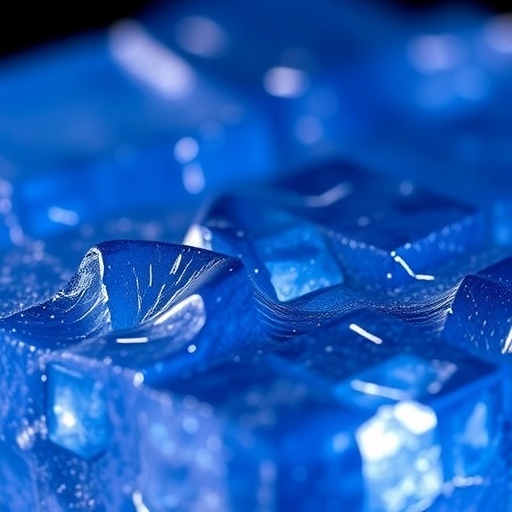
Contrary to what classical models suggested, the TU Wien team discovered that the α-Al2O3(0001) surface is far from a uniform and ordered plane. Instead, it appears as a remarkably irregular and rugged landscape when viewed on the atomic scale. This surface is incomplete in its ordered aluminum atom arrangement, revealing that the pristine and smooth configurations exist only in tiny localized patches. Beyond these nano-sized domains, the surface abruptly transitions into disordered regions, featuring substantial atomic-scale height variations, spanning several atomic layers, and thus significantly differing in structure and reactivity.
This structural irregularity has a profound implication for the chemical behavior of the surface. The presence of atomic-scale roughness disrupts the anticipated uniform catalytic activity, offering a compelling explanation for the historically observed discrepancy between theory and experiment. Indeed, where the small patches of ordered aluminum atoms predict reactivity consistent with traditional catalytic models, the majority rough and inhomogeneous surface areas lack such activity.
This breakthrough hints at a critical reevaluation of how scientists interpret and predict surface chemical processes, particularly at the nanoscale. It illustrates that theoretical calculations relying on assumptions of ideal, smooth surfaces could bear limited accuracy when applied to real-world materials. Instead, the true atomic topography—including disorder and defects—must be rigorously accounted for to achieve meaningful predictions of surface reactivity and catalysis.
The ramifications of this insight into the surface nature of α-Al2O3(0001) extend considerably beyond aluminum oxide itself. Given that numerous technologically relevant materials—ranging from catalysts used for environmental remediation to substrates involved in thin-film growth—exhibit similarly complex atomic-scale surface structures, this research necessitates a broad reconsideration of surface chemistry principles. Materials scientists and engineers must now recognize that chemical composition alone cannot fully describe surface behavior; rather, atomic-scale architecture plays an equally vital and dynamic role.
The investigative journey pursued by the TU Wien group relied heavily on noncontact atomic force microscopy, a sophisticated analytical technique that allows researchers to “see” the positions of individual atoms without perturbing the delicate surface chemistry. This technique, combined with robust computational methods grounded in density functional theory, enabled the researchers to correlate the observed atomic-scale irregularities with distinct modifications in surface chemical potential and activity. It is this interplay of experimental precision and theoretical rigor that exposed the complexity of the α-Al2O3(0001) surface.
Practically, this discovery challenges researchers to rethink the design and application of aluminum oxide surfaces in catalytic converters, hydrogen generation, and sensor technologies. Tailoring surface properties might no longer be achieved by simply controlling chemical stoichiometry or macroscopic morphology; instead, atomic-level engineering and control of surface reconstruction and disorder will become indispensable. Such efforts could pave the way for optimized materials that capitalize not only on their chemical identity but also on their spatial atomic configurations.
Moreover, this work opens exciting new pathways for future research in the field of surface science. The recognition that surfaces previously assumed smooth are instead atomically rugged suggests a new landscape of potential reaction sites whose properties can be selectively harnessed. Understanding and manipulating these irregularities could unlock unprecedented control over surface reactions, including those fundamental to energy sustainability, environmental catalysis, and the fabrication of nanoscale devices.
This study also underscores the indispensable role of high-resolution imaging technologies in material science. By revealing surface realities invisible to traditional characterization methods, AFM imaging coupled with theoretical calculations provides a more comprehensive and truthful representation of material surfaces. Such an approach not only resolves long-standing scientific mysteries but also equips researchers with tools necessary for pioneering advances across multiple scientific and industrial sectors.
In conclusion, the revelation that the α-Al2O3(0001) surface is inhomogeneous and rough fundamentally alters long-standing assumptions in catalysis research and materials science. The discovery that atomic-scale geometric disorder governs chemical properties redefines how surfaces are understood and utilized. This knowledge recalibrates existing theoretical models and necessitates an integrative approach, combining precise experimental measurements with advanced simulations to predict and exploit surface chemistry accurately.
The insight gained through TU Wien’s research dramatically enhances our understanding of aluminum oxide and similar materials, where surface structure intricacies dictate functionality. As technologies increasingly move towards the nanoscale, appreciating and engineering atomic-scale surface variations will be crucial. This advancement embodies a significant leap forward in characterizing and applying surfaces for the next generation of catalytic and electronic materials.
Subject of Research: Not applicable
Article Title: AFM imaging reveals the unreconstructed α‑Al2O3(0001) surface to be inhomogeneous and rough
News Publication Date: 27-May-2026
Web References: DOI: 10.1038/s41467-026-73690-0
Image Credits: TU Wien
Keywords
Atomic force microscopy, Aluminum oxide, Surface roughness, Catalysis, Density functional theory, Surface chemistry, Atomic-scale disorder, Water splitting, Surface reactivity, Nanomaterials, Material science, Surface physics
Tags: advancements in catalysis researchaluminum oxide surface roughnessatomic-scale surface imaging techniquescatalytic properties of aluminum oxidedensity functional theory in surface chemistryhydrogen production catalysisnoncontact atomic force microscopy AFMsurface chemistry experimental methodssurface reactivity of α-Al2O3titanium oxide vs aluminum oxide surfaceswater splitting catalyst materialsα-Al2O3(0001) atomic structure